
Every dealership executive running paid media should require three things from every vendor before a single dollar is spent on a new creative: a written hypothesis, a documented sample-size threshold, and a vendor scorecard with a pass/fail decision rule. Without those three elements, ad creative testing is just opinion dressed up as data.
Start this week with these three mandates:
- Require a written hypothesis for every test ("If we lead with a 0% APR offer in the hook, then VDP views will increase by 15% because financing is the primary objection for in-market shoppers").
- Set minimum sample-size floors: at least 1,000 impressions for hook rate, 2,000–5,000 impressions for CTR, and 50–100 conversions before drawing CPA conclusions.
- Demand a vendor scorecard on every test report, with fields for KPI baseline, lift target, statistical confidence, and a result flag.
Priority KPIs to require in every test brief:
- VDP views (vehicle detail page traffic from the ad)
- Lead form conversion rate
- Phone call volume (tracked via call-rail or platform call extensions)
- CPA and ROAS (cost per acquisition and return on ad spend)
Table of Contents
- Which testing frameworks actually scale for high-volume dealership accounts?
- How to write testable hypotheses and which KPIs dealers must require
- Designing experiments that produce defensible results
- What to test differently across social, search, video, CTV, and email
- How to hold vendors accountable with scorecards and required deliverables
- When to scale winners and how to govern learnings across vendors
- What AI can and cannot do in your creative testing program
- One-page checklist and ready-to-use templates
- Legal and compliance considerations for automotive ad creatives
- How test results should connect to your overall marketing strategy
- Who owns what: stakeholder roles for test execution
- Key Takeaways
- Why discipline beats dashboard browsing
- Autoroiq delivers the independent creative test audits your vendors won't
- Useful sources and further reading
Which testing frameworks actually scale for high-volume dealership accounts?
Structured creative testing frameworks like the 3-3-3 matrix and the 3-Phase approach give dealership accounts a repeatable, auditable system rather than ad-hoc experimentation.
The 3-3-3 matrix organizes 27 asset combinations across three hooks, three body messages, and three calls to action. For a dealership, that means testing three opening angles (financing offer, inventory urgency, service value), three body messages (model-specific, brand trust, local dealer advantage), and three CTAs (schedule a test drive, view inventory, get a quote). Each combination is a distinct variant with its own tracking ID.
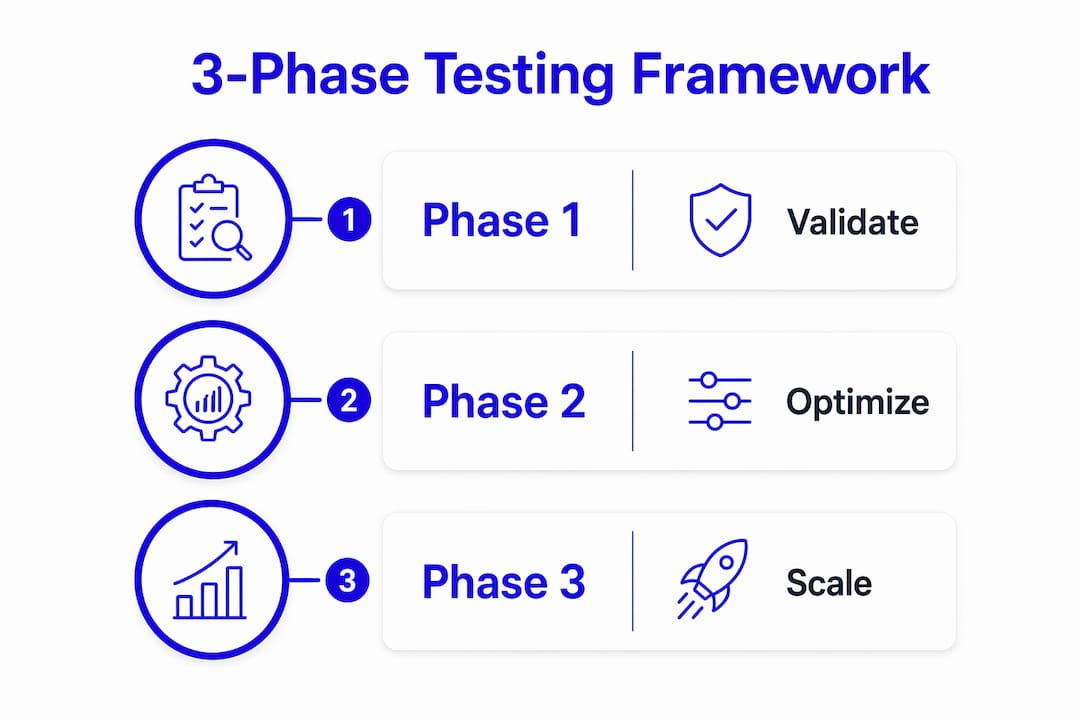
| Phase | Name | Primary Goal | Key Action |
|---|---|---|---|
| Phase 1 | Pre-Flight | Validate tracking and baseline | Confirm pixel, CAPI, and event match quality |
| Phase 2 | New vs. BAU | Identify winning concepts | Run variants against proven control creative |
| Phase 3 | Scaling | Ramp budget on winners | Apply phased budget ramps with frequency monitoring |
The 70/30 budget rule protects ROI while maintaining test velocity: 70% of budget runs proven winners (business-as-usual creative), and 30% funds new tests. This ratio prevents the common mistake of starving proven performers to fund unvalidated concepts.
Pro Tip: Use concept-level tests (different hooks or offers) to find directional winners fast, then isolate individual elements (headline word choice, image vs. video) only after a concept proves viable. Reversing that order wastes budget on granular tests that have no strategic anchor.
How to write testable hypotheses and which KPIs dealers must require
Hypothesis discipline is the single biggest lever for vendor accountability. The standard template is: "If [creative change], then [metric] will [direction] by [amount] because [rationale]."
Sample dealership hypotheses:
- Message test: "If we replace the brand tagline with a '72-hour price guarantee' in the headline, then lead form submissions will increase by 20% because price transparency reduces friction for in-market shoppers."
- Offer test: "If we feature a 0% APR offer in the first three seconds of video, then hook rate will exceed 35% because financing cost is the primary objection in our market."
- Format test: "If we switch from static image to a 15-second vehicle walkthrough video, then VDP views will increase by 25% because video communicates inventory quality more effectively."
Primary metrics (required in every test brief):
- Hook rate at 3 seconds
- CTR
- VDP views
- Lead form conversion rate
- Phone call volume
- CPA and ROAS
Secondary metrics to track but not use as sole decision criteria: video completion rate, frequency (7-day), landing page bounce rate, and incrementality signals from holdout groups.
A test is callable when it hits the minimum sample threshold and the result clears the pre-set confidence level. Document null and negative results with equal rigor. A failed hypothesis that is recorded prevents the same test from running again six months later under a different vendor.

Designing experiments that produce defensible results
| Metric | Minimum Impressions | Minimum Conversions | Confidence Target |
|---|---|---|---|
| Hook rate (3s) | 1,000 | N/A | 90% |
| CTR | 2,000–5,000 | N/A | 90% |
| CPA / Lead conversion | — | 50–100 | high confidence levels |
| ROAS | — | 50–100 | high confidence levels |
For most mid-market dealership accounts, a test window of several days is the operational standard. Shorter windows risk catching day-of-week variance; longer windows risk audience overlap and frequency buildup that distorts results.
The most common creative testing failure is not a bad creative. It is a test that was called too early, with too few conversions, against a control that was never properly defined. Require vendors to document the decision rule before the test launches, not after results come in.
Use high confidence targets for directional metrics like hook rate and CTR, reserving even higher confidence levels for conversion and CPA decisions involving budget changes.
Four pitfalls to audit in every vendor report:
- Insufficient sample sizes (calling a winner at 15 conversions)
- Changing multiple variables simultaneously (headline AND image AND CTA)
- Early stopping when a variant looks good on day two
- Confusing attribution drift with creative failure when frequency exceeds 2.5 on a 7-day window
What to test differently across social, search, video, CTV, and email
Each channel produces different signals, and executives should set channel-specific expectations before reviewing vendor reports.
Social (Meta, TikTok): Hook rate at 3 seconds is the primary filter. Use ABO (ad-set budget) for clean variant tests because CBO biases spend toward perceived winners and can starve underexposed variants. Watch platform learning windows; for example, Meta requires a certain number of optimization events before exiting the learning phase.
Search (Google Ads): Ad copy variants and extension combinations drive performance. CTR-to-lead funnel matters more than view metrics. Google's responsive search ads test headline and description combinations automatically, but require a minimum impression threshold before results are statistically meaningful.
Video and CTV: Test thumbnail, opening hook, and format length (15s vs. 30s) as separate variables. Expect longer scaling timelines and higher spend per variant than social. CTV attribution requires a separate pixel or measurement partner.
Email and CRM: Subject line and hero creative tests run on smaller sample sizes than paid media. Segment by lifecycle stage before testing; a conquest email and a service retention email require different hypotheses.
Attribution and tracking checklist to require before any test launches: pixel and CAPI active, event match quality above 6.0, landing page UTM parameters confirmed, VDP tracking verified, and call-rail numbers assigned per variant.
How to hold vendors accountable with scorecards and required deliverables
Every vendor test report should include these deliverables before you review results:
- Test brief with written hypothesis, control creative ID, variant creative IDs, and spend per variant
- Raw data export (CSV) with impressions, clicks, conversions, and spend by ad ID
- Statistical confidence level and the method used to calculate it
- Creative scorecard entry with result flag (pass/fail/inconclusive)
- Recommended next action (scale, iterate, or retire)
Sample vendor scorecard fields:
| Field | Required Content |
|---|---|
| KPI baseline | Measured control performance before test |
| Lift target | Pre-set percentage improvement to declare a winner |
| Statistical confidence | Minimum 90% for directional, high confidence levels for budget decisions |
| Attribution mapping | Which pixel events and windows were used |
| Result flag | Pass / Fail / Inconclusive with rationale |
Pro Tip: Embed a data-access clause in vendor contracts: the dealership owns all creative assets, raw ad IDs, and performance data. Vendors who resist this clause are signaling that accountability is not part of their model. For more on evaluating vendor relationships, see how to choose a dealership marketing agency.
Recommended cadence: weekly raw data pull, bi-weekly creative scorecard review, monthly executive summary with budget reallocation recommendations.
When to scale winners and how to govern learnings across vendors
Scaling a winning creative without a governance system means the learning disappears when a vendor or team member changes. Prevent that with these rules:
- Budget ramps: Scale winners in phases: 25%, then 50%, then 75%, then 100% of target budget over consecutive weeks. Monitor frequency at each step.
- Frequency cap: Flag any ad set exceeding 2.5 frequency on a 7-day window. That threshold often signals audience saturation, not creative failure.
- Naming conventions: Use a consistent format: [Channel][Concept][Variable][Version][Date]. Example: META_APR-Offer_Hook_v2_2026-03.
- Central creative scorecard: Every test result, including null results, goes into a shared log accessible to the dealership, not just the vendor.
- Handoff rules: When a vendor rotates, require a full scorecard export and a briefing on active tests before the transition completes.
Confirmed hypotheses become brief templates. A hypothesis that proved "financing-led hooks outperform inventory-urgency hooks for conquest audiences" should appear in every new vendor onboarding document.
What AI can and cannot do in your creative testing program
AI tools accelerate two specific tasks: variant generation and predictive performance scoring. AI outputs require human validation and an underlying rigorous framework to be reliable. They do not replace hypothesis discipline or statistical rigor.
- Automated variant generation: AI can produce dozens of headline, copy, and image combinations quickly. Require vendors to document which variants were AI-generated and confirm that each still maps to a testable hypothesis.
- Predictive scoring: AI models can rank variants by predicted CTR or conversion likelihood before launch. Treat these scores as prioritization signals, not conclusions.
- Multi-armed bandit allocation: Some platforms use dynamic budget allocation to shift spend toward better-performing variants in real time. This is useful for scaling but problematic for clean hypothesis testing because it disrupts equal spend per variant.
Pro Tip: Require any AI-driven recommendation to include an explainability summary: which signals drove the prediction, what the confidence interval is, and what human QA step was applied before the recommendation was acted on. A vendor who cannot explain an AI output should not be scaling budget based on it.
The dealership retains control over: hypothesis approval, scorecard sign-off, budget reallocation decisions, and creative asset ownership.
One-page checklist and ready-to-use templates
Hypothesis template: "If [creative element change], then [primary KPI] will [increase/decrease] by [target %] because [customer behavior rationale]."
Test brief required fields:
- Hypothesis (written, pre-approved)
- Control creative ID and baseline metrics
- Variant creative IDs
- Budget per variant and total test budget
- Test duration and end date
- Minimum sample-size threshold
- Decision metric and confidence level
- Result flag criteria (pass/fail/inconclusive)
Pre-launch sign-off checklist:
- Pixel and CAPI active and verified
- Event match quality confirmed
- UTM parameters and call-rail numbers assigned
- ABO confirmed for social tests
- Naming convention applied to all variants
- Hypothesis documented in creative scorecard
- Vendor has provided raw ad IDs
Vendor scorecard template:
| Field | Test A | Test B |
|---|---|---|
| Hypothesis | [Written statement] | [Written statement] |
| Control baseline | [Metric + value] | [Metric + value] |
| Lift target | [%] | [%] |
| Confidence achieved | [%] | [%] |
| Result flag | Pass/Fail/Inconclusive | Pass/Fail/Inconclusive |
Archive all scorecard entries in a shared folder with version control. Structured templates convert ad-hoc testing into repeatable systems and protect institutional knowledge when personnel or vendors change.
Target 5–10 creative tests per week as a baseline operational velocity. Top-performing accounts run 10–20 concepts weekly.
Legal and compliance considerations for automotive ad creatives
Automotive advertising in the United States is subject to Federal Trade Commission (FTC) guidelines on deceptive advertising, state-level dealer advertising regulations, and lender-specific disclosure requirements for financing offers. Every creative that features a price, APR, monthly payment, or lease term must include the required disclosures clearly and legibly, not buried in fine print that disappears on mobile.
Key compliance checkpoints for every test creative:
- APR and financing offers must disclose the full terms (term length, down payment, qualified buyer requirement) per FTC and Regulation Z requirements.
- Lease creative must include the money factor, residual, and acquisition fee disclosures where required by state law.
- Price claims must reflect the actual selling price, not a pre-incentive MSRP, unless the incentive is clearly disclosed.
- Testimonials and endorsements must reflect genuine customer experience per FTC guidelines updated in 2023.
Run every winning creative through a compliance review before scaling. A creative that performs well in testing but carries a disclosure violation can generate regulatory exposure that far exceeds any media savings.
How test results should connect to your overall marketing strategy
Creative test results are most valuable when they feed directly into budget allocation decisions, not just creative refreshes. A confirmed hypothesis about which message drives VDP views should shift budget toward that message across all channels running similar audiences, not just the channel where the test ran.
Connect test outcomes to strategy through three mechanisms. First, tie winning creative attributes to your quarterly media plan: if financing-led hooks consistently outperform inventory-urgency hooks, that finding should inform both your social and search copy briefs. Second, use CPA and ROAS results from tests to recalibrate channel-level budget splits at the monthly review. Third, track cost per lead vs. cost per sale across test cohorts to confirm that creative winners at the top of the funnel are producing qualified buyers, not just cheap clicks.
Executives who treat creative testing as a standalone activity, disconnected from media planning and budget governance, will see incremental gains. Executives who wire test results into their planning cycle will see compounding returns.
Who owns what: stakeholder roles for test execution
Creative testing fails organizationally when ownership is unclear. Assign these roles before any test launches:
- General Manager / Executive sponsor: Approves test budget allocation, reviews monthly scorecard, and holds vendors accountable to scorecard results.
- Marketing Director / Manager: Owns the test brief, hypothesis approval, and creative scorecard. Manages vendor deliverable deadlines and reporting cadence.
- Vendor / Agency: Executes test setup, provides raw data exports, and submits scorecard entries. Does not self-grade results without dealership review.
- BDC / Sales team: Provides qualitative feedback on lead quality from test cohorts. Flags if a creative is generating high volume but low-quality inquiries.
Weekly: vendor submits raw data and scorecard update. Bi-weekly: marketing director reviews results and flags budget reallocation needs. Monthly: GM reviews executive summary and approves next test cycle budget. This cadence prevents the common failure mode where test results sit in a vendor dashboard, unreviewed, until the next quarterly business review.
Key Takeaways
A disciplined ad creative testing program with enforced sample-size rules, a 70/30 budget split, and a vendor scorecard is the most direct path for dealership executives to reduce wasted ad spend and hold vendors accountable.
| Point | Details |
|---|---|
| Hypothesis before spend | Require a written hypothesis and decision rule from every vendor before any test budget is committed. |
| Sample-size floors | Minimum 1,000 impressions for hook rate, 2,000–5,000 impressions for CTR, and 50–100 conversions for CPA conclusions. |
| 70/30 budget discipline | Allocate 70% to proven winners and 30% to new tests to protect ROI while maintaining test velocity. |
| Governance prevents knowledge loss | A central creative scorecard with naming conventions and handoff rules keeps learnings intact when vendors or staff change. |
| Autoroiq for independent audits | Autoroiq delivers vendor-agnostic creative test audits and scorecard reviews so dealership executives get objective results, not vendor-graded reports. |
30-day actions: Mandate written hypotheses on all active tests, convert past test results into the creative scorecard format, and audit pixel and CAPI integrity across all active channels.
90-day actions: Run a full 3-Phase testing program, require vendor scorecards on every test report, and implement the 70/30 budget split across paid social and search.
180-day actions: Institutionalize winning hypotheses as brief templates, archive all scorecard learnings in a shared repository, and tie vendor compensation or contract renewal to scorecard performance where appropriate.
Why discipline beats dashboard browsing
The most common pattern Autoroiq sees across dealership marketing accounts is this: vendors produce polished dashboards, executives review top-line ROAS numbers, and nobody asks whether the underlying creative was ever tested against a documented hypothesis. The result is that budget follows the vendor's preferred narrative rather than verified performance.
Hypothesis documentation and scorecard governance are not administrative overhead. They are the mechanism by which a dealership builds a proprietary creative intelligence library that compounds over time. Every documented test, including the ones that fail, narrows the hypothesis space for the next test. Dealerships that operate this way spend less time re-learning the same lessons and more time scaling what actually works.
The executives who get the most from their marketing budgets are not the ones who approve the most creative. They are the ones who require the most documentation.
Autoroiq delivers the independent creative test audits your vendors won't
Dealership marketing budgets deserve the same accountability standard as any other major operating expense. Autoroiq provides independent marketing intelligence for automotive dealerships, including vendor-agnostic creative test audits, scorecard delivery, and executive-level budget recommendations. The difference from a traditional agency: Autoroiq does not sell advertising and has no financial interest in any vendor's results.

Executives who engage Autoroiq typically gain faster identification of winning creative, clearer vendor accountability through documented scorecards, and measurable improvement in CPA and ROAS by eliminating spend on unvalidated assets. If your current vendor reports lack a written hypothesis, a sample-size threshold, or a pass/fail result flag, that gap is costing you. Request a creative test audit from Autoroiq and get an objective assessment of what your testing program is actually producing.
Useful sources and further reading
- Creative testing frameworks for high-volume accounts — covers the 3-3-3 matrix and 3-Phase approach with operational guidance.
- Creative Testing Framework: Scale Winning Ads with AI — source for the 70/30 budget rule, sample-size thresholds, and test velocity targets.
- Creative testing with AI: capabilities and caveats — covers AI variant generation limits and the need for human validation.
- How to analyze ad performance: a 6-step system — supports hypothesis discipline, frequency thresholds, and attribution drift identification.
- Free ad creative testing framework template — adaptable test brief and scorecard templates for mid-market accounts.
- Ultimate guide to creative testing — ABO vs. CBO guidance for clean Meta tests.
- Test and optimize creative messages — Google Ads Help — Google's official guidance on ad variation testing and incremental measurement.