
What is AI search visibility and why it matters for marketers
AI search visibility measures how often and how prominently a brand appears within AI-generated answers across platforms like ChatGPT, Gemini, Perplexity, and Google AI Overviews. It tracks mentions and citations inside those answers, not positions on a list of blue links. That distinction changes everything about how marketing teams should think about brand presence.
Traditional SEO optimizes for rankings and click-through rates. AI visibility optimizes for being the source an AI model trusts enough to quote. A brand can rank on page one of Google and still be completely absent from every AI-generated answer a potential buyer reads. That gap is widening fast as AI-powered search becomes the default for high-intent queries.
Why this matters for your marketing program:
- AI search compresses the buying funnel to two stages: educational and transactional. If an AI doesn't cite your brand in the educational stage, you may never enter the consideration set.
- Competitors who appear in AI answers shape the narrative in your market, regardless of your traditional rankings.
- Foundational SEO practices such as indexability, page speed, site structure, and high-quality unique content remain necessary for AI overview optimization, but they are no longer sufficient on their own.
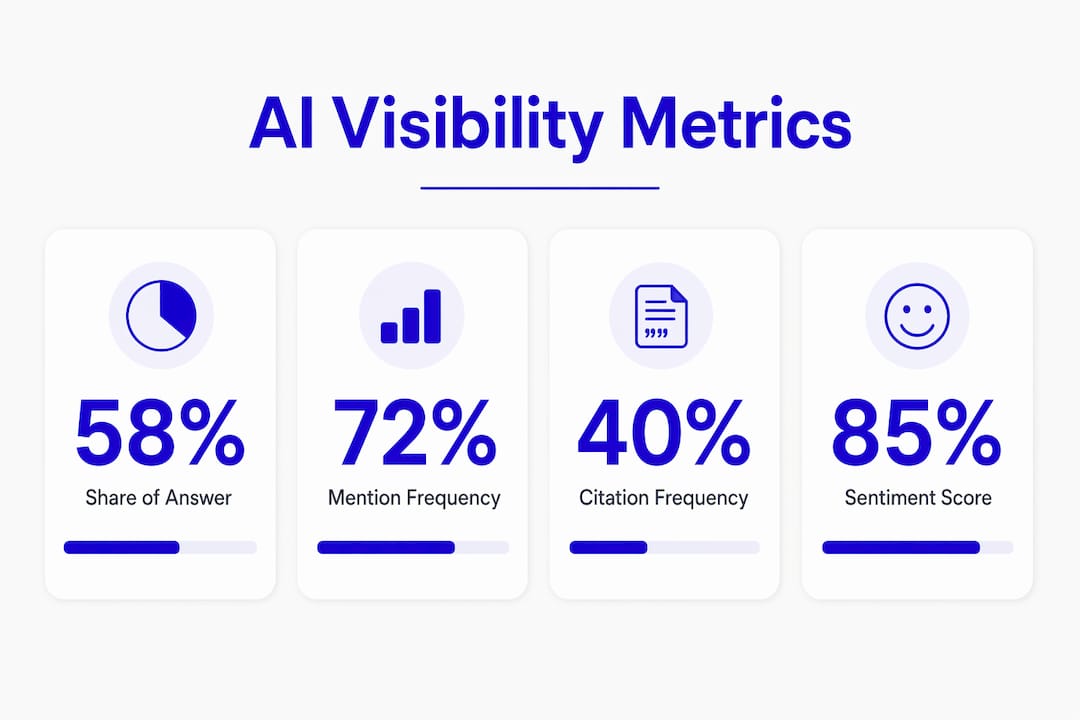
- AI visibility is a measurable metric, not a soft brand concept. Share of answer, citation frequency, and sentiment scores are trackable KPIs.
- Brands that build AI authority now accumulate a compounding advantage as AI search adoption grows across the US market.
How AI search visibility is measured: insights from the 2026 global study
The core metrics for AI visibility are share of answer, mention frequency, citation frequency, sentiment, and average position within AI responses. Each one captures a different dimension of how an AI model represents your brand. Share of answer tells you what percentage of relevant AI responses include your brand at all. Sentiment tells you whether the representation is positive, neutral, or negative.
The 2026 global study on AI visibility used manual verification across 1,700+ businesses and sampled results across multiple AI platforms to produce representative data. Manual verification matters here because AI responses are non-deterministic. The same query can produce different answers at different times, so sampling methodology directly affects the reliability of the data.
Pro Tip: Test your brand on ChatGPT, Perplexity, and Claude using the same 3–5 questions your customers actually ask. Screenshot the responses. That manual baseline is your starting point before any tool investment.
Measuring AI visibility differs from tracking keyword rankings in one critical way: you are extracting actual AI answers, not querying an index. Tools that simulate real user browser queries produce more accurate results than those relying solely on API access, because API responses can differ from what a real user sees. Methodology transparency is a key trust signal when evaluating any AI visibility study or platform.
| Metric | What it measures | Data collection method |
|---|---|---|
| Share of answer | % of AI responses mentioning your brand | Multi-platform query sampling |
| Citation frequency | How often AI links to your site | Manual extraction and verification |
| Sentiment score | Positive, neutral, or negative framing | NLP analysis of AI response text |
| Average position | Where your brand appears in the answer | Rank within AI response structure |
AI search visibility benchmarks and industry variation in the US market
US-specific data from the 2026 study reveals that most brands are invisible in AI-generated answers for their core topics. The variation across industries is sharp. Categories with high content volume, strong domain authority, and well-structured factual content, such as finance, healthcare, and technology, tend to appear in AI answers more frequently than industries with thinner or less structured web content.
Statistic callout: AI Overviews appear on approximately 16% of searches as of late 2025, after peaking near 25% in mid-2025. That share will grow, and the brands already optimized for it will hold the citation advantage.
Factors driving industry-level variation include content quality, topical depth, and what practitioners call relevance engineering: the practice of building content that AI models can extract, verify, and trust. Industries that publish original data, clear entity definitions, and authoritative sourcing consistently outperform those relying on generic content. For US marketing teams, the implication is direct: your industry benchmark sets the competitive floor, but your content quality determines where you land within it.
| Industry | AI visibility level | Primary driver |
|---|---|---|
| Finance and insurance | High | Authoritative sourcing, regulatory clarity |
| Healthcare | High | Structured factual content, entity definitions |
| Technology / SaaS | High | Original data, deep topical coverage |
| Retail and e-commerce | Moderate | Product schema, review content |
| Automotive | Moderate | Local SEO signals, inventory data |
| Legal services | Moderate to low | Thin content, limited original research |
| Home services | Low | Sparse structured content |

Key strategies and tactics to improve your brand's AI search visibility
The most effective content structure for AI citation uses a summary-first model with a direct 40–80 word answer immediately following each H2 question. AI systems extract clean, quotable passages. A page that buries its answer in paragraph four rarely gets cited.
Practical steps to improve your AI presence:
- Rewrite key headings as direct questions, then answer them in the first paragraph under each heading.
- Add specific, sourced statistics to your content. AI systems prefer citing content with verifiable data over vague generalizations.
- Define your brand as an entity: include clear descriptions of what your company does, who it serves, and what makes it distinct.
- Build citations on authoritative third-party sites. AI models weight off-site mentions alongside on-site content.
- Keep content current. AI search systems favor recent content, so update high-priority pages regularly.
- Use schema markup on your top pages. Google's Rich Results Test confirms whether your schema is valid.
Pro Tip: Edge caching via a CDN is not optional for AI visibility. Many AI systems request pages in real time and skip slow-loading content entirely. If your page takes more than two seconds to load, it may never be evaluated as a citation source.
Relevance engineering focuses on semantic clarity and entity extraction rather than shortcuts. Avoid tactics that attempt to game AI citation through inauthentic signals. AI models are trained on patterns of authority, and manufactured signals degrade over time. The brands that build durable AI visibility do it through original research, clear writing, and consistent topical authority.

Google's guidance confirms that no special AI schema or llms.txt file is required for AI Overviews. Foundational SEO remains the technical baseline. The differentiation happens at the content and authority layer.
Top AI search visibility tools for US marketing teams
Six platforms stand out for US marketing teams tracking and improving their presence in AI-generated answers. Each takes a different approach to measurement and optimization.
| Tool | Core services | Specialty | Best for | Rating |
|---|---|---|---|---|
| Surfer | AI-driven SEO workflow, NLP content editor, keyword research | Content optimization for AI visibility | Marketing teams needing content and SEO in one platform | 4.1★ (18 reviews) |
| Peec AI GmbH | AI search analytics, visibility tracking, sentiment and position monitoring | Brand performance analysis across AI platforms | Teams needing detailed sentiment and competitive tracking | 4.3★ (11 reviews) |
| AIclicks | AI visibility tracking, source citation identification, automated outreach agents | Automated citation acquisition and monitoring | Brands automating AI mention growth | 5★ (6 reviews) |
| Attorney Visibility AI | Law firm SEO, AI search optimization, Google Maps SEO, PPC for lawyers | Legal market AI authority and local dominance | Law firms building AI search presence | 5★ (2 reviews) |
| Similarweb NYC | Competitive analysis, market benchmarking, acquisition tracking | Broad digital intelligence and AI brand benchmarking | Marketing leaders needing market-wide competitive data | 3★ (2 reviews) |
| AthenaHQ | AI visibility tracking across 8+ LLMs, PR monitoring, executive dashboard, citation analysis | AI trust building and reputation management | Brands managing AI visibility and PR across multiple models | 5★ (2 reviews) |
Surfer serves marketing teams that want content optimization and AI-driven SEO workflow in a single platform, backed by a user base of over 150,000 marketers. Its NLP-powered content editor is the core differentiator for teams producing high volumes of content.
Peec AI GmbH focuses specifically on AI search analytics, tracking visibility, position, and sentiment across AI platforms. It suits marketing teams that need granular performance data rather than content creation tools.
AIclicks goes a step further by identifying which sources drive AI citations for your brand and deploying automated outreach agents to acquire new mentions. For brands that want to move from passive tracking to active citation building, that automation layer is the key feature.
Attorney Visibility AI is purpose-built for legal marketing, with AI search optimization layered on top of law firm SEO, Google Maps ranking, and local service ads. It has earned recognition in Forbes, the Wall Street Journal, and USANews, which reflects its positioning in a specialized vertical.
Similarweb NYC brings broad competitive intelligence to the AI visibility question. Its strength is market-level benchmarking rather than granular citation tracking, making it the right fit for marketing leaders who need to contextualize their AI presence against the full competitive field.
AthenaHQ tracks AI visibility across 8+ large language models and pairs that tracking with PR monitoring and an executive dashboard. Its Y Combinator backing and features in Forbes and the Wall Street Journal signal credibility for enterprise teams that need visibility and reputation management in one place.
How emerging AI search technologies are reshaping visibility trends
AI search is not a static target. Query fan-out, agentic retrieval-augmented generation (RAG), and multi-step reasoning are changing how AI models select and cite sources. Query fan-out means a single user question generates multiple sub-queries internally, each pulling from different sources. A brand that covers a topic deeply across multiple related pages has a structural advantage over one with a single authoritative post.
Agentic AI search, where the model takes multiple steps to research and synthesize an answer, weights source credibility differently than a single-pass retrieval system. Brands with consistent entity definitions, strong off-site citation profiles, and current content perform better across both retrieval modes. The practical implication: topical depth and cross-page consistency are becoming as important as individual page quality.
Case studies of successful AI search visibility campaigns
The clearest pattern in successful AI visibility campaigns is the combination of original data and structured content. A B2B SaaS company that publishes its own benchmark report, structures the findings with clear H2 questions and direct answers, and earns citations from industry publications creates exactly the conditions AI models favor. The original data gives the AI a citable fact. The structure makes it extractable. The third-party citations confirm authority.
Legal firms using Attorney Visibility AI have applied this model to local AI search, combining Google Maps optimization with AI-specific content structured around the questions potential clients ask. The result is presence in both local AI answers and broader legal topic responses. The lesson transfers to any industry with strong local intent: local entity signals and AI content optimization compound each other.
Ethical considerations and data privacy in AI search visibility
AI visibility tracking involves querying AI platforms at scale, which raises questions about terms of service compliance and data handling. Reputable platforms like AthenaHQ and Peec AI GmbH use methodologies designed to comply with platform terms. Marketing teams should verify that any tool they deploy queries AI systems in a compliant way, particularly as OpenAI, Google, and Anthropic continue to update their crawler and API policies.
Data privacy enters the picture when AI visibility tools collect user query data or behavioral signals to inform recommendations. Before deploying any platform, confirm what data it retains, how long it stores query results, and whether it shares data with third parties. For enterprise teams subject to CCPA or sector-specific regulations, those questions are not optional.
Future outlook and evolving standards for AI search visibility
The standards for AI visibility measurement are still forming. Share of answer and citation frequency are the leading metrics today, but the field is moving toward more granular measures: sentiment trajectory, entity accuracy (whether the AI describes your brand correctly), and competitive share within specific topic clusters. Platforms like AthenaHQ and Peec AI GmbH are already building toward those dimensions.
Google, OpenAI, and Anthropic will continue refining how their systems select and cite sources. The brands best positioned for those changes are the ones building genuine authority now, through original research, clear entity definitions, and consistent content quality. AI visibility is not a one-time optimization. It is an ongoing measurement and content discipline, much like traditional SEO became after the early years of keyword stuffing gave way to quality signals.
Key Takeaways
AI search visibility is now a primary brand metric, and the brands building citation authority in 2026 will hold a compounding advantage as AI-powered search continues to displace traditional results.
| Point | Details |
|---|---|
| AI visibility differs from SEO rankings | It measures brand mentions and citations in AI-generated answers, not link positions. |
| Measurement requires multi-platform sampling | The 2026 global study used manual verification across 1,700+ businesses for reliable data. |
| Content structure drives citation | A summary-first format with 40–80 word direct answers after H2 questions maximizes AI extractability. |
| Tool selection depends on team goals | Surfer, AthenaHQ, and AIclicks serve different needs; match the platform to your measurement and optimization priorities. |
| Autoroiq applies this lens to dealerships | Autoroiq's independent analysis helps automotive dealers assess AI visibility as part of broader marketing performance reviews. |
Independent marketing intelligence for dealerships navigating AI search
Automotive dealerships face the same AI visibility challenge every brand does, but with an added layer: conflicting vendor reports that make it hard to know whether your marketing spend is actually producing presence in AI-generated answers.
Autoroiq offers a different path. Rather than selling advertising or managing campaigns, Autoroiq delivers independent marketing performance analysis that evaluates vendor claims against objective data, including how your dealership's digital presence holds up in the AI search environment. If you're questioning whether your current vendors are actually building the kind of authority that earns AI citations, or just reporting metrics that look good on a dashboard, Autoroiq's vendor-agnostic reviews give you a clear answer. Learn more about how independent analysis applies to your dealership marketing decisions.