
The best dealership CRM is not simply a contact database. It is a platform built around a Customer Data Platform (CDP) that unifies every customer record across sales, service, marketing, credit, compliance, and inventory, giving your team a single, accurate view of each buyer. Without that foundation, attribution breaks down, vendor reports conflict, and marketing spend becomes impossible to defend.
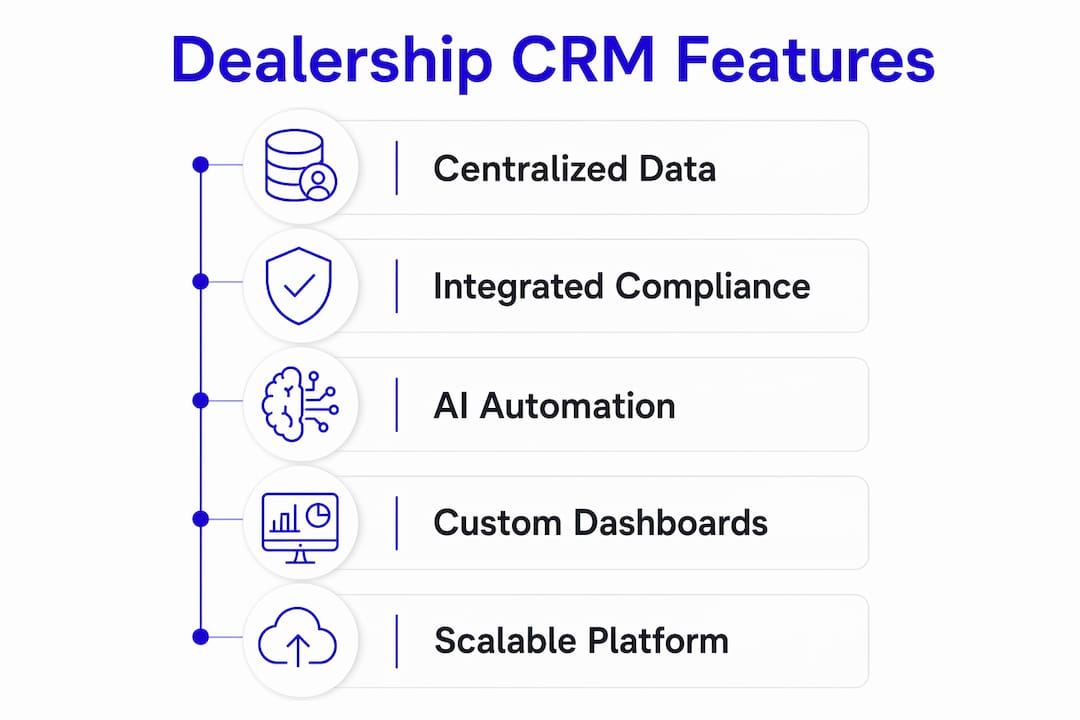
What separates a top-tier automotive CRM from a basic lead-tracking tool comes down to a few non-negotiable capabilities:
- A built-in CDP that eliminates duplicate records and delivers a 360-degree customer view across all departments
- Native integration with your DMS, inventory management, desking, credit, and compliance workflows
- AI-driven lead engagement that automates follow-up and surfaces high-intent opportunities without adding manual workload
- Vendor-agnostic marketing performance intelligence so you can measure ROI independently of what vendors report
- Configurable dashboards and workflows that align sales and marketing around shared performance metrics
- Scalability to support single-point stores and multi-rooftop dealer groups equally well
Autoroiq's independent evaluation methodology assesses CRM platforms against these criteria without any vendor affiliation, giving dealership executives defensible data rather than sales-driven recommendations.
Table of Contents
- 1. Key features your dealership CRM must have
- 2. How to evaluate CRMs for marketing ROI and vendor accountability
- 3. Common pitfalls in dealership CRM selection
- 4. How to implement a dealership CRM for sales and marketing alignment
- Advisory insights for smarter CRM investment decisions
- What successful dealership CRM implementations look like
- Key Takeaways
1. Key features your dealership CRM must have
The architecture of a dealership CRM determines whether your teams operate from one version of the truth or spend hours reconciling conflicting data. These are the features that matter most.

Built-in Customer Data Platform. Data quality and centralization via a built-in CDP is the ceiling on any CRM's effectiveness. A platform that pulls customer records from your DMS, service lane, and marketing channels into one unified profile eliminates the duplicate records that inflate lead counts and distort attribution.
Integrated credit, compliance, and desking. Most dealerships rely on up to eight separate systems to complete a single vehicle sale. Platforms that consolidate CRM, credit, compliance, and desking into one environment reduce operational risk and remove the friction of multiple logins and invoices. FTC compliance violations can exceed $50,000 per incident, making integrated compliance automation a financial safeguard, not just a convenience.
AI-driven workflow automation. AI embedded throughout CRM workflows acts as an extension of your sales team, handling personalized video messaging, proactive follow-up, and lead prioritization at scale. The result is higher conversion rates without proportional headcount increases.
Configurable dashboards and reporting. Sales managers, marketing directors, and GMs need different views of the same data. Configurable dashboards and workflows tailored to each role reduce noise and keep every team focused on the metrics that drive their decisions.
Data mining and campaign tools. A CRM with built-in data mining identifies equity opportunities, service-to-sales conversions, and conquest targets directly from your customer database, rather than relying on third-party list vendors.
Scalability across store configurations. Whether you operate one franchise point or a regional dealer group, the platform should adapt without requiring a full re-implementation.
2. How to evaluate CRMs for marketing ROI and vendor accountability
Choosing the right automotive CRM requires a framework that goes beyond feature checklists. The evaluation must center on measurable marketing outcomes and transparent vendor performance.
- Use an independent evaluation methodology. Vendor demos are designed to sell, not to reveal weaknesses. Autoroiq's proprietary methodology delivers unbiased analysis and executive-level recommendations that reflect actual marketing performance, not vendor-supplied metrics.
- Prioritize integrated marketing intelligence. A CRM that generates its own performance reporting, rather than relying on disconnected analytics tools, gives you a cleaner line from spend to outcome.
- Demand vendor accountability scorecards. Vendor accountability measured through independent scorecards linked to real marketing performance data removes the ambiguity that lets underperforming vendors retain budget.
- Assess total cost of ownership. System consolidation reduces the cost of managing multiple platforms, separate invoices, and redundant data reconciliation. Factor that into any cost comparison.
- Verify DMS and inventory integration depth. Surface-level integrations that require manual data exports are not integrations. Confirm bidirectional, real-time data flow with your specific DMS before committing.
- Evaluate user adoption support. A CRM your team does not use consistently delivers no ROI regardless of its feature set.
Pro Tip: Before any CRM demo, audit your current customer database for duplicate records and data gaps. The platform that handles your actual data quality problems, not a clean demo dataset, is the one worth buying.
3. Common pitfalls in dealership CRM selection
Procurement mistakes at the CRM selection stage tend to compound over time. These are the patterns dealership executives encounter most often, and how to avoid them.
- Selecting a CRM without a native CDP. Fragmented customer data across systems produces inaccurate attribution, inflated lead counts, and marketing spend that cannot be justified. A CDP is not optional.
- Accepting heavy manual reconciliation. If your team needs to export, clean, and re-import data to get a complete customer view, the platform is creating work rather than eliminating it.
- Ignoring vendor transparency on ROI. CRM vendors have an incentive to report favorable metrics. Without independent performance analysis, you are evaluating their platform using their own scorekeeping.
- Overlooking scalability. A platform that fits your current store count may not support a second or third rooftop without significant re-configuration costs. Build for where you are going, not just where you are.
- Underinvesting in training and change management. Poor user adoption is one of the most common reasons CRM investments fail to deliver. Budget for structured onboarding and ongoing coaching, not just a one-time launch session.
- Delaying DMS integration. Data silos form quickly when CRM and DMS operate independently. Prioritize integration in the implementation timeline, not as a post-launch project.
- Locking into closed vendor ecosystems. Platforms that restrict data portability or block third-party marketing intelligence tools limit your ability to get independent analysis of your own performance data.
4. How to implement a dealership CRM for sales and marketing alignment
Implementation quality determines whether your CRM investment pays off or sits underutilized within six months. These steps reflect what successful deployments have in common.
- Map unified workflows before go-live. Define how sales, marketing, service, credit, and compliance teams will interact within the platform before anyone logs in for the first time. Workflow design is harder to fix after adoption begins.
- Invest in structured training by role. Sales and marketing teams aligned through unified CRM workflows produce better customer experiences and stronger ROI. Role-specific training accelerates that alignment. Dealerships using structured follow-up planning within their CRM report 25% higher appointment rates.
- Establish data quality standards upfront. A centralized customer database is the foundation for accurate marketing attribution and ROI analysis. Define data entry standards, deduplication rules, and record ownership before migration.
- Configure dashboards for continuous monitoring. Set up reporting views for each leadership level, from BDC managers tracking daily follow-up to GMs reviewing monthly cost per sale, so performance gaps surface quickly.
- Use data mining from day one. Equity mining, service conquest, and lease pull-ahead campaigns generate near-term revenue while your team builds CRM proficiency. Do not wait until adoption is complete to activate these tools.
- Schedule independent performance reviews. Regular vendor accountability reviews, conducted outside the CRM vendor's own reporting environment, keep performance benchmarks honest and protect marketing budget from underperforming channels.
Advisory insights for smarter CRM investment decisions
The CRM selection process often gets treated as a technology procurement exercise. For dealership executives, it is a marketing infrastructure decision with direct implications for cost per lead, cost per sale, and gross profit per vehicle.
Two advisory principles stand out from Autoroiq's work with franchise dealerships. First, the CRM you choose sets the ceiling on your marketing attribution accuracy. A platform without a unified customer record cannot tell you which channels drove a sale versus which ones touched a buyer who was already committed. That gap costs real money in misdirected spend.
Second, vendor accountability does not happen automatically. CRM vendors, digital advertising platforms, and third-party lead providers all have an incentive to report metrics that justify their invoices. Independent analysis, using your own CRM data evaluated against actual sales outcomes, is the only way to know whether your marketing agency selection and channel mix are performing or just appearing to perform.
Executives who treat CRM selection as a one-time decision tend to find themselves locked into platforms that no longer serve their needs within two to three years. Build evaluation checkpoints into your vendor contracts from the start.
What successful dealership CRM implementations look like
The most effective CRM deployments share a pattern: they start with a clear data strategy, not a feature wishlist.
Marine Chevrolet's implementation of an AI-native CRM platform modernized their operations by unifying customer engagement across sales, service, and marketing on a single record. The outcome was faster response times, more consistent follow-up, and measurable improvement in customer experience scores. The key was treating the CRM as an operational backbone rather than a sales tool bolted onto existing processes.
Multi-rooftop dealer groups that consolidate onto a single CRM platform with enterprise-level governance gain visibility across all stores simultaneously, which makes performance benchmarking between locations straightforward. When a BDC director can compare appointment rates and lead response times across five stores in one dashboard, underperformance becomes visible and addressable within days rather than quarters.
The common thread in these cases is that the CRM was evaluated and implemented with marketing ROI and operational alignment as the primary criteria, not just feature count or vendor relationship. That orientation, combined with ongoing independent performance monitoring, is what separates dealerships that get measurable returns from those that renew their CRM contract out of inertia.
Key Takeaways
The best dealership CRM centralizes customer data through a native CDP, integrates across all dealership systems, and supports independent marketing performance analysis to protect ROI and vendor accountability.
| Point | Details |
|---|---|
| CDP is non-negotiable | A built-in Customer Data Platform eliminates duplicate records and enables accurate marketing attribution. |
| System consolidation reduces risk | Replacing up to eight disconnected systems with one platform lowers operational cost and FTC compliance exposure. |
| Independent evaluation matters | Vendor-supplied metrics favor the vendor; Autoroiq's methodology delivers unbiased performance analysis. |
| Training drives adoption | Structured, role-specific onboarding is what separates CRM investments that perform from those that stall. |
| Appointment rates are measurably stronger in dealerships using integrated follow-up planning within their CRM. |