
How do CallRail and Invoca compare for your business?
CallRail is the right choice for most marketing teams reading this. It starts at $45/month with self-serve setup, a 14-day free trial, and no annual contract. Invoca is designed for large enterprises handling high call volumes and features custom pricing with a multi-week implementation process. The decision comes down to scale, not quality.
Three platforms cover the full spectrum of call tracking needs in 2026: CallRail for SMBs and agencies, Invoca for enterprise contact centers, and WhatConverts for PPC and SEO professionals who need multi-channel lead attribution across calls, forms, and chat.
| Platform | Best For | Pricing | Call Tracking | Conversation Intelligence | Integrations | Ease of Use |
|---|---|---|---|---|---|---|
| CallRail | SMBs, agencies, multi-industry | From $45/mo, self-serve | Dynamic number insertion, source-level attribution, form tracking | AI transcription, keyword spotting, sentiment analysis (on $90+ plans) | Google Ads, GA4, HubSpot, Salesforce | 9.1/10 (G2) |
| WhatConverts | PPC/SEO agencies, multi-channel attribution | 14-day free trial; tiered plans | Call, form, chat, eCommerce tracking | Lead management and reporting | Google Ads, GA4, agency reporting tools | — |
| Invoca | Large enterprises, contact centers | Custom, ~$1,000+/mo, annual | High-volume call tracking, real-time scoring | Signal AI Studio, real-time outcome detection, live agent guidance | Salesforce, Adobe Experience Cloud, Five9, Genesys | 8.4/10 (G2) |

CallRail pros: Transparent pricing, fast self-serve setup, Lead Center inbox, strong Google Ads and GA4 attribution, no annual contract required.
CallRail cons: Conversation intelligence requires the $90+ tier, reporting can feel limited for complex enterprise funnels, some users report integration hiccups with Zoho.
Invoca pros: Real-time Signal AI call scoring, PreSense agent enablement, deep Salesforce and Adobe Experience Cloud integrations, purpose-built for regulated industries.

Invoca cons: No published pricing, annual contracts required, implementation takes 4–12 weeks, Signal AI Studio is a paid add-on on top of the base contract.
What features actually separate these platforms?
G2 user ratings show CallRail scoring 9.1/10 on ease of use versus Invoca's 8.4/10, while Invoca leads on single-touch attribution at 9.4/10 compared to CallRail's 8.6/10. Those numbers reflect a real architectural difference, not just user preference.
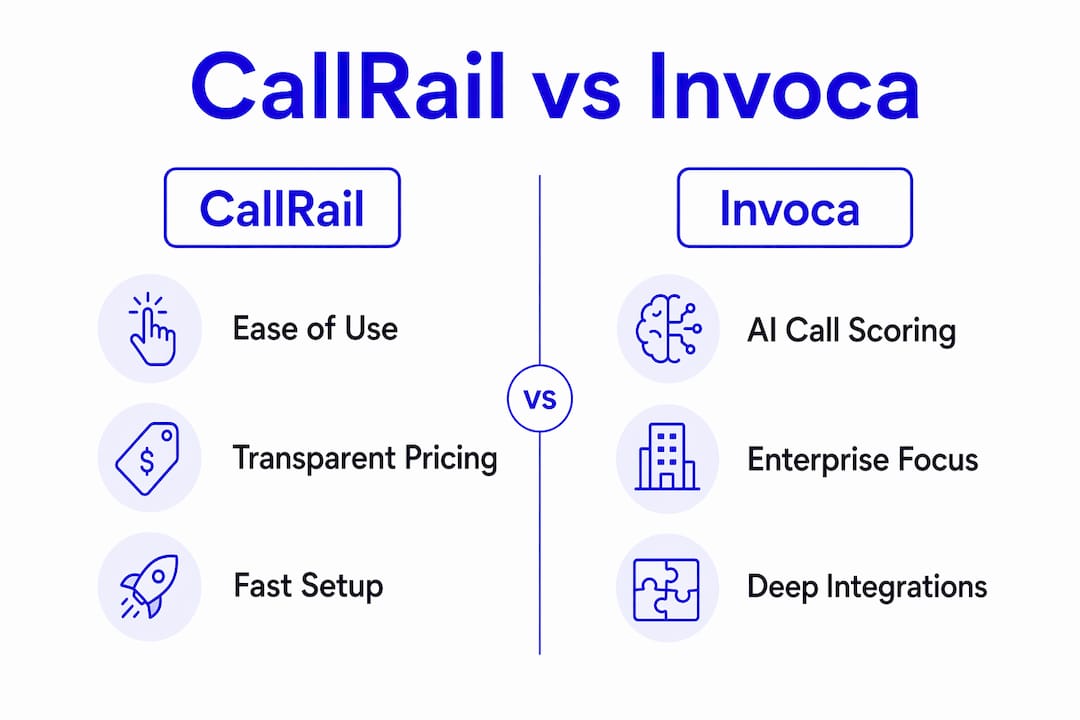
Dynamic number insertion and attribution work well on both platforms. CallRail's implementation is particularly clean for agencies managing multiple client accounts, swapping phone numbers based on traffic source so keyword-to-call attribution stays accurate. Invoca's attribution is engineered for enterprise multi-channel measurement, feeding call outcomes into automated bidding across Google, Meta, and Microsoft Ads at a scale most SMBs never reach.
Conversation intelligence is where the gap widens. CallRail offers AI transcription, keyword spotting, and sentiment analysis on its $90+ plans. That covers the needs of any team handling a few thousand calls per month. Invoca's Signal AI Studio runs in real time during calls, detecting qualified leads, appointment bookings, and escalation risks as the conversation happens. Non-technical teams can train custom outcome models without writing code. CallRail's keyword-based approach cannot replicate that depth.
WhatConverts takes a different angle entirely. It tracks calls, forms, chat, and eCommerce transactions in one platform, making it the strongest option for PPC and SEO agencies that need to report on every lead type across a client portfolio. Its lead management tools let you search, filter, qualify, and export leads in ways neither CallRail nor Invoca prioritize.
- CallRail's Lead Center combines calls, texts, and chats into one inbox, functioning as a lightweight softphone for small teams on the $90+ plan
- Invoca's PreSense delivers a caller's full digital journey to the agent before pickup, a capability with no equivalent in CallRail
- WhatConverts ranks #1 for call tracking and marketing attribution on G2, specifically among PPC and SEO professionals
How do pricing models and business fit break down?
Pricing is the clearest dividing line in this comparison. CallRail pricing begins at a base monthly fee covering a set number of numbers and usage, with additional numbers and minutes charged incrementally. CallRail offers upgraded plans that include advanced conversation intelligence and bundled features, with pricing increasing accordingly. No credit card is required for the 14-day trial.
Invoca requires a custom quote. Contracts typically start around $1,000/month for mid-market accounts and reach five figures monthly for full Signal AI deployments. Invoca requires mandatory annual contracts and a paid onboarding process that can span several weeks. Signal AI Studio and premium integrations are priced as add-ons, so the headline contract often understates total cost.
| Platform | Starting Price | Free Trial | Contract | Onboarding |
|---|---|---|---|---|
| CallRail | $45/mo | 14 days, no credit card | Month-to-month | Self-serve, same day |
| WhatConverts | Tiered plans | 14 days | Flexible | Self-serve |
| Invoca | ~$1,000/mo (custom) | demo-gated | Annual required | 4–12 weeks, dedicated CSM |
For automotive dealerships specifically, CallRail suits smaller lead volumes and multi-channel attribution well. Invoca's AI is better matched to high-volume contact center environments with complex CRM integration requirements. The hidden costs of Invoca extend beyond monthly fees to mandatory management resources and model training time, which materially affect total cost of ownership.
Pro Tip: Before requesting an Invoca quote, audit your monthly call volume. If you handle fewer than 10,000 calls per month, the contract economics rarely justify the investment. CallRail's attribution and conversation intelligence cover the vast majority of performance marketing needs at a fraction of the cost.
How do you choose the right call tracking platform?
The decision criteria are straightforward when you frame them correctly.
- Business size and call volume: CallRail is suited for teams with moderate call volumes, while Invoca is designed for enterprise environments managing very high call volumes.
- Budget and contract flexibility: CallRail's month-to-month pricing lets you scale or cancel without procurement cycles. Invoca's annual contracts require organizational commitment and budget approval well in advance.
- Technical resources: CallRail is self-serve. Utilizing Invoca effectively typically involves dedicated marketing operations and management resources.
- Integration priorities: If Google Ads, GA4, and HubSpot are your core stack, CallRail covers everything you need. If Salesforce Sales Cloud, Adobe Experience Cloud, or contact center platforms like Five9 and Genesys are central, Invoca's integrations run deeper.
- AI requirements: Real-time call scoring and live agent guidance are exclusive to Invoca. Post-call transcription and keyword spotting are available on CallRail's mid-tier plans.
For agencies managing PPC and SEO clients who need to report on every lead type, WhatConverts is worth evaluating alongside both. Its multi-channel lead management fills a gap neither CallRail nor Invoca fully addresses for agency workflows.
Understanding cost per lead vs. cost per sale is also worth doing before committing to any platform. The right call tracking tool should feed clean attribution data into that calculation, not complicate it.
How does customer support and onboarding compare?
User sentiment consistently shows CallRail can be set up within an hour, while Invoca requires weeks and a dedicated customer success manager. That gap has real operational implications for teams without a marketing ops function.
CallRail's support draws mixed reviews. Users praise the self-serve documentation and fast initial setup, but some report slow response times and unhelpful answers when integration problems arise, particularly with Google Ads and Zoho. Invoca's quality of support scores 9.1/10 on G2, higher than CallRail's 8.9/10, reflecting the white-glove service model that comes with enterprise pricing. The tradeoff is that Invoca's support is embedded in a sales-led process, so getting help requires navigating account management layers.
For teams that want to move fast, CallRail's self-serve model is a genuine advantage. For enterprise teams that need a partner through a complex deployment, Invoca's dedicated CSM model delivers more structured guidance.
What are the data privacy and security compliance differences?
Invoca is built for regulated industries. The platform includes PCI and HIPAA compliance as part of its enterprise contracts, making it the appropriate choice for healthcare, financial services, and insurance organizations that handle sensitive caller data. Those compliance certifications are not available on CallRail's standard plans.
CallRail handles standard data privacy requirements and integrates with GDPR-relevant workflows, but it does not publish PCI or HIPAA compliance as a core feature. Teams in regulated industries should verify compliance requirements with both vendors before committing, since compliance scope can affect which plan tier is required.
How do scalability and customization options differ?
Invoca scales to enterprise contact center complexity. Signal AI Studio lets teams build custom call outcome models without writing code, and the platform connects to Salesforce, Adobe Experience Cloud, Five9, and Genesys to create a unified revenue intelligence layer. That architecture supports organizations routing millions of calls annually across multiple business units.
CallRail scales well for agencies and growing SMBs. Its multi-account structure is purpose-built for agencies managing dozens of client accounts, and the platform handles hundreds of tracking numbers cleanly. The ceiling is real, though. Teams with complex sales funnels, 50+ paid channels, or contact center infrastructure will eventually find CallRail's reporting and routing options insufficient.
What do real users say about performance?
Users consistently describe CallRail's interface as intuitive, with setup requiring minimal training. The platform's ability to tie calls back to specific campaigns and keywords earns consistent praise from agency users and in-house marketing teams at SMBs. The most common complaints center on unexpected price increases over time and occasional integration gaps with tools outside the core Google and Meta ecosystem.
Invoca users in enterprise environments highlight Signal AI's accuracy in detecting call outcomes as a genuine differentiator. The ability to suppress remarketing audiences in real time when a caller converts on the phone is a use case that directly affects paid media efficiency at scale. The friction points are cost and complexity. Several reviewers note that the total investment, including implementation and add-ons, exceeds initial expectations.
For automotive dealerships evaluating marketing spend efficiency, the pattern holds: CallRail delivers clear attribution for multi-channel campaigns without requiring a dedicated implementation team, while Invoca's value only materializes at high call volumes with the technical infrastructure to support it.
Autoroiq offers a different approach to call tracking ROI
If you've evaluated CallRail and Invoca and still aren't sure which vendor's data to trust, that's a different problem than platform selection. Autoroiq provides independent marketing performance analysis for automotive dealerships, without selling advertising or favoring any vendor.
Where call tracking platforms give you data, Autoroiq gives you an objective interpretation of that data against your actual marketing spend. Dealership leaders use Autoroiq's vendor accountability scorecards to cut through conflicting reports and identify exactly where budget is producing results and where it isn't. It's the layer above the platform, not a replacement for it. If your call tracking data is telling you one thing and your sales results are telling you another, Autoroiq's marketing intelligence can clarify which number to believe.
Key Takeaways
CallRail is the right fit for most marketing teams, while Invoca earns its price only when call volume, contact center infrastructure, and enterprise integrations justify a five-figure annual contract.
| Point | Details |
|---|---|
| CallRail suits most buyers | Self-serve setup, $45/month entry price, and no annual contract make it the practical choice for SMBs and agencies. |
| Invoca is enterprise-only | Custom pricing starting around $1,000/month, annual contracts, and 4–12 week onboarding make it impractical for smaller teams. |
| WhatConverts fills a gap | PPC and SEO agencies needing call, form, chat, and eCommerce attribution in one platform should evaluate WhatConverts alongside both. |
| AI depth differs materially | Invoca's Signal AI runs in real time during calls; CallRail's conversation intelligence works post-call on the $90+ tier. |
| Autoroiq adds independent oversight | For dealerships where vendor reports conflict, Autoroiq delivers objective analysis of call tracking ROI without selling advertising. |