
For most U.S. dealerships focused on volume and reach, CarGurus is the stronger default choice. An independent inventory analysis found CarGurus holds substantially more unique listings than AutoTrader and Cars.com combined, and its listings cover nearly the vast majority of total inventory across all three major platforms. AutoTrader earns its place when buyer-verification features, KBB valuation integration, and polished listing pages matter more than raw reach.
TL;DR:
- CarGurus leads on inventory breadth and dealer count, making it the default for volume-driven campaigns.
- AutoTrader's Private Seller Exchange adds buyer identity verification and secure payments, at a cost: listing fees of $9–$49 plus a 0.99% transaction fee (minimum $99).
- A significant share of all dealer-listed vehicles appear on all three major platforms simultaneously, so overlap is real and must factor into your budget allocation.
- Platform signals amplify reach, but dealer operational consistency determines conversion rate.
| Dimension | CarGurus | AutoTrader | Cars.com |
|---|---|---|---|
| Inventory reach | Highest (~90% of total 3-platform inventory exposure for single-site searchers) | Majority of total | Majority of total |
| Audience intent | Price-comparison shoppers, deal-rating driven | Research-focused buyers, KBB-integrated | Broad; strong dealer-review readers |
| Lead quality | High volume, price-sensitive | Higher intent on verified private-sale side | Moderate; review-influenced |
| Pricing model | Freemium to paid subscription | Subscription + per-transaction fees | Subscription-based |
| Unique features | Algorithmic deal ratings, price history | Buyer ID verification, secure payments | Dealer review ecosystem |
| DMS/CRM integrations | Yes | Yes | Yes |
| Reporting transparency | Moderate | Moderate | Moderate |
| Best for | Volume reach, used inventory | Buyer trust, private-sale safety | Supplemental reach + reviews |
| Timeline to signal | 6–8 weeks minimum | 6–8 weeks minimum | 6–8 weeks minimum |
Table of Contents
- How does account management compare between CarGurus and AutoTrader?
- Which platform is easier to manage day-to-day?
- What advertising options exist beyond standard listings?
- What should dealers know about contract terms and flexibility?
- How do dealers actually perceive these platforms?
- Does running both platforms create overlap or conflict?
- How Autoroiq helps dealers measure what actually matters
- Key Takeaways
How does account management compare between CarGurus and AutoTrader?
Both platforms assign dedicated account representatives to paying dealers, but the experience varies by tier. CarGurus' freemium model means smaller dealers often receive less hands-on support until they upgrade to a paid tier. AutoTrader, owned by Cox Automotive, can route dealers into a broader ecosystem of support resources, though several dealer reviews flag slow response times on the Private Seller Exchange side. Onboarding on both platforms is largely self-serve for standard listings. Dealers running higher-spend accounts on either platform typically report faster escalation paths and more proactive check-ins.
Which platform is easier to manage day-to-day?
CarGurus' dealer dashboard centers on deal-rating visibility and price-position alerts, which is useful for inventory managers who adjust pricing frequently. AutoTrader's interface integrates KBB valuation data directly into listing pages, giving dealers a built-in pricing reference without leaving the platform. Cars.com offers a comparable dealer toolkit with review management built in. None of the three platforms has a universally praised dashboard; the right fit depends on whether your team prioritizes pricing signals (CarGurus) or valuation-backed trust cues (AutoTrader).

What advertising options exist beyond standard listings?
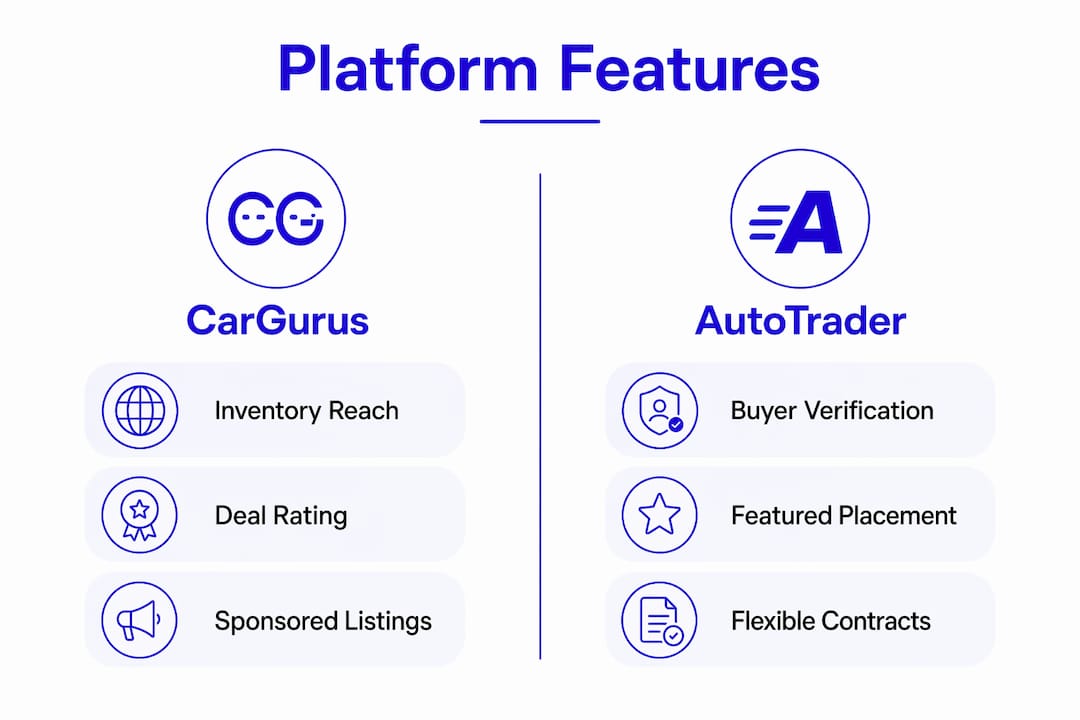
CarGurus offers sponsored listings and featured placement tiers that push inventory higher in search results. AutoTrader provides similar promoted listing products, plus access to display advertising across the Cox Automotive network, which includes KBB. Cars.com has its own featured listing and dealer spotlight products. Cox Automotive's broader ecosystem means AutoTrader dealers can extend campaigns across KBB pages, creating cross-property exposure that CarGurus cannot match on its own. For dealers running brand-awareness campaigns alongside inventory listings, that cross-property reach is a concrete differentiator.
What should dealers know about contract terms and flexibility?
Both CarGurus and AutoTrader operate on monthly or annual subscription structures, with annual commitments typically carrying lower per-month rates. Neither platform publicly lists standard cancellation windows, so dealers should negotiate exit clauses before signing. Volume discounts are available for dealer groups, but terms are negotiated directly with account teams rather than published. Hidden costs, including offer expirations and verification friction, can affect realized ROI in ways the base subscription price does not reflect. Always request a full fee schedule in writing before committing.
How do dealers actually perceive these platforms?
CarGurus draws mixed feedback: dealers value its inventory breadth and deal-rating visibility, but some report that price-sensitive shoppers generated through the platform require more negotiation. AutoTrader's Trustpilot rating sits at 1.6 out of 5 stars, with most negative reviews tied to the Private Seller Exchange's safety features rather than dealer-side experiences. Cars.com is generally viewed as a reliable supplemental channel. The KBB integration on AutoTrader is consistently cited as a trust-builder that reduces negotiation friction, particularly on higher-value units.
Does running both platforms create overlap or conflict?
Yes, and the overlap is measurable. Because close to 40% of all vehicles are listed on all three major platforms simultaneously, running CarGurus and AutoTrader together does not double your reach. It does, however, give you two independent lead streams to compare. The practical risk is budget dilution: paying for both without a clear attribution framework means you cannot identify which platform is actually closing sales. Tracking cost per lead vs. cost per sale at the VIN level is the only way to determine whether the incremental spend on a second platform is justified. Cross-platform synergy is real for brand visibility; cross-platform conflict is real for budget efficiency.
How Autoroiq helps dealers measure what actually matters
Autoroiq provides vendor-agnostic marketing intelligence specifically for automotive dealerships. Rather than selling advertising on any platform, Autoroiq delivers independent performance reviews, vendor accountability scorecards, and executive-level recommendations grounded in DMS and CRM-level attribution data. When a dealer cannot determine whether CarGurus or AutoTrader is actually driving sales, Autoroiq designs and oversees a structured 6–8 week A/B test: matched inventory cohorts by VIN age and trim, synchronized campaign windows, and CRM lead-to-sale mapping with a pre-agreed confidence threshold. The result is a defensible answer, not a vendor-supplied report. Dealers who have run this process through Autoroiq's marketing intelligence advisory consistently reallocate spend away from underperforming channels and toward measurable ROI. To request an independent platform evaluation for your dealership, visit Autoroiq's insights hub or contact the advisory team directly.
Platform comparison: key dimensions at a glance
The six entities below represent the primary options and context layers in this comparison. Understanding what each does, and for whom, is the foundation of any valid vendor evaluation.
| Platform | What it is | Best for |
|---|---|---|
| Autoroiq | Vendor-agnostic marketing intelligence and advisory | Dealers needing independent ROI measurement and test design |
| CarGurus | Dealer marketplace with algorithmic deal ratings | Volume reach, price-competitive used inventory |
| AutoTrader | Established marketplace with KBB integration and buyer verification | Buyer trust, private-sale safety, research-stage shoppers |
| Cars.com | Broad listing network with dealer review tools | Supplemental reach and review-driven buyer research |
| Cox Automotive | Parent ecosystem (AutoTrader, KBB, and wholesale tools) | Dealers wanting bundled valuation, financing, and listing tools |
| Kelley Blue Book (KBB) | Trusted valuation brand integrated with AutoTrader | Pricing credibility and valuation badges on listings |
Key Takeaways
CarGurus leads on inventory reach, AutoTrader leads on buyer-verification features, and neither platform's vendor report replaces DMS-level attribution tied to actual sales.
| Point | Details |
|---|---|
| CarGurus leads on reach | CarGurus listings account for nearly 90% of total inventory exposure if a customer searches only on that site. |
| Overlap reduces incremental value | Close to 40% of all dealer-listed vehicles appear on all three platforms simultaneously. |
| AutoTrader's fees add up | AutoTrader's Private Seller Exchange charges $9–$49 to list plus a 0.99% transaction fee (minimum $99). |
| Attribution is the real gap | Tracking cost per lead vs. cost per sale at the VIN level is the only reliable way to compare platform ROI. |
| Autoroiq fills the measurement gap | Autoroiq's vendor-agnostic advisory designs structured A/B tests and delivers DMS-level attribution analysis. |