
CRM data hygiene is the single operational change that restores reliable forecasting, lead routing, and marketing ROI at a dealership. If your pipeline numbers don't match your sales results, or your vendor attribution reports conflict with each other, the root cause is almost always bad data. Commission three things now: (1) a duplicate and completeness audit on a random sample of 100–200 records, (2) a named RevOps owner with restricted import and admin permissions, and (3) a quarterly hygiene audit cadence with automated weekly checks in between.
Table of Contents
- What is CRM data hygiene, and why do the six dimensions matter?
- How poor data quality costs dealerships real revenue
- The six dimensions in practice: benchmarks for your dealership
- The priority checklist: triage, stabilize, and operationalize
- What tools actually help with CRM data hygiene automation?
- Who owns data governance at your dealership?
- How to measure hygiene improvement and report it to leadership
- Common pitfalls and how to stop them fast
- Realistic timeline and effort for U.S. dealerships
- The 90-day dealership playbook
- Key Takeaways
- The real cost of waiting on this
- How Autoroiq can accelerate your data hygiene program
- Useful sources and further reading
What is CRM data hygiene, and why do the six dimensions matter?
CRM data hygiene is the ongoing operational discipline of keeping every record in your system accurate, complete, consistent, timely, valid, and unique. That last sentence is not a definition for its own sake. Those six terms are a measurement framework, and each one maps directly to a dealership failure mode:
- Accuracy: Is the contact's phone, email, and ownership field correct? Inaccurate records produce wrong lead routing and missed follow-ups.
- Completeness: Are deal-critical fields filled? Missing fields break pipeline stage logic and forecasting.
- Consistency: Are dropdowns and formats standardized across sources? Inconsistent entries corrupt segmentation and attribution.
- Timeliness: How stale are ownership and status fields? Staff churn makes stale fields one of the fastest sources of data quality decay.
- Validity: Do values conform to defined formats? Invalid emails and phone numbers break automation at scale.
- Uniqueness: Are duplicate records identified and merged? Duplicates inflate CPL metrics and send the same lead to two reps.
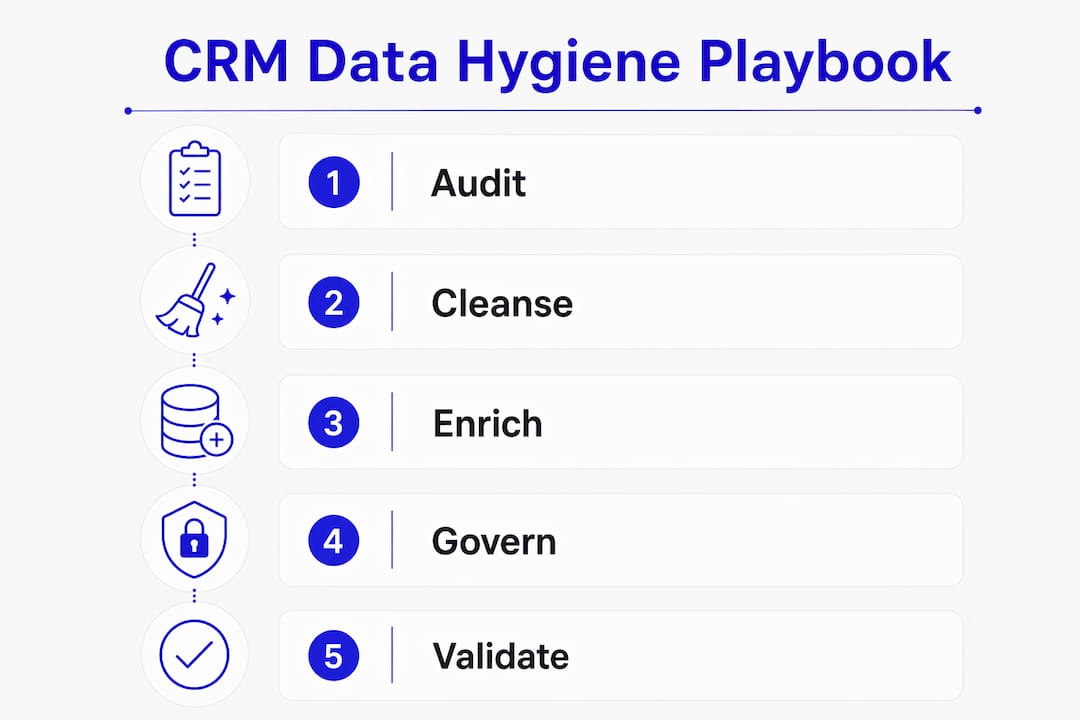
Hygiene is not a one-time cleansing project, and it is not the same as enrichment. Cleansing removes existing errors. Enrichment adds missing data. Hygiene is the continuous operating model that prevents errors from accumulating in the first place.
How poor data quality costs dealerships real revenue
Bad CRM data is a revenue problem, not an IT problem. Duplicate records from omnichannel lead capture inflate your lead count, making cost-per-lead look artificially low. Stale ownership fields after a sales rep leaves mean inbound leads sit unrouted. Missing VDP-to-deal linkage makes it impossible to attribute which marketing channel closed the sale, so you end up wasting marketing dollars on channels that look productive only because the data is broken.
B2B contact data decays at 22–34% annually. For a dealership running active conquest campaigns, that rate means a significant share of your contact records become unreliable within months, not years.
When AI-driven automation and lead-scoring tools run on bad inputs, they produce confidently wrong outputs at scale. A misrouted lead that gets an automated sequence for the wrong vehicle segment is not a minor inconvenience. It is a lost sale and a damaged customer relationship.
The six dimensions in practice: benchmarks for your dealership
| Dimension | Dealership example | Target benchmark |
|---|---|---|
| Accuracy | Phone and email on active service leads | verified at point of entry |
| Completeness | Required fields on deal records (source, VDP, trade-in) | >95% critical-field completion |
| Consistency | Lead source dropdown values across all capture channels | Zero free-text variants in key fields |
| Timeliness | Ownership field updated after rep departure | <48-hour SLA for reassignment |
| Validity | Email format and phone format on imported partner leads | <1% invalid format rate |
| Uniqueness | Duplicate contact or deal records | <2% duplication rate |
Start with a random sample of 100–200 records to establish a baseline score before any remediation. That sample gives you a defensible starting point for measuring improvement.
The priority checklist: triage, stabilize, and operationalize
Triage (days 1–14)
- Pull a 100–200 record sample and score each dimension above.
- Run a full duplicate audit; quarantine conflicting records before merging.
- Freeze bulk imports from partner feeds until pre-import validation is in place.
- Identify the top five fields with the highest error or missing-data rate.
- Brief the GM and marketing director on the health score findings.
Stabilize (days 15–60)
- Enforce required fields on deal-stage transitions (no progression without source, VDP link, and contact email).
- Replace free-text fields with dropdowns for lead source, vehicle interest, and trade-in status.
- Configure automated dedupe rules based on email domain and phone number matching.
- Run enrichment on high-value active deals to fill firmographic and contact gaps.
- Document field definitions and acceptable values in a shared governance guide.
Operationalize (ongoing)
- Assign a single RevOps owner with a written SLA: data correction requests resolved within 48 hours.
- Schedule automated weekly health checks and a comprehensive quarterly audit.
- Require an intake checklist for every new record source before it connects to the CRM.
- Review governance rules quarterly as your marketing stack evolves.
What tools actually help with CRM data hygiene automation?
Four tool categories address different parts of the problem. Understanding what each one does prevents you from buying overlap.
- Deduplication and normalization tools identify and merge duplicate records using fuzzy matching on email, phone, and company domain. They are the first tool to deploy.
- Enrichment platforms fill missing fields by querying external data sources. Waterfall enrichment that queries multiple providers reaches match rates of 80–90%, compared with 40–60% for single-provider approaches. For high-value conquest accounts, that gap is significant.
- Point-of-entry validation tools enforce format rules and required fields at ingestion, before bad data enters the system. This is the highest-leverage intervention because prevention beats downstream fixes every time.
- Orchestration platforms automate recurring hygiene workflows: scheduled enrichment refreshes, stale-record alerts, and SLA exception reports.
When evaluating vendors, check for CRM-native integrations, matching logic transparency, enrichment coverage for automotive contacts, and a documented SLA for data refresh cadence. For a deeper look at enrichment techniques and how multi-source approaches improve match rates, the technical literature is worth reviewing before issuing an RFP.
Pro Tip: Insist on pre-import validation for every bulk partner feed. A single unchecked import from a third-party lead aggregator can introduce hundreds of duplicates and invalid records in minutes.

Who owns data governance at your dealership?
Governance without a named owner fails within a quarter. Assign one person, typically a RevOps or marketing operations manager, as the data quality owner. That role carries three responsibilities: approving new record sources, resolving SLA exceptions, and running the quarterly audit.
| Role | Responsibility | Permission level |
|---|---|---|
| RevOps owner | Approves imports, resolves exceptions, runs audits | Full admin |
| Marketing director | Reviews monthly health scorecard, approves field changes | Read + limited edit |
| Sales manager | Enforces field completion at stage transitions | Standard user |
| Vendor/import contacts | Submit data via validated intake form only | No direct CRM access |
Restrict mass import permissions to the RevOps owner. Limit custom property creation to approved requests with a documented business case. Every new field added without governance adds future debt.
Pro Tip: Use an intake checklist for every new record source. Before any feed connects to your CRM, require the source to pass a sample validation against your field standards.
How to measure hygiene improvement and report it to leadership
Track these KPIs on a weekly and monthly basis:
- Duplication rate: target below 2%
- Critical-field completion %: target above 95% for deal-stage required fields
- Email bounce rate: a proxy for contact data accuracy; rising bounce rates signal decay
- New-duplicate creation rate: measures whether prevention controls are working
- Enrichment match rate: tracks how well your enrichment pipeline fills gaps
- Ownership reassignment latency: time from rep departure to record reassignment
Clean CRM data is the prerequisite for reliable attribution and ROI metrics. Without unique, accurate, and consistent records, your vendor performance scorecards and cost-per-sale calculations are built on a flawed foundation.
A practical dashboard structure: a weekly health scorecard showing duplication rate and field completion, a monthly SLA exception report reviewed by the marketing director, and a quarterly audit report that ties hygiene improvements to forecasting accuracy and marketing attribution changes. The quarterly report is what connects hygiene work to budget decisions.
Common pitfalls and how to stop them fast
- Duplicate records from omnichannel capture: Block imports until pre-validation passes. Run a merge pass on existing duplicates before the next campaign launch.
- Stale ownership after staff churn: Set an automated alert when a rep's records go uncontacted for more than five business days. Require reassignment within 48 hours.
- Inconsistent dropdowns: Audit all free-text entries in lead source and vehicle interest fields. Migrate to picklists and lock free-text input.
- Bulk-import corruption: Require a sample validation (50 records minimum) before any full import executes. Quarantine the batch if the error rate exceeds 5%.
- Missing VDP-to-deal linkage: Without this connection, you cannot measure which VDP traffic sources actually convert. Enforce VDP source as a required field at deal creation.
Pro Tip: Build a short list of "deal-critical" fields, no more than eight, and protect every one with a validation rule at point of entry. These fields are non-negotiable for routing, attribution, and forecasting.
Realistic timeline and effort for U.S. dealerships
| Phase | Primary activities | Estimated effort | Typical cost band |
|---|---|---|---|
| Triage (weeks 1–2) | Audit, quarantine, freeze imports, health score | — | $0 (internal) |
| Stabilization (weeks 3–8) | Required fields, dedupe rules, enrichment setup | 40–80 staff hours + tooling | — |
| Automation and ops (months 2–5) | Orchestration, dashboards, SLA cadence | — | — |
Larger dealer groups with multiple rooftops should budget toward the higher end of each band and plan for a dedicated RevOps contractor during stabilization.
The 90-day dealership playbook
Deliverables by phase
- Week 0–2: CRM health score report, duplicate list with merge recommendations, stop-gap import controls in place, top-five broken fields identified.
- Week 3–8: Validation rules live on deal-stage transitions, dedupe run completed, enrichment pipeline active for priority records, governance guide drafted.
- Week 9–12: Weekly health dashboard live, RevOps SLA documented and signed off, quarterly audit plan on the calendar, first before/after attribution comparison delivered to leadership.
| Week | Deliverable | Owner | Success metric |
|---|---|---|---|
| 0–2 | Health score + duplicate list | RevOps | Baseline duplication rate documented |
| 3–8 | Validation rules + dedupe run | RevOps + Marketing Ops | Field completion >90% on active deals |
| 9–12 | Dashboard + SLA + audit plan | RevOps + GM | Weekly scorecard running; Q1 audit scheduled |
When commissioning this work from a vendor or internal team, request these three deliverables explicitly. Any engagement that cannot produce a health score in the first two weeks is not starting in the right place.
Key Takeaways
Dealership CRM data hygiene requires a named RevOps owner, point-of-entry validation, and a quarterly audit cadence to keep forecasting, lead routing, and marketing attribution reliable.
| Point | Details |
|---|---|
| Six dimensions as your framework | Accuracy, completeness, consistency, timeliness, validity, and uniqueness each map to a specific dealership failure mode. |
| Data decays fast | B2B contact data decays at 22–34% annually, making quarterly-only hygiene insufficient for active campaigns. |
| Prevention beats cleanup | Point-of-entry validation and pre-import checks stop bad data before it corrupts reports and automations. |
| Measure with five KPIs | Track duplication rate, critical-field completion %, email bounce rate, match rate, and ownership reassignment latency. |
| Autoroiq as your independent advisor | Autoroiq delivers a vendor-agnostic health assessment and 90-day implementation plan tied to measurable marketing ROI outcomes. |
The real cost of waiting on this
Most dealerships treat CRM cleanup as a project they will get to after the next campaign. That framing is the problem. One-time cleanups see the CRM degrade again within a quarter because the underlying capture and governance problems are never fixed. The executives who get the most from their marketing data are not the ones who ran the biggest cleanup. They are the ones who built the operating model that prevents the mess from returning.
The other underappreciated risk is vendor accountability. When your CRM data is unreliable, you cannot challenge a vendor's attribution claim with confidence. You are negotiating from a position of uncertainty. Clean data is not just an operational asset. It is a negotiating tool. Dealerships that can produce a defensible cost-per-sale figure, backed by clean attribution data, consistently get better terms and better performance from their marketing partners. That is the business case that belongs in front of a GM, not a conversation about field formats.
How Autoroiq can accelerate your data hygiene program
Dirty CRM data produces unreliable vendor scorecards, inflated CPL figures, and forecasts your GM cannot trust. Autoroiq's independent marketing intelligence service gives dealerships a clear, vendor-agnostic picture of where the data breaks down and what it is costing them.
An Autoroiq engagement starts with a CRM health assessment that scores your data across the six dimensions, identifies the highest-revenue-risk gaps, and delivers a prioritized 90-day remediation plan your team can execute or commission. Because Autoroiq does not sell advertising and has no vendor relationships to protect, the recommendations are objective. Executives get a marketing performance review they can act on immediately, with before/after measurement built in from day one. To commission an independent assessment for your dealership, visit autoroiq.com.
Useful sources and further reading
The following sources informed this article. They are worth sharing with vendors or internal teams when issuing RFPs or change requests:
- Databar.ai: CRM Data Quality Guide covers the six dimensions, sampling methodology, and enrichment match rate benchmarks.
- Inveo: CRM Data Hygiene as an Operational Function makes the case for treating hygiene as a continuous discipline, not a project.
- Integrate: CRM Data Management Best Practices explains why most data problems originate upstream at ingestion.
- ZoomInfo: CRM Hygiene Five-Step Framework provides a structured cleansing process applicable to the stabilization phase.
- Flawless Inbound: CRM Data Quality Best Practices covers deduplication, mandatory fields, and enrichment automation.
- Zapier: What Is CRM Data Quality? is a practical overview of causes, fixes, and automation options for teams new to the topic.
When issuing a vendor RFP for hygiene tooling, reference the Databar.ai benchmarks and the Integrate ingestion-first framework as evaluation criteria. They give you an objective standard that vendors must respond to specifically.