
Run both channels as a full-funnel system. Meta creates demand by reaching low-intent users through visual discovery; Google captures intent by matching active search queries to your inventory. For dealerships, the practical rule is straightforward: shift budget toward Google when a model has strong search volume and you need leads now, shift toward Meta when you are launching a new EV, clearing certified pre-owned inventory, or building awareness during a slow season.
- Channel roles: Meta (Facebook/Instagram) = awareness and demand generation; Google = intent capture and lead conversion
- Immediate lead gen: Prioritize Google Search campaigns targeting high-intent queries ("used F-150 near me," "Toyota Camry lease deals")
- New model launch or awareness: Prioritize Meta video and carousel ads to build reach before search demand exists
- Allocation rule of thumb: Start at 60% Google / 40% Meta for established models; flip to 40/60 for new launches or low-search inventory
- Measurement requirement: Use matched conversion definitions and multi-touch attribution across both channels before drawing budget conclusions
Vendor reports from both platforms will each claim credit. An independent performance review from Autoroiq cuts through that conflict with a vendor-agnostic channel audit and defensible budget recommendations.
Table of Contents
- How do Facebook ads vs Google ads compare for dealerships?
- When should you prioritize Google, Meta, or both?
- Creative, tracking, and attribution best practices per channel
- How Autoroiq evaluates channel performance for dealerships
- Platform policies and restrictions that affect dealership campaigns
- Autoroiq gives dealerships a vendor-agnostic view of both channels
- Key Takeaways
How do Facebook ads vs Google ads compare for dealerships?
| Dimension | Google Ads | Meta (Facebook/Instagram) Ads |
|---|---|---|
| Primary funnel role | Demand capture (bottom-funnel) | Demand generation (top/mid-funnel) |
| Best for / use cases | High-intent leads, local search, used-vehicle queries | New model launches, awareness, retargeting, CPO clearance |
| Typical metrics | CPA, CPL, conversion rate, Quality Score | CPM, view-through rate, assisted conversions, frequency |
| Creative requirements | Search copy, ad extensions, local intent signals | Video-first, carousel, Reels, high creative refresh cadence |
| Attribution complexity | Simpler last-click; ROAS visible quickly | Multi-touch required; view-through credit essential |
| Time to conversion | Hours to days (high-intent traffic) | Days to weeks; learning phase runs 7–14 days |
| Ease of measurement | Straightforward with UTM + conversion tracking | Requires pixel, view-through windows, and assisted-conversion reporting |
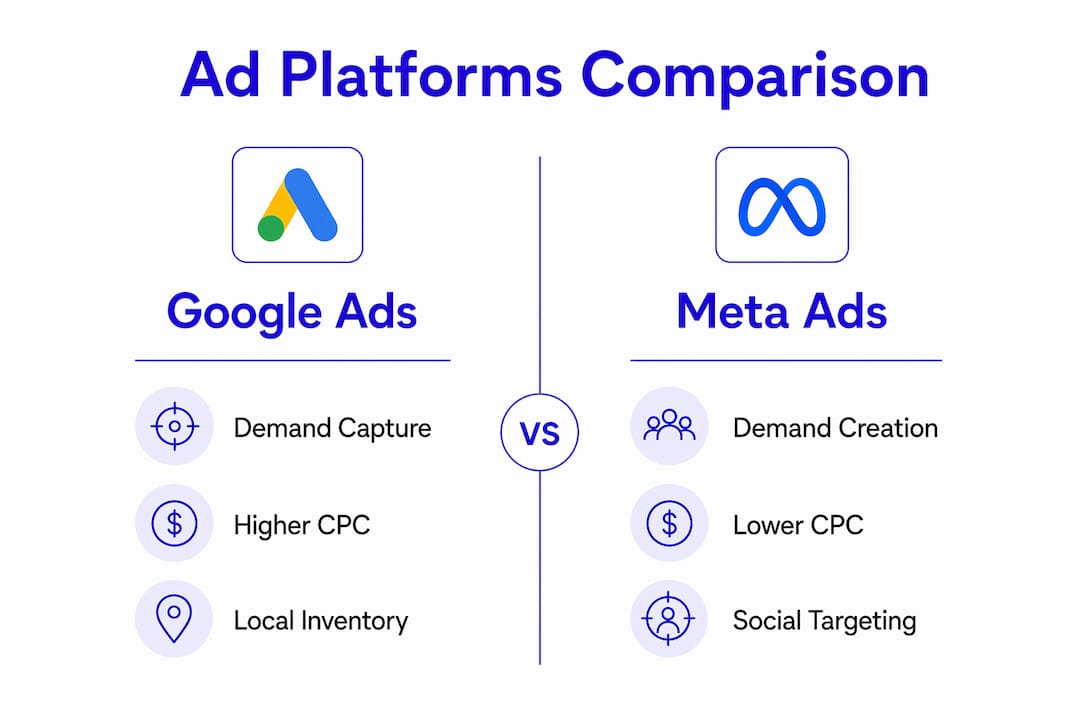
For dealerships running new-model launches, used-vehicle clearance, and service-lane retention simultaneously, neither channel alone covers the full buyer journey. Meta builds the audience; Google closes it. Coordinated use of Meta for top-of-funnel awareness and Google for branded search capture compounds ROAS because shoppers who saw your Meta ads later search your brand name.
Pro Tip: Never compare CPC across platforms. A $1.07 Meta click and a $2.69 Google click are not equivalent units. Compare cost per lead or cost per sale, accounting for Meta view-throughs and assisted conversions, or you will systematically undervalue Meta's contribution.
When should you prioritize Google, Meta, or both?
-
Immediate used-vehicle lead push. Prioritize Google Search with exact and phrase-match keywords targeting in-market queries. KPI focus: CPL and CPA. Evaluation window: 14–21 days. The typical allocation for established models is 60% Google / 40% Meta retargeting, but may shift higher toward Google for urgent, high-intent lead needs. Negative keyword hygiene is non-negotiable here.
-
New EV or model launch. Product maturity dictates allocation: when search volume is low, Meta video and awareness campaigns build the audience first. KPI focus: view-through rate, reach, and frequency. Evaluation window: 30–45 days. Start with a 40% Google / 60% Meta split for new launches or low-search vehicles.
-
Service-lane retention. Meta custom audiences built from your CRM (past service customers) outperform broad search here. Retargeting with service offers and seasonal messaging keeps your name in front of existing owners. KPI focus: cost per appointment, return visit rate.
-
Certified pre-owned clearance. Run Google Shopping and Search for high-intent CPO queries alongside Meta dynamic ads pulling from your inventory feed. Budget split: typically 50/50. Evaluate on CPA and days-to-sale.
-
Brand awareness during slow season. Meta reach campaigns with video creative are the most cost-efficient way to maintain share of mind when transaction volume is low. Protect branded search on Google so competitors do not capture the demand Meta generates.
Creative, tracking, and attribution best practices per channel
Meta creative checklist:
- Lead with video (Reels and Stories) in the first three seconds; static images underperform for vehicle discovery
- Refresh creative every 10–14 days to prevent frequency fatigue; the learning phase resets with aggressive structural changes, so rotate creative without restructuring ad sets
- Use 9:16 vertical format for Stories/Reels; 1:1 for feed placements
Google search and landing checklist:
- Build and maintain negative keyword lists weekly; broad-match spill is the most common source of wasted spend in dealership accounts
- Align every ad group to a specific VDP or model landing page, not the homepage
- Use call extensions, location extensions, and vehicle listing ads where eligible
Tagging and attribution checklist:
- Apply consistent UTM parameters across both platforms using the same naming convention
- Set conversion windows to 7-day click / 1-day view for Meta; 30-day click for Google Search
- Include view-through conversions from Meta in your reporting; excluding them systematically undervalues Meta's role in the sale
- Use a cost-per-lead vs cost-per-sale framework to translate channel metrics into business outcomes
Pro Tip: Run a 30-day A/B hold-out test: pause Meta for one store or region while keeping Google constant, then measure the change in branded search volume and total lead volume. The drop in Google branded conversions will reveal exactly how much demand Meta was generating.
How Autoroiq evaluates channel performance for dealerships
Autoroiq's evaluation process is built on vendor-agnostic principles. No advertising is sold, and no platform vendor's reporting is accepted at face value. The methodology examines whether conversion definitions are consistent across channels, whether attribution windows are matched, and whether view-through and assisted conversions are included before any budget recommendation is made. Executive-level scorecards identify which channel is genuinely driving cost-per-sale efficiency and which is claiming credit it has not earned. Benchmarks are drawn from dealership-specific performance data, not general industry averages, so recommendations reflect the actual competitive and inventory context of each store.

Platform policies and restrictions that affect dealership campaigns
Both platforms impose restrictions that directly affect how dealerships can set up and optimize campaigns.
Meta (Facebook/Instagram): Meta's Special Ad Categories apply to automotive credit and financing offers. Campaigns promoting financing terms must be classified under the Special Ad Category for Credit, which restricts audience targeting: age, gender, ZIP code radius, and certain interest segments are limited. This reduces targeting precision for lease and finance promotions. Dealerships running inventory retargeting must comply with Meta's data use policies, and the Meta Pixel requires a current cookie consent framework on the dealer website.
Google Ads: Google's vehicle ads and local inventory ads require a properly configured Google Merchant Center feed with accurate pricing and availability. Disapprovals for price discrepancies or landing-page mismatches are common in dealership accounts and can pause high-performing campaigns without warning. Dealerships advertising financing must comply with Google's financial products policy, including clear disclosure of representative APR where required. Performance Max campaigns, increasingly the default recommendation from Google reps, consolidate control and reduce transparency into search term data, which makes negative keyword management harder and independent auditing more important.
Understanding these constraints before campaign setup prevents the compliance-driven pauses that waste budget and reset algorithm learning.
Autoroiq gives dealerships a vendor-agnostic view of both channels
Conflicting vendor reports are the norm, not the exception. Google's attribution credits search; Meta's credits social. Neither report tells you what actually drove the sale.
Autoroiq provides dealerships with an independent marketing performance review that evaluates both channels on the same terms: matched conversion definitions, consistent attribution windows, and a cost-per-sale framework that accounts for assisted conversions. The result is a clear, defensible picture of where your budget is working and where it is not. If you are allocating significant spend across Meta and Google and relying on vendor-provided reports to justify that spend, request an independent review to get an objective read on your channel mix.
Key Takeaways
Google and Meta serve different funnel roles for dealerships, and budget allocation should follow model maturity and campaign objective rather than platform preference.
| Point | Details |
|---|---|
| Channel roles are distinct | Meta generates demand; Google captures it. Treat them as complementary, not competing. |
| Allocation follows objective | Use 60/40 Google-to-Meta for established models; shift closer to 40/60 for new launches or low-search inventory. |
| Attribution must include view-throughs | Excluding Meta view-through and assisted conversions systematically undervalues its contribution to cost-per-sale. |
| Policy restrictions affect setup | Meta's Special Ad Categories and Google's financial product policies limit targeting and require compliance before launch. |
| Autoroiq provides independent clarity | Autoroiq's vendor-agnostic scorecards evaluate both channels on matched terms, delivering defensible budget recommendations. |