
What is incrementality testing and why does it matter?
Incrementality testing is a randomized, controlled experiment that measures the causal impact of a marketing campaign by comparing outcomes between a test group exposed to the campaign and a control group that is not. The core question it answers: how much revenue or conversions did your campaign actually generate beyond what would have happened anyway?
Traditional attribution models assign credit based on correlation, not causation. A customer who was already going to buy sees your retargeting ad, converts, and the ad gets full credit. That is the "coattail effect" attribution cannot prevent. Incrementality testing eliminates it by isolating true causal lift.
Key benefits of this approach:
- Identifies true marketing ROI by separating organic demand from campaign-driven demand
- Prevents over-attribution that inflates channel performance and distorts budget decisions
- Produces defensible metrics: incremental lift, incremental revenue, incremental ROAS (iROAS), and incremental CPA (iCPA)
- Supports privacy-first measurement since geo-based and aggregated methods require no individual-level tracking
Google Think has called incrementality testing the gold standard for understanding advertising's true impact in a privacy-first environment.
How to design an incrementality test that actually works
The right methodology depends on your channel, your data access, and the scale of your campaign. Three primary designs dominate the field.
- User-level holdouts: Randomly split your audience into exposed and unexposed groups. Best for digital-native campaigns with precise user targeting, such as paid search or social. Requires smaller budgets and produces granular results.
- Geo-based holdouts: Divide geographic markets into test and control regions. Suited for TV, retail media, or any channel where user-level holdouts are not feasible. Google Ads supports this via its Trimmed Match and Time-based Regression methods.
- Time-based testing: Alternate campaign activity across defined time windows. Useful when neither user nor geo splits are practical, though more vulnerable to external confounders.
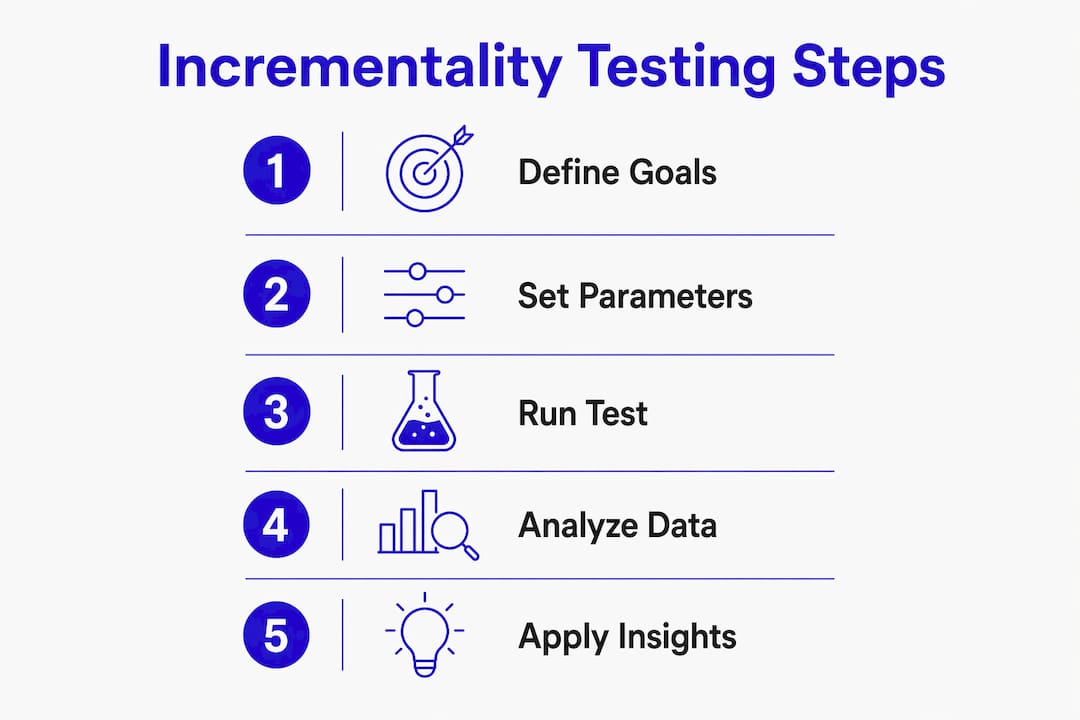
Proper test design requires setting four parameters upfront: test duration, sample size, minimum detectable effect (the smallest lift that would actually change a budget decision), and confidence level. Most marketing tests target 90%–95% confidence intervals, meaning a p-value below 0.05–0.10. Achieving that with a moderate expected lift requires several weeks of runtime and meaningful audience volume.
Pro Tip: Match your methodology to channel maturity. Forcing a user-level holdout onto a TV or out-of-home campaign produces inconclusive data. When in doubt, geo-based holdouts offer broader applicability and do not depend on cookies or device IDs.

How to calculate incremental lift, iROAS, and iCPA
The math is straightforward once your test has run. Start with conversion rates from both groups, then work through the following steps.
| Metric | Formula | What it tells you |
|---|---|---|
| Incremental lift | (Test CVR − Control CVR) / Control CVR | Percentage increase in conversions caused by the campaign |
| Incremental conversions | Total test conversions × (Lift / (1 + Lift)) | Actual new conversions the campaign created |
| iROAS | Incremental revenue / Media spend | Revenue per dollar of spend, net of organic demand |
| iCPA | Media spend / Incremental conversions | True cost to acquire one net-new customer |
A channel showing a $30 standard CPA but a $60 iCPA is less efficient than a channel with a $40 standard CPA and a $45 iCPA. The second channel creates more genuine new demand per dollar spent. That gap between attributed and incremental metrics is exactly where budget waste hides.
Before acting on results, validate statistical significance. Calculate p-values and confidence intervals to confirm the observed lift is not random noise. If confidence intervals overlap between test and control groups, the test is inconclusive and you need more data, not a decision.
Key metric interpretations:
- iROAS above 1.0 means the campaign generates more incremental revenue than it costs
- A high standard ROAS with a low iROAS signals heavy over-attribution
- iCPA significantly above standard CPA indicates the channel is capturing organic demand, not creating new demand
Practical applications of incrementality testing in real campaigns
Incrementality testing enables better budget allocation by revealing which channels drive true incremental conversions versus those riding organic demand. The applications span every major channel.
- Paid search: Determine how much of your branded search traffic would have arrived organically. Many advertisers discover their branded campaigns have low incremental lift, freeing budget for non-branded terms.
- YouTube and video: Rocket Mortgage tested a demand generation campaign on Google Ads and found it generated 23% more value than their original model estimated, prompting a full recalibration of their Marketing Mix Model.
- Remarketing: DefShop, a European streetwear retailer, ran a randomized controlled experiment on cart abandoners and found dynamic remarketing drove an incremental 12% increase in purchases and 23% more site visits.
- Display advertising: HomeAway ran a controlled experiment on the Google Display Network and found its cost per incremental acquisition was 51% lower than last-click attribution had suggested, directly reshaping its bidding strategy.
"Incrementality testing has become the industry's gold standard for understanding advertising's true impact in a privacy-first way." — Google Think
When test results come in, start with modest budget reallocation: shift 10%–20% of spend based on incremental findings, monitor overall efficiency, then scale. Pairing test results with AI-powered bidding tools such as value-based bidding or Performance Max can further compound efficiency gains over time.
Common pitfalls and how to avoid them
Poorly designed tests produce data that misleads rather than informs. These are the failures that show up most often in practice.
- Overlapping campaigns: A local promotion running in the same markets as a geo holdout contaminates the control group. One misaligned campaign can invalidate months of test planning.
- Insufficient sample size or duration: Stopping a test early because results look promising is a classic error. Statistical confidence requires accumulating enough conversions in both groups across the full customer journey.
- Ignoring external factors: Seasonality, competitor promotions, and economic shifts all affect both groups differently. Document what was happening in the market during the test window.
- Test fatigue: Running too many overlapping tests simultaneously degrades data quality across all of them.
Holdout testing inherently causes short-term performance dips in control groups. That is not a flaw. It is the mechanism that produces truthful measurement. Plan for it with your finance team before the test begins.
Close alignment between marketing, agency, and finance teams before testing prevents overlapping promotions and keeps test conditions clean. Build an annual testing calendar that sequences experiments across channels without overlap.
Pro Tip: Brief your CFO before a holdout test, not after. When they see a short-term dip in reported conversions, they need to understand it reflects withheld advertising, not a drop in business performance.
Why independent expertise strengthens your testing program
Incrementality testing is only as useful as the decisions it informs. A few expert-level principles separate programs that generate insight from those that generate reports.
- Attribution models assign credit based on correlation. Incrementality testing proves causality, which is the only valid basis for budget decisions.
- Test results have a limited shelf life. Seasonality, competitor actions, and shifting media mixes degrade the accuracy of findings over time. Ongoing testing is the only way to maintain an accurate view of channel effectiveness.
- Incrementality data calibrates Marketing Mix Models. When test results feed MMM inputs, forecasts become more reliable and budget decisions carry more defensible logic.
- Methodology selection is a judgment call, not a formula. Matching the right experimental design to channel maturity and business context requires experience, not just a checklist.
Autoroiq applies this same discipline to automotive dealership marketing, where vendor reports routinely conflict and attribution models overstate channel performance. Independent, vendor-agnostic analysis built on causal measurement principles gives dealership leaders the clarity to act on real data rather than vendor-favorable metrics. Explore how Autoroiq approaches marketing channel evaluation for dealerships navigating these exact challenges.
How incrementality testing differs from attribution and A/B testing
Attribution models (last-click, data-driven, multi-touch) distribute credit across touchpoints after a conversion occurs. They answer "which channels were present?" not "which channels caused the outcome?" That distinction produces systematically inflated performance numbers for channels that intercept customers already in the purchase funnel.

A/B testing compares two versions of a creative, landing page, or offer within an exposed audience. It measures relative performance between variants but does not establish whether either variant drove incremental demand versus organic behavior. Incrementality testing goes further by including a true holdout group that receives no marketing at all, establishing a genuine counterfactual baseline.
The practical implication: a channel can win an A/B test and still have low incrementality. It performed better than the other variant, but both variants may have been capturing organic demand. Only a holdout-based experiment reveals whether the channel is creating new demand or just intercepting it. For dealerships evaluating cost per lead vs. cost per sale, this distinction directly affects how marketing budgets should be structured.
How external factors affect test validity
No test runs in a vacuum. Economic conditions, competitor promotions, seasonal demand cycles, and even weather patterns can shift conversion behavior in ways that affect test and control groups differently.
The critical requirement is proportional impact: external factors must affect both groups equally for the test to remain valid. A geo-based holdout breaks down if a competitor runs a heavy local promotion exclusively in your control markets. A user-level holdout breaks down if a major product announcement or PR event reaches your test group disproportionately.
Mitigation strategies include running pre-test validity checks, monitoring both groups during the test for divergence unrelated to the campaign, and documenting all known external events in the test window. The CausalImpact R package, developed at Google, addresses this directly by using control time series to model the counterfactual, then flagging when covariate relationships shift post-intervention. When external validity cannot be maintained, the honest answer is to restart the test under cleaner conditions rather than act on compromised data.
Key Takeaways
Incrementality testing is the only method that proves marketing causality rather than correlation, making it the foundation for defensible budget decisions.
| Point | Details |
|---|---|
| Causality over correlation | Attribution assigns credit after the fact; incrementality testing proves which campaigns actually drove new conversions. |
| Methodology must match channel | User-level holdouts fit digital campaigns; geo-based holdouts suit TV and retail media with no cookie dependency. |
| iROAS is the decision metric | Divide incremental revenue by media spend to get the true return, net of organic demand. |
| Tests have a shelf life | Seasonality and competitor activity degrade results over time; ongoing testing keeps budget decisions accurate. |
| Finance alignment is required | Brief your CFO before holdout tests to prevent misreading short-term performance dips as business decline. |

Autoroiq delivers independent marketing performance analysis for automotive dealerships, cutting through conflicting vendor reports to show where budgets are actually working. If your current measurement relies on attribution data from vendors with a stake in the outcome, the numbers you are acting on may not reflect reality. Get objective marketing intelligence built on causal measurement principles, not vendor-favorable metrics.