
Rank every channel by incremental contribution margin per visitor, then run holdout tests on your top two spenders before you touch next quarter's budget. That single move fixes most of what goes wrong in marketing channel evaluation: teams compare revenue instead of profit, trust platform-reported ROAS instead of testing what happens when a channel goes dark, and reallocate budget based on hunches dressed up as data.
Here's what to do this week:
- Inventory every channel currently receiving spend, including "free" ones like organic and email that still consume headcount.
- Rank channels by contribution margin per visitor, not raw revenue or platform ROAS.
- Pick your two highest-spend channels and design a simple holdout test for the next 30 days.
- Set a date to reconvene with finance and marketing ops to review results and shift budget.
Pro Tip: If you only have time for one thing this week, pull last quarter's spend by channel and cross-reference it against your CRM's closed-deal source field. The mismatches you find there usually explain half your budget waste.
Key Takeaways
Ranking channels by incremental contribution margin, not platform-reported ROAS, is the single change that most improves marketing budget decisions.
| Point | Details |
|---|---|
| Use contribution margin | Score channels on profit after real costs, not raw revenue or platform ROAS. |
| Test incrementality quarterly | Run holdout or geo tests on your top spend channels before trusting attribution. |
| Include hidden costs | Add labor, tooling, and content production to channel cost calculations. |
| Standardize the scorecard | Compare every channel on the same metrics and time windows to avoid biased reallocation. |
| Consider independent review | AutoROIQ offers vendor-agnostic dealership evaluations that validate attribution and build a reallocation plan. |
Where to Learn More About Channel Evaluation Methods
- Coursera's course on analyzing and optimizing marketing channel performance for a structured measurement curriculum.
- HubSpot's overview of marketing channel strategy for standardization principles.
These sources were selected because they address cost accuracy, attribution limits, and scorecard consistency, the three areas where most evaluations quietly go wrong. Pair them with GA4, Search Console, your CRM, and a server-side payment connector to build the data foundation this framework depends on.
Table of Contents
- What Is Marketing Channel Evaluation, Exactly?
- A Four-Step Framework for Evaluating Marketing Channels
- Which Metrics Actually Tell You a Channel Is Working?
- How Do You Measure Channels Reliably Across Platforms?
- How Do You Decide Which Channels Belong in the Mix?
- What Experiment Design Actually Proves Channel Impact?
- Building a Scorecard to Rank and Reallocate Budget
- What Belongs on Your Evaluation Checklist and Dashboard?
- A Dealership Case Study in Vendor-Agnostic Channel Evaluation
- Frequently Asked Questions
- Sources
What Is Marketing Channel Evaluation, Exactly?
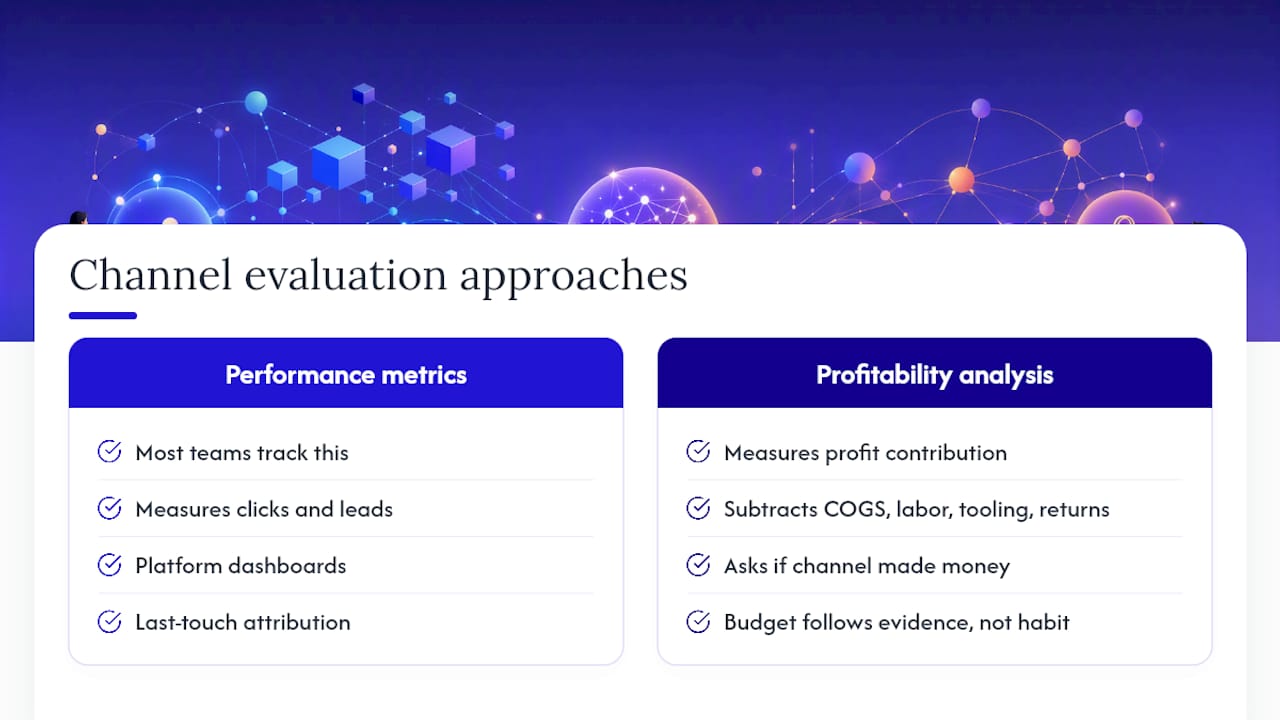
Marketing channel evaluation is the structured process of measuring what each acquisition source actually contributes to profit, not just clicks or leads, so budget follows evidence instead of habit. Most teams already track channel performance analysis in some form, a dashboard here, a monthly report there. Few do channel profitability analysis, which asks a harder question: after subtracting cost of goods, labor, tooling, and returns, did this channel make money or just generate activity?
The distinction matters because a channel can look brilliant on a platform's own dashboard and still be quietly losing money once you account for real costs. Coursera's marketing analytics curriculum makes this point directly: last-touch attribution and platform-reported metrics systematically misattribute conversions, which means teams routinely overfund channels that platforms flatter and underfund the ones that quietly close the sale.
A Four-Step Framework for Evaluating Marketing Channels
Run the same four steps every budget cycle and your channel performance assessment stops being a debate and starts being a process.
- Inventory every channel and its true cost. List paid, organic, referral, and offline channels alongside every dollar spent on each, including agency fees, ad spend, content production, and the hours your team logs managing them.
- Normalize revenue against contribution margin, not gross revenue. Strip out cost of goods, fulfillment, returns, and payment processing fees before you compare one channel's output to another's.
- Test incrementality on your top spenders. Use a holdout or geo test to find out what happens to conversions when the channel is paused, rather than assuming attributed conversions are all real.
- Score and prioritize with a standardized scorecard. Rank every channel on the same dimensions so a scale problem doesn't accidentally read as a quality problem.
Picture this as a loop, not a line: inventory feeds the scorecard, the scorecard flags which channels need testing, and test results feed back into next month's inventory. Run steps 1 and 2 monthly, run incrementality tests quarterly on your two or three biggest spenders, and do a full annual audit that questions channels you haven't touched in a year.
Ownership matters more than most teams admit. Analytics owns the data pipeline and normalization. Marketing ops runs the tests. Finance signs off on what counts as contribution margin. An executive sponsor breaks ties when a channel with strong brand value scores poorly on hard numbers.
Pro Tip: Assign one person to own the scorecard itself, not just the channels in it. Without a single owner, every department tweaks the definitions to favor their own budget line.
Which Metrics Actually Tell You a Channel Is Working?
Marketing channel roi conversations usually stall because everyone in the room is using a different definition of "working." Fix that first.
- Reach: unique people exposed to the channel, useful for brand-building comparisons but a weak signal alone.
- Engagement: early-funnel actions like clicks, video views, or email opens that indicate interest before intent.
- Conversion rate: the share of visitors who complete a desired action, which varies wildly by channel intent.
- CPA/CAC: cost per acquisition or customer, the most commonly cited but most commonly misused metric.
- ROAS: revenue divided by ad spend, useful as a first pass but blind to true profitability.
- Revenue per visitor (RPV): combines conversion rate and average order value into one comparable number, and it's often the fastest way to rank channels by actual business impact when full incrementality data isn't ready yet.
- Contribution margin: revenue minus variable costs, the number that tells you if a channel is actually profitable.
- Incremental ROI: the lift a channel generates that wouldn't have happened anyway, measured through testing rather than attribution.
- LTV: the total value a customer delivers over their relationship with you, which reframes channels that look expensive up front.
Use ROAS as a quick sanity check, contribution margin for real profitability comparisons, and incremental contribution margin when you're deciding whether to cut or scale a channel. The honest formula, per Entrepreneur's ROI framework, is (Incremental Contribution Margin − Channel Spend) ÷ Channel Spend.
Three traps sink most evaluations of marketing channels: last-touch bias credits whichever channel happened to close the deal, platform-reported ROAS inflates itself because platforms score their own homework, and teams routinely undercount costs by 30 to 50 percent by leaving out labor, content production, and tooling.
Pro Tip: Ask every platform vendor for their attribution window and compare it against your actual sales cycle. A 7-day click window on a 45-day purchase decision will always overstate that channel's contribution.
How Do You Measure Channels Reliably Across Platforms?
No single tool gives you a complete picture, which is exactly why measurement architecture matters more than any individual dashboard.
- Google Analytics 4 (GA4) tracks on-site behavior and conversion paths, though it's blind to anything that happens outside your website.
- Google Search Console shows organic search visibility, click-through rates, and query-level performance that GA4 doesn't capture.
- Ad platforms (Google Ads, Meta) report their own attributed conversions, useful for pacing but not for profitability.
- CRM systems like Salesforce connect marketing touches to actual closed deals, which is where channel attribution gets tested against reality.
- Server-side payment data confirms revenue actually happened, independent of what any front-end pixel claims.
The gaps between these systems are where most evaluation errors hide. GA4 running client-side can lose attribution entirely when server-side payments through tools like Stripe aren't connected, and Safari's tracking restrictions can drop attribution after just seven days. That's not a rounding error. That's a channel getting credit it didn't earn, or losing credit it deserved.
Close the gap with a short checklist:
- Connect server-side conversion events to your ad platforms and CRM.
- Audit attribution windows across every platform and standardize them where possible.
- Reconcile CRM-reported revenue against platform-reported conversions monthly.
- Flag discrepancies over 15% for manual review before trusting the dashboard.
Pro Tip: If your CRM and ad platform disagree on conversion counts by more than 20%, don't average the two numbers. Find out which system is wrong before you build a scorecard on top of bad data.
How Do You Decide Which Channels Belong in the Mix?
Not every channel needs to justify itself with a clean ROI number today. Some earn their place on strategic grounds that a spreadsheet won't capture on its own.
- Reach and audience overlap: does this channel find people your other channels miss, or is it mostly channel overlap analysis showing you're paying twice for the same customer?
- Funnel role: is this a top-of-funnel awareness play or a bottom-of-funnel closer, and are you measuring it accordingly?
- Measurability: can you actually attribute outcomes to this channel, or are you flying on assumption?
- Cost structure: fixed cost, variable cost, or a hybrid, and how does that scale with volume?
- Synergy: does this channel make other channels perform better, the way branded search often lifts direct traffic?
- Brand fit: does the channel align with how you want to be perceived, independent of short-term conversion math?
Prioritize testing new channels only after your core channels have a stable scorecard baseline. Reserve test budget separately so a promising new channel doesn't cannibalize funding from a proven one before it's earned it. Channels with poor measurability but clear brand value—such as sponsorships, event presence, and PR—deserve a qualitative review cadence rather than exclusion from the budget entirely.
What Experiment Design Actually Proves Channel Impact?
Attribution tells you what happened. Testing tells you what would have happened anyway, and that difference is the entire point of incrementality work.
- Holdout tests: withhold a channel from a portion of your audience or geography and compare outcomes against the exposed group.
- Geo tests: pause or reduce spend in specific markets while running normally elsewhere, then compare performance deltas.
- Incrementality cohorts: track a stable customer segment over time with and without exposure to a given channel.
- Funnel-level A/B tests: test creative, landing pages, or offers within a channel to isolate what's actually driving conversion.
Run holdout tests for at least two to four weeks to smooth out day-of-week noise, longer for channels with extended consideration cycles. Measure incremental conversion rate and incremental revenue, not just raw conversions, and calculate contribution margin on the incremental lift specifically. Quarterly holdout testing on your top spend channels is the most reliable way to isolate causal impact, and those results should directly adjust your contribution-margin math going forward, not sit in a slide deck nobody revisits.
Pro Tip: Don't test everything at once. Stagger your holdout tests by channel so external factors, like a seasonal demand shift, don't get misattributed to the channel you happened to be testing that month.
Building a Scorecard to Rank and Reallocate Budget
A scorecard turns evaluation of marketing channels from a debate into a documented decision. Score each channel on a 1 to 5 scale across the dimensions that actually predict profitability.
Weight each dimension by strategic priority, sum the weighted scores, and rank channels from highest to lowest.
- Channels scoring below your threshold (say, 3.0) get paused or restructured, not automatically killed.
- Mid-range candidates get test budget and a defined evaluation window before any permanent decision.
- Channels with high incremental ROI get first claim on new budget, even if their raw CPA looks worse than a competitor channel.
Pro Tip: Build the scorecard in a shared spreadsheet everyone can see, not a private analyst file. Transparency kills most budget arguments before they start.
What Belongs on Your Evaluation Checklist and Dashboard?
Turning this framework into a habit means giving your team a checklist and a dashboard, not just a one-time report.
- Assign scorecard ownership and set the reporting cadence before you start pulling data.
- Connect GA4, Search Console, ad platforms, and your CRM into one reconciled data source.
- Validate attribution windows and flag discrepancies before the first scorecard run.
- Publish the scorecard and hold a standing review meeting with marketing, finance, and an executive sponsor.
Your dashboard needs, at minimum: RPV by channel, CAC by channel, contribution margin by channel, incrementality test results with sample size and date window, and a composite score updated on a fixed schedule. Run the operational view monthly, schedule experiments quarterly, and reserve a full audit annually where every channel, even the ones nobody questions, gets re-scored from zero.
How Long Does a Full Channel Evaluation Take?
A quick audit takes one to two weeks with existing data. A full evaluation with incrementality testing runs three to six months, since holdout tests alone need several weeks per channel to produce clean results.
- Budget 10 to 20 analyst hours per month for ongoing scorecard maintenance.
- Add developer time upfront for server-side attribution setup, a one-time cost that pays off across every future cycle.
- Bring in outside help when internal bandwidth can't support both the data plumbing and the testing calendar simultaneously.
A Dealership Case Study in Vendor-Agnostic Channel Evaluation
Automotive marketing budgets face a specific version of this problem: a dozen vendors, each reporting glowing numbers, and a general manager with no way to compare them on equal footing. AutoROIQ built its methodology around exactly that gap, applying marketing channel strategy review work that treats every vendor's claims as a hypothesis to test, not a fact to accept.
The approach follows the same core steps outlined above, adapted for dealership realities:
- Inventory every active vendor and channel, including ones buried in bundled packages.
- Validate attribution by reconciling vendor-reported leads against CRM-confirmed sales.
- Calculate contribution margin per channel, accounting for dealership-specific costs like floor plan interest and F&I margin.
- Run holdout tests on the highest-spend vendors to isolate real incremental impact.
- Deliver a reallocation recommendation with clear before-and-after cost projections.
A dealership's marketing spend often gets evaluated one vendor pitch at a time, which means no one ever compares the whole portfolio against a single, consistent standard. That's the gap independent evaluation is built to close.
Dealership leaders should consider bringing in outside expertise when internal teams lack the bandwidth to reconcile CRM and vendor data monthly, or when vendor accountability has become a political problem rather than a data problem.
Where Do Most Channel Evaluations Actually Fail?
Three mistakes account for most of the bad decisions we see. Undercounting costs makes losing channels look profitable, fix it by including labor and tooling in every calculation. Last-touch bias hands credit to whichever channel closed the sale, fix it by testing incrementality instead of trusting attribution alone. Skipping incrementality testing entirely means budget decisions rest on correlation, not causation. Standardizing your scorecard across every dealership CRM and channel is what keeps these errors from repeating quarter after quarter.
How AutoROIQ Supports Dealership Marketing Decisions
Running a rigorous marketing channel evaluation in-house takes analyst time, clean CRM data, and the discipline to question vendors whose numbers look too good. AutoROIQ exists for dealership leaders who need that rigor without building an internal analytics team from scratch.

AutoROIQ doesn't sell advertising and doesn't answer to any vendor, which means the recommendations you get are built entirely around your dealership's numbers. A typical engagement delivers a cleaned attribution model, a completed channel scorecard, a documented budget reallocation plan, and a vendor accountability report your general manager can defend to ownership. If your marketing reviews currently amount to comparing vendor slide decks against each other, an independent evaluation from AutoROIQ gives you a defensible, third-party answer instead. Reach out to start a marketing intelligence review and get a scorecard built around your dealership's actual sales data.
Frequently Asked Questions
What is the fastest way to start a marketing channel evaluation?
Pull last quarter's spend by channel, calculate revenue per visitor for each, and rank them. That single step surfaces obvious problems before you invest in a full scorecard build.
How is channel profitability analysis different from ROAS?
ROAS divides revenue by spend and ignores cost of goods, labor, and fulfillment. Channel profitability analysis uses contribution margin, which subtracts those real costs to show actual profit per channel.
How often should we run incrementality tests?
Quarterly on your highest-spend channels is a reasonable baseline. Lower-spend or stable channels can be tested annually unless something changes materially in their performance.
Do we need a data team to evaluate marketing channels properly?
Not necessarily. A single analyst can maintain a scorecard with the right dashboard setup, though server-side attribution work benefits from developer support, and dealerships without internal bandwidth often bring in independent help.
What if a channel has poor measurability but strong brand value?
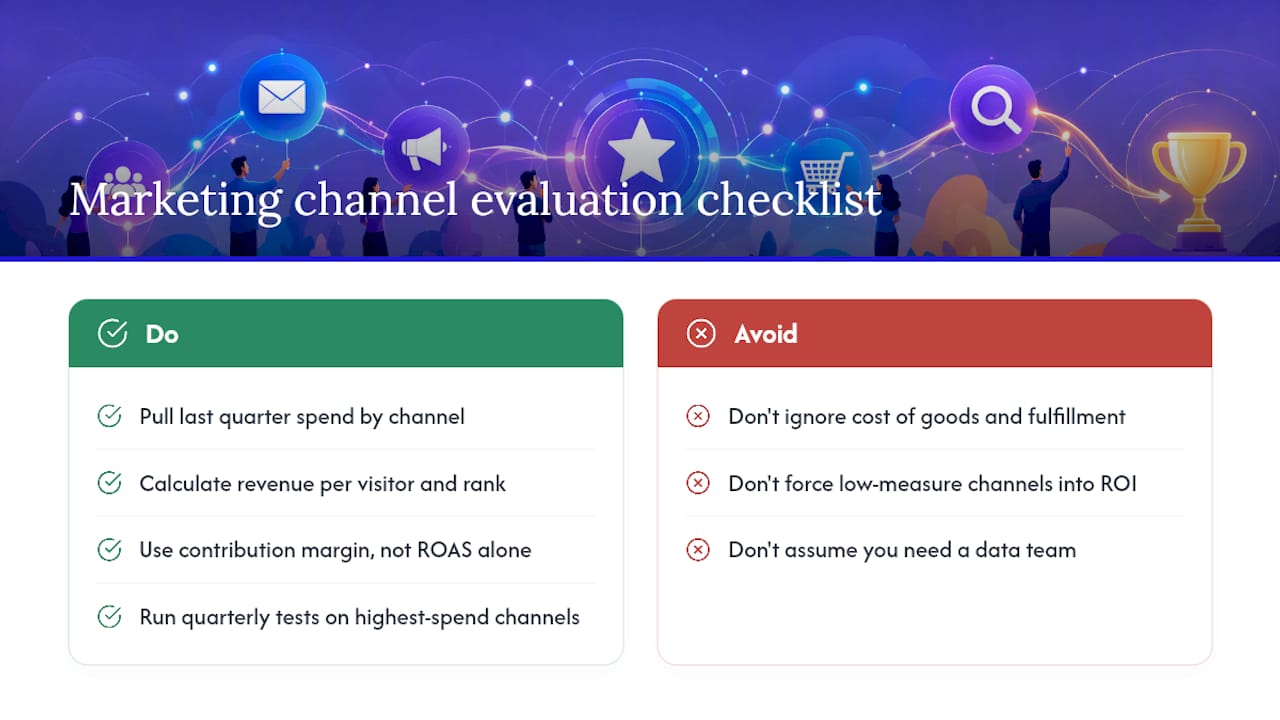
Keep it in the mix and review it qualitatively rather than forcing it into a hard ROI number it can't produce. Sponsorships and PR often fall into this category.
Sources
- Analyze and Optimize Marketing Channel Performance | Coursera
- Marketing Channel ROI: How to Calculate It — Fairview
- Measure Marketing ROI by Channel (2026) | Attrifast