
Media mix modeling (MMM) is a top-down, regression-based statistical method that estimates the incremental revenue contribution of each marketing channel using aggregate historical data. Unlike click-based attribution, it never requires user-level tracking, making it privacy-safe by design and fully functional in a post-cookie environment. MMM measures both online and offline channels simultaneously, quantifying ROI by channel, detecting saturation points, and modeling adstock decay — the lingering effect of past ad exposure on current sales. The primary KPIs MMM delivers include channel-level ROI, incremental revenue contribution, saturation curves, and diminishing return thresholds. It is a quarterly planning tool, not a real-time dashboard.
Key terms every analyst needs to know:
- Incremental impact: The revenue directly attributable to a specific channel, net of baseline sales
- Adstock: The accumulated, decaying effect of media spend over time after a campaign ends
- Saturation curves: Nonlinear functions showing where additional spend produces progressively smaller returns
- Diminishing returns: The point at which each additional dollar of spend generates less revenue than the last
How media mix modeling works: statistical methods and phases
MMM is built on multivariate regression, with the dependent variable being sales or revenue and the independent variables representing each marketing channels spend, plus external controls. Three estimation approaches dominate in practice.
Linear regression is the baseline. It is fast and interpretable but assumes constant returns, which rarely holds in real media markets. Econometric models extend linear regression with lagged variables, price effects, and competitive activity. Bayesian MMM is the current standard for enterprise teams: it incorporates prior knowledge about channel behavior, produces credible intervals around each coefficient, and handles short time series more reliably than frequentist methods.
Adstock and saturation curves are the two transformations that separate a real MMM from a basic regression. Adstock converts raw spend into a decayed accumulation variable, capturing carryover effects. Saturation curves apply a nonlinear transformation that flattens response as spend increases. Applying both correctly prevents the model from overstating channel impact at high spend levels.
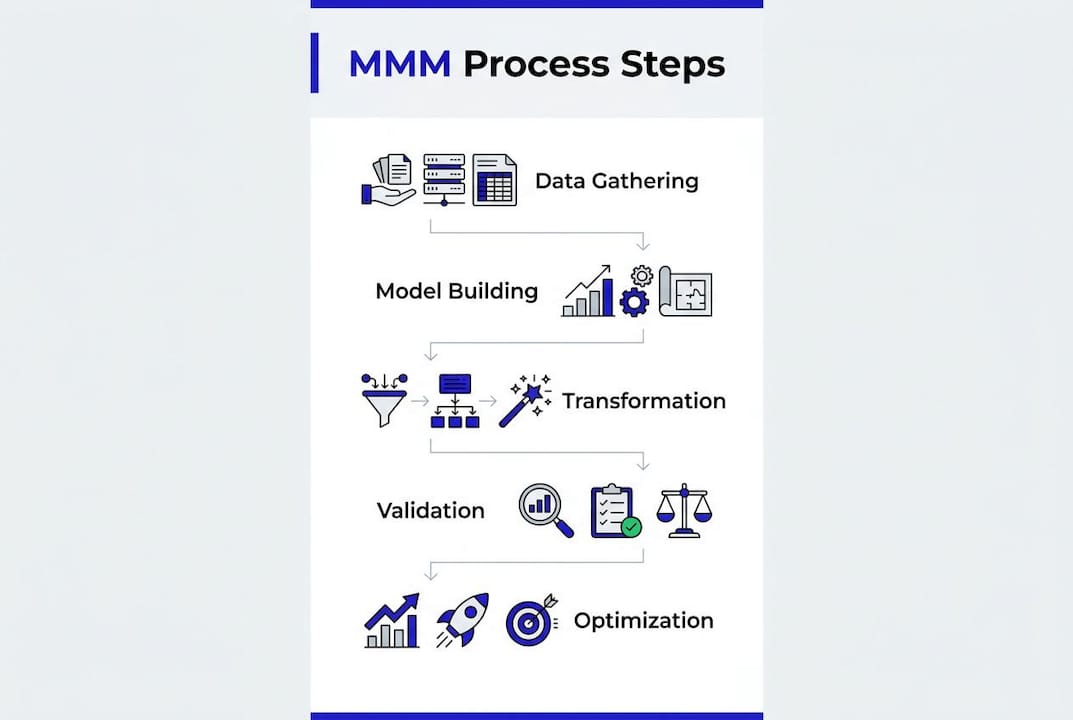
The modeling workflow follows five phases:
- Data preparation: Collect weekly channel spend, CRM outcomes, pricing data, seasonality indices, and macroeconomic indicators. Impute missing values before modeling begins.
- Model specification: Define adstock decay rates, saturation curve shapes, and whether to use an additive or multiplicative structure.
- Parameter estimation: Fit the model using Bayesian inference or maximum likelihood estimation.
- Validation: Run nine standard checkpoints covering statistical fit, business plausibility, and holdout accuracy.
- Scenario analysis: Use fitted response curves to simulate budget reallocations and forecast revenue outcomes.
Pro Tip: Apply the saturation transformation before the adstock transformation when media effects saturate quickly at high weekly spend levels. Reverse the order when carryover effects are the dominant concern. The choice affects coefficient magnitude, so document it explicitly in your model specification.
What makes MMM valuable for budget decisions
MMM's most practical advantage is its ability to include channels that attribution tools cannot see. Television, radio, direct mail, and out-of-home advertising all enter the regression as spend variables, receiving the same statistical treatment as paid search or paid social. That parity corrects a systematic bias in click-based attribution, which tends to over-credit lower-funnel digital touchpoints and under-credit the awareness channels that drove the consumer to search in the first place.

The privacy resilience of MMM is equally significant. Because the method operates on aggregated weekly data, iOS App Tracking Transparency restrictions and third-party cookie deprecation do not degrade its outputs. Organizations running marketing on MTA alone are now systematically over-crediting retargeting and under-crediting brand channels.
Specific use cases where MMM delivers clear value:
- Channel budget allocation: Quantify ROI per channel and shift spend toward higher-return channels before the next planning cycle
- Saturation detection: Identify channels where spend has passed the point of efficient return and reallocate accordingly
- New channel evaluation: Model the expected revenue contribution of adding a channel before committing budget
- Scenario planning: Simulate the revenue impact of a 20% budget cut or a reallocation from linear TV to connected TV
- Finance alignment: Present channel-level ROI in revenue terms that CFOs and finance teams can evaluate directly
Industry thresholds recommend prioritizing MMM when offline channels represent a significant portion of total spend, sales cycles are long, or identity resolution is limited. These conditions commonly apply in automotive dealerships.
What MMM does not measure
MMM operates on weekly or monthly aggregated data, which means it cannot tell you which specific keyword, creative, or campaign drove a conversion. That granularity belongs to multi-touch attribution (MTA). Expecting MMM to answer campaign-level questions is the most common misapplication of the method.
Additional limitations analysts should plan around:
- No real-time optimization: MMM refreshes quarterly, not daily. It cannot inform a bid adjustment running this afternoon.
- Minimum data requirements: Models built on fewer than 18 months of weekly data struggle to separate media effects from seasonality.
- Model misspecification risk: Incorrect adstock decay rates or omitted external factors (competitor launches, economic shocks) can produce misleading channel coefficients.
- No user journey visibility: MMM cannot reconstruct individual conversion paths or identify which audience segments respond to which channels.
- Short-history budgets: Brands with limited spend history or highly variable channel mix give the model insufficient variation to estimate reliable coefficients.
The practical answer is not to abandon MMM but to pair it with MTA for tactical execution and incrementality testing for causal validation.
Implementation requirements and data needs
MMM requires at least 18 months of weekly spend and revenue data, along with external control variables, before the model can reliably separate media effects from seasonal patterns. Two years of weekly data is the preferred minimum for teams running Bayesian models.
The data types the model needs:
- Weekly channel spend broken out by placement or tactic, not just by platform
- CRM outcomes tied to the same weekly cadence (leads, sales, revenue)
- Pricing and promotional calendars
- Seasonality indices relevant to the category
- Macroeconomic indicators such as consumer confidence or fuel prices for automotive
- Competitor activity where observable
Cross-department coordination is not optional. Marketing owns the spend data, Finance owns the revenue definitions, RevOps owns the CRM pipeline, and Data Engineering owns the pipeline that standardizes all of it. Without agreed-upon outcome definitions, the model will produce coefficients that Finance does not trust and Marketing cannot act on.
Pro Tip: Before building the model, reconcile your revenue definition across Marketing, Finance, and CRM. A mismatch between gross revenue in the ad platform and net revenue in the P&L is the single most common reason MMM outputs fail to earn executive buy-in.

Core skills the team needs: econometrics or statistical modeling, data engineering for pipeline construction, and a business analyst who can translate model outputs into budget recommendations. Smaller teams can consolidate these roles; enterprise teams typically separate them.
How MMM results configure and validate other measurement tools
Leaders run a three-layer measurement system: MMM for channel budget allocation, MTA for in-flight campaign optimization, and incrementality testing to validate both. Each layer answers a different question and operates on a different time horizon.
MMM sets the quarterly budget envelope. It answers whether the overall channel mix is efficient and where to move dollars across channels, regions, or programs. MTA then operates inside those envelopes, optimizing creative rotation, audience segments, and keyword bids on a weekly or daily basis. Incrementality testing, through geo-holdouts or conversion-lift studies, provides the causal ground truth that neither MMM nor MTA can produce on its own.
When MMM and MTA disagree, that gap is diagnostic, not a problem to suppress. A channel that MMM values highly but MTA under-credits usually indicates a tracking blind spot: the channel drives awareness that converts through a later digital touchpoint, which MTA credits instead. Conversely, a channel MTA over-credits relative to MMM often reveals a halo effect or a retargeting loop that inflates platform-reported ROAS without driving incremental revenue.
The reconciliation protocol:
- Align time windows first. MMM measures 4–8 week adstock lag; MTA defaults to 7-day windows. Extending MTA to a 30-day view-through window often narrows the gap.
- If the gap persists, run a geo-holdout or conversion-lift study as the tiebreaker.
- Document the known gap rather than forcing the two methods to agree. The disagreement itself is a signal worth preserving.
Real-world examples of MMM in automotive marketing
Automotive dealerships are among the clearest beneficiaries of MMM because the conditions that break attribution are present by default. Sales cycles average 120 days, offline media (TV, radio, direct mail) typically represents a large share of total spend, and identity resolution across that consideration window is poor. Click-based attribution systematically under-values the offline channels that generate initial awareness and over-credits the last digital touchpoint before a dealer visit.
A typical MMM engagement for a dealership group surfaces findings that attribution tools miss entirely:
- Television and radio spend shows positive adstock effects extending three to four weeks past the campaign end date, meaning the revenue contribution appears in weeks when no spend is running
- Paid search ROAS reported by the platform is partially a reflection of TV-driven branded search volume, not purely search-driven demand
- Direct mail response curves show saturation at lower spend levels than the dealership assumed, suggesting budget reallocation to digital channels would improve overall efficiency
Independent marketing analysis consistently shows that dealerships relying solely on vendor-reported attribution are misallocating budget toward channels that receive credit rather than channels that generate demand. MMM corrects that by measuring what actually drove revenue, not what the last click recorded.
Autoroiq applies this methodology directly to dealership marketing audits, identifying where vendor reports conflict with actual revenue contribution and providing defensible channel-level ROI that dealership principals and CFOs can act on. For dealerships evaluating whether their current attribution setup is costing them budget efficiency, the signs of wasted marketing spend are often visible before a full MMM build is required.
Profiles of leading MMM providers in the United States
Two providers stand out for marketing teams evaluating MMM and incrementality measurement services in the U.S. market.
| Provider | Core Specialty | Key Differentiator | Measurement Approach |
|---|---|---|---|
| Tinuiti | Full-funnel performance marketing | Amazon, streaming TV, audio, and display advertising | Cross-channel media strategy with commerce and TV expertise |
| Incrmntal | AI-driven incrementality measurement | Privacy-first, continuous measurement without user-level data | Causal data science across online and offline channels |
Tinuiti operates as a full-funnel media agency with deep expertise across Amazon media, linear TV, connected TV, audio, and display advertising. Their positioning centers on building brands through channel-level performance marketing, making them a fit for teams that need both media execution and measurement within one partner.
Incrmntal takes a different angle entirely. Their platform delivers continuous incrementality measurement using AI and causal data science, without requiring user-level tracking. For teams operating in privacy-constrained environments or with significant offline spend, Incrmntal's approach aligns closely with the conditions where MMM and incrementality testing are most valuable.
Key Takeaways
Media mix modeling delivers defensible, channel-level ROI by using aggregate historical data to separate true incremental revenue from baseline sales, making it the right tool for budget allocation across complex, multi-channel marketing ecosystems.
| Point | Details |
|---|---|
| MMM is a quarterly planning tool | It refreshes quarterly and cannot optimize campaigns running in real time. |
| Minimum data threshold matters | At least 18 months of weekly spend and revenue data is required before model outputs are reliable. |
| Offline channels need MMM | When offline spend exceeds 30% of total budget, click-based attribution systematically under-values those channels. |
| Three-layer measurement wins | MMM sets budget envelopes, MTA optimizes within channels, and incrementality testing validates both. |
| Disagreement between MMM and MTA is diagnostic | Gaps between the two methods reveal tracking blind spots and channel halo effects worth investigating. |
Autoroiq provides independent marketing intelligence for automotive dealerships, delivering vendor-agnostic analysis and executive-level budget recommendations. Learn how independent marketing analysis can clarify where your dealership's marketing dollars are actually working.