
If your primary bottleneck is service-lane texting and payment collection, evaluate Podium first. If you run a multi-location group that needs consolidated listings, NPS surveys, and aggregated reputation analytics, Birdeye is the stronger operational fit. The core difference is platform DNA: Podium is communications-first, built around SMS workflows and native text-to-pay. Birdeye is reputation-first, built around directory sync and enterprise analytics.
Key decision factors before you commit:
- Platform DNA match: Podium's webchat-to-SMS handoff and bundled payments shorten time-to-transaction in service departments. Birdeye's listings infrastructure and survey tooling shorten time-to-visibility for multi-location SEO.
- TCO gap: Public plan references show Birdeye Starter at about $299/month and Podium Essentials at about $399/month (annual contract examples); both vendors add per-location fees and feature add-ons that can significantly increase total cost.
- Contract risk: Both platforms default to 12-month terms, with documented renewal pressure and cancellation friction. Read the exit clause before signing.
- When to audit first: If you are unsure which bottleneck is actually limiting your reputation ROI, an independent vendor audit from Autoroiq is the lower-risk next step before committing to either annual contract.
Table of Contents
- How Podium and Birdeye Compare for Dealership Priorities
- How to Choose the Right Platform for Your Dealership
- Which Dealership Profile Fits Each Platform?
- Autoroiq's Independent Vendor Audit Reduces Your Contract Risk
- Key Takeaways
How Podium and Birdeye Compare for Dealership Priorities
| Dimension | Podium | Birdeye |
|---|---|---|
| Best for | Service-driven, single/small-group dealerships with heavy texting and payment needs | Multi-location groups, franchise portfolios, and agencies needing listings and survey programs |
| Platform DNA | Communications-first: SMS, webchat-to-SMS, payments | Reputation-first: listings, surveys/NPS, multi-location analytics |
| SMS/messaging | Core product; strong webchat-to-SMS handoff | Strong bulk SMS; native text-to-pay |
| Text-to-pay | Bundled in mid tiers | Priced as an add-on |
| Web chat | Webchat-to-SMS handoff native | Available; listings sync and survey tooling |
| Listings management | Limited | Extensive directory sources; deep sync |
| Reputation analytics | Review monitoring and AI responses | Consolidated multi-location dashboards; AI insights |
| Surveys/NPS | Basic | Native NPS and survey programs |
| DMS/CRM integrations | Automotive DMS connections available | Broad integration catalog; enterprise CRM support |
| Ease of use | Faster onboarding for service staff | Steeper learning curve; more configuration required |
| Support/onboarding | Reported slower support response times | Dedicated account management at enterprise tiers |
| Headline pricing | Starting monthly cost (actual spend varies) | Starting monthly cost (actual spend varies) |
| TCO shape | Lower entry; add-ons for advanced AI and analytics | Lower headline; add-ons for payments, advanced directory sync |
| Timeline to ROI | 30–60 days for service-lane texting workflows | 60–120 days for listings and survey programs to show traction |
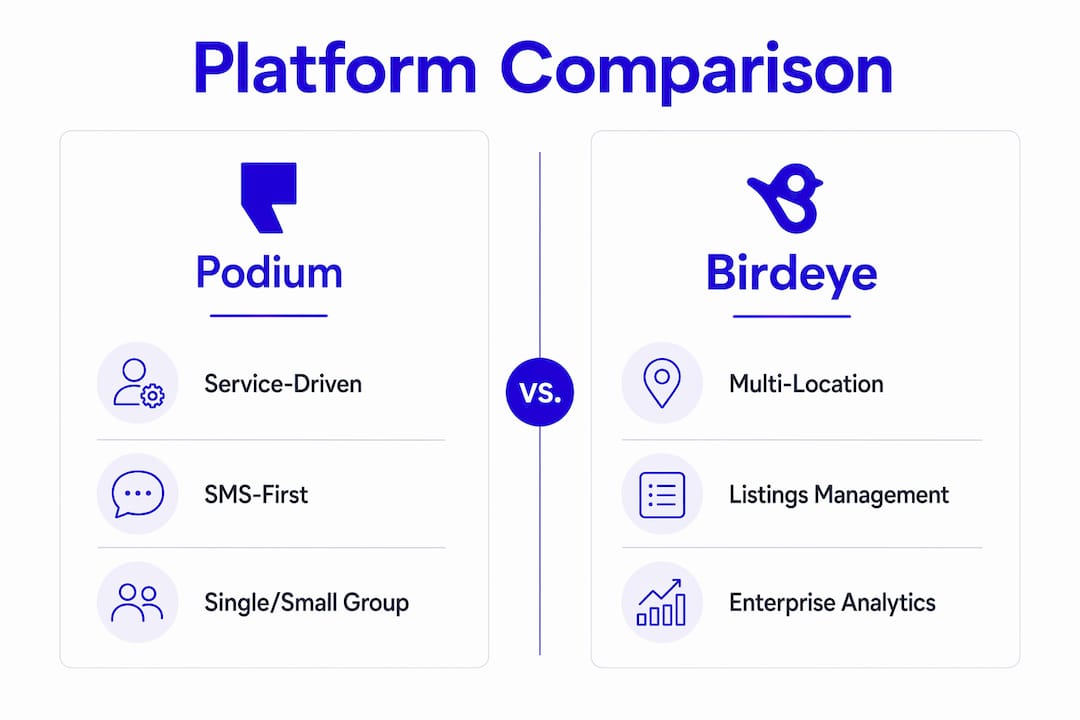
Podium in one sentence: The right fit for a dealership where the service advisor's daily workflow runs on text messages and payment links, and where a 30-day ramp to measurable conversion lift is the goal.
Birdeye in one sentence: The right fit for a regional group or franchise portfolio where consistent directory presence, NPS tracking, and a single reputation dashboard across 10 or more locations are the operational priority.
Important: Both platforms commonly use annual contracts with renewal pressure and documented cancellation friction. Message history and review data portability vary by vendor. Require explicit data-export clauses in any contract before signing.
How to Choose the Right Platform for Your Dealership
Diagnose your primary bottleneck first
Platform DNA alignment with your internal workflow is the most predictive factor for long-term adoption. Before evaluating features, answer one question: where does your reputation ROI break down today? Service-lane conversion and payment friction point to Podium. Inconsistent directory listings, low review volume across locations, or absent NPS data point to Birdeye. Buying on a feature checklist without that diagnosis is how dealerships end up paying for capabilities their staff never uses.
Vendor questions to ask in every demo
- Provide a fully itemized TCO quote for our location count, including per-location fees, onboarding, and every add-on we would realistically need.
- Which DMS and CRM platforms do you integrate with natively, and what is the implementation timeline for our specific stack?
- What is your data export policy? Can we pull full message history and review data at any time, in a portable format?
- What are the exact contract terms, auto-renewal notice window, and cancellation process?
- What SLAs do you commit to for support response and uptime, and will you put them in the contract?
Red flags to watch for
- Add-ons for features that were presented as included during the demo
- Inability to provide an itemized TCO before contract signature
- Multi-year lock-ins presented as the only path to a reasonable per-location rate
- Vague answers on directory coverage scope or DMS integration depth
- No written data-export policy
Dealerships that miss these governance signals often discover the gap only at renewal, when switching costs are highest.
TCO example: 5-location dealership group, 12-month horizon
| Cost Item | Podium (est.) | Birdeye (est.) |
|---|---|---|
| Base subscription | Birdeye Starter: about $299/month; Podium Essentials: about $399/month (annual billing examples). Actual pricing depends on location count and selected features. | |
| Per-location fees (4 add'l) | Varies; confirm in quote | Varies; confirm in quote |
| Onboarding/setup | Often required; confirm | Often required; confirm |
| Payments add-on | Bundled in mid tier | Separate add-on cost |
| Advanced AI/analytics | Add-on | Included at higher tiers |
| Estimated 12-mo range | Confirm with itemized quote | Confirm with itemized quote |
These figures use referenced starting prices of approximately $399/month for Podium Essentials and $299/month for Birdeye Starter (annual contracts). Actual spend depends on location count, tier, and add-ons. Always require a written itemized quote before signing.
Pro Tip: Require a line-item TCO spreadsheet from each vendor before the final demo. Any vendor that refuses to provide one in writing is a red flag on vendor accountability.
Which Dealership Profile Fits Each Platform?
1. Single-location, service-focused dealership
A high-volume service department where advisors text customers for approvals, status updates, and payment links is Podium's home turf. The SMS-first workflow and bundled text-to-pay reduce friction at the point of transaction. Expect a 30–60 day ramp to measurable adoption. Budget for onboarding fees and confirm DMS integration depth upfront. The recommended next step: request a Podium demo with a live service-lane workflow walkthrough, ask for an itemized TCO, and have Autoroiq validate the integration fit before signing.
2. Regional group with 10–75 locations
At this scale, inconsistent Google Business Profile data and fragmented review volume across locations are the most common reputation liabilities. Birdeye's listings sync and multi-location dashboard address both directly. Implementation typically runs 60–120 days to full listings coverage. Hidden costs to budget: per-location fees, NPS survey add-ons, and advanced analytics tiers. Word-of-mouth and review ratings drive measurable buyer decisions at this scale, making consolidated reputation visibility a genuine revenue lever.

3. Enterprise franchise portfolio (100+ locations)
Birdeye's white-label agency features and enterprise analytics make it the practical choice here. The complexity is real: steeper learning curve, more configuration, and a larger internal team required to manage the platform. Expect a 90–180 day implementation timeline and dedicated account management as a contract requirement. The governance caveat applies most forcefully at this scale: without an assigned internal owner, defined SLAs, and weekly review-request audits, software alone will not deliver ROI. An independent pre-contract audit from Autoroiq can verify integration fit and governance readiness before you commit at enterprise pricing.
Autoroiq's Independent Vendor Audit Reduces Your Contract Risk
Vendor selection at the dealership level carries real financial exposure: annual contracts, per-location fees, and add-on inflation can push 12-month spend significantly above the headline price either vendor quotes. Autoroiq's independent marketing intelligence service gives you a vendor-agnostic evaluation before you sign.
An Autoroiq audit covers itemized TCO verification, DMS and CRM integration fit, governance readiness, and a scored vendor-accountability scorecard your team can use in contract negotiations. The deliverable is a clear, executive-level recommendation tied to your specific dealership profile, not a generic feature comparison. Because Autoroiq does not sell advertising or take vendor commissions, the analysis is fully independent.
To request an audit, visit autoroiq.com and submit your dealership profile. First contact typically includes a scoping call to confirm your location count, current vendor stack, and primary bottleneck before any engagement begins.
Key Takeaways
Podium fits service-lane, SMS-first dealerships best; Birdeye fits multi-location groups that need listings management and consolidated reputation analytics, but both carry annual contract risk that requires independent TCO verification before signing.
| Point | Details |
|---|---|
| Platform DNA is decisive | Match the vendor's core workflow strength to your daily bottleneck, not its feature list. |
| TCO exceeds headline price | Both vendors add per-location fees and add-ons; require a written itemized quote before signing. |
| Contract risk is real | Both platforms default to 12-month terms with documented cancellation friction; negotiate data-export clauses. |
| Governance determines ROI | Assigned internal ownership, defined SLAs, and weekly review audits are required for either platform to deliver results. |
| Autoroiq reduces selection risk | An independent vendor audit from Autoroiq verifies TCO, integration fit, and governance readiness before you commit. |