
Which platform wins for automotive dealership marketing analytics?

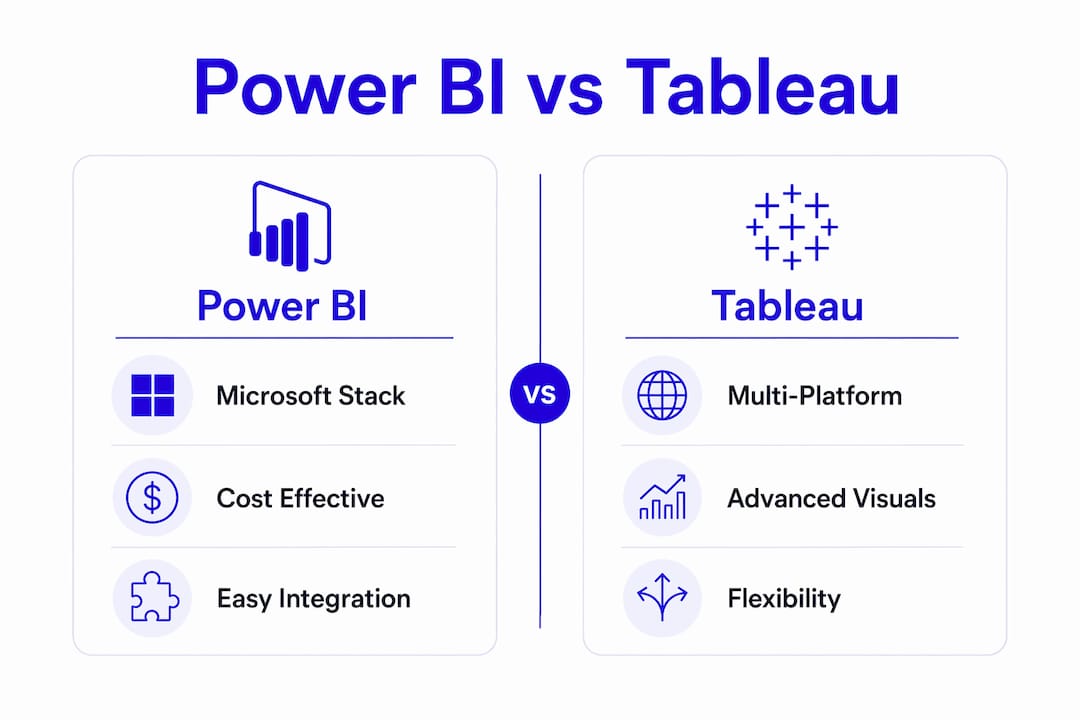
Power BI is the stronger choice for dealerships running Microsoft 365, Azure, or SQL Server; Tableau fits better when your data environment spans Salesforce, Snowflake, or multiple cloud platforms. The technical capabilities between the two are roughly equal in 2026; the real differences come down to integration depth, governance approach, AI maturity, and total cost of ownership.
Here is where each platform stands for dealership marketing intelligence:
- Power BI integrates natively with Microsoft Entra ID, Azure, and Microsoft 365, making it the default for Microsoft-centric dealership groups. Pro licenses for Power BI are competitively priced, and Power BI Desktop is free for local use.
- Tableau connects across Salesforce Data Cloud, Snowflake, Databricks, and mixed cloud environments. Creator licenses for Tableau are priced at a premium, reflecting its enterprise governance depth and visual storytelling capabilities.
- Both platforms require analyst involvement for custom dashboard creation. Neither enables true self-service conversational analytics for business users, which creates operational bottlenecks for marketing teams.
- Governance models differ significantly: Power BI enforces row-level security at the semantic model layer; Tableau applies it per workbook, increasing administrative overhead.
- AI features are evolving fast. Power BI Copilot generates DAX formulas and automated visualizations but requires Premium capacity. Tableau Pulse offers proactive metric monitoring but sits outside the core dashboarding experience.
The right choice depends on your existing technology stack, visualization priorities, governance requirements, and how you account for the full cost of ownership beyond software licensing.
Table of Contents
- How does each platform connect to your dealership's data ecosystem?
- What do AI features and governance mean for your marketing performance analysis?
- What does Power BI vs Tableau actually cost your dealership?
- How Autoroiq's independent intelligence maximizes your BI investment
- Key Takeaways
How does each platform connect to your dealership's data ecosystem?
Your CRM, DMS, advertising platforms, and website analytics tools generate the data that drives marketing decisions. How well a BI platform connects to those sources determines how quickly your team can act on insights.
- Power BI integrates directly with Azure, SQL Server, Microsoft Fabric, and Microsoft 365. For dealerships already using these products, Microsoft-centric organizations gain automated identity management, simplified data pipelines, and consistent metric definitions enforced at the model level.
- Tableau supports a wide connector library including Salesforce Data Cloud, Snowflake, Databricks, and multi-cloud environments. Dealerships with heterogeneous data stacks or Salesforce-aligned CRM workflows often find Tableau's flexibility more practical.
- Microsoft Entra ID integration in Power BI handles user access and security automatically across reports. Tableau requires separate configuration of user/group permissions and SSO, adding setup time and ongoing administrative work.
- Power BI's centralized semantic model enforces consistent metric definitions across all reports. Tableau's workbook-level flexibility gives analysts more control but demands active governance to prevent metric drift across teams.
- For dealerships tracking cost per lead, VDP views, and attribution across multiple vendors, metric consistency is not optional. A platform that enforces definitions at the model level reduces the risk of conflicting numbers appearing in different reports.
Pro Tip: Before selecting a platform, audit which data sources your marketing team actually uses daily. If 80% of your data lives in Microsoft products, Power BI's native connectors will save significant integration time and cost.
What do AI features and governance mean for your marketing performance analysis?
AI capabilities in BI tools are advancing quickly, but the practical value for dealership marketing teams depends on how well those features integrate with your existing workflow and governance structure.
- Power BI Copilot, embedded in Microsoft Fabric, generates DAX formulas from natural language, creates visualizations automatically, and supports semantic model editing. It is ahead of Tableau's AI as of mid-2026 for individual analyst productivity, but requires Premium capacity licenses to access.
- Tableau Pulse and Tableau's AI agents provide proactive metric monitoring and anomaly detection. These features require a Tableau+ subscription and are not part of the core dashboarding experience, making them an additional cost consideration.
- Neither platform delivers true conversational analytics for non-technical users. Both tools rely on analyst gatekeepers for custom queries, which limits how quickly marketing directors can get answers without submitting requests to an analyst.
- Power BI enforces row-level security at the data model layer through Microsoft Entra ID, applying consistent access controls automatically across every report built on that model.
- Tableau implements row-level security through user filters or Virtual Connections, requiring manual policy setup per workbook. For dealership groups with multiple rooftops and separate data access requirements, this increases governance overhead and the risk of misconfiguration.
- US automotive data regulations and dealership-level data privacy requirements make consistent, auditable access controls a practical necessity, not a preference.
What does Power BI vs Tableau actually cost your dealership?
License fees are the visible part of the cost. Governance overhead, training investment, and analyst time are where the real budget impact accumulates.
- Power BI Pro licensing is often bundled within Microsoft 365 E5, reducing the marginal cost for dealerships already paying for Microsoft productivity tools. Enterprise features requiring Premium capacity or Fabric F-SKU add infrastructure costs that can approach Tableau's pricing at scale.
- Tableau Creator licensing represents a significant per-seat commitment. For a dealership group with ten analysts and thirty report consumers, the per-user model scales linearly with headcount. Power BI's capacity model allows read-only consumers to access reports without individual licenses, which typically produces a lower total cost of ownership for large teams.
- Tableau's governance features, including data catalog and lineage tracking, require separate add-ons beyond the base license. That increases total spend beyond what the Creator license price suggests.
- Training requirements are substantial for both platforms. Power BI's DAX language has a steep learning curve due to the complexity of row context and filter context transitions. Tableau's Level of Detail expressions like FIXED and INCLUDE are more readable and faster to write, but still require dedicated analyst skill.
- Governance complexity adds hidden costs that directly affect marketing decision speed. When analysts spend time managing access policies or reconciling metric definitions, the time between a marketing question and a reliable answer grows. For dealerships evaluating signs of wasted marketing spend, that delay has a direct impact on budget efficiency.
- A complete cost picture includes license fees, infrastructure, governance administration, training, and the analyst time required to maintain consistent, trustworthy marketing data.
How Autoroiq's independent intelligence maximizes your BI investment
Choosing between Power BI and Tableau is one decision. Getting reliable, consistent marketing performance data out of either platform is a separate challenge that most dealerships underestimate.
- Autoroiq provides vendor-agnostic marketing intelligence that resolves the metric inconsistencies and conflicting vendor reports that persist regardless of which BI tool a dealership uses. The platform you select does not eliminate the problem of vendors reporting performance in ways that favor their own numbers.
- Autoroiq's proprietary methodology evaluates total cost of ownership across software licensing, governance overhead, training investment, and analyst time. That analysis gives dealership executives a defensible basis for platform decisions and budget allocation.
- Independent analysis of channel effectiveness, including attribution across paid search, third-party listings, and VDP performance, translates BI tool output into executive-level recommendations that drive actual budget decisions.
- Aligning a BI platform's strengths with your dealership's specific CRM ecosystem and reporting workflows accelerates adoption and reduces the analytic bottlenecks that slow marketing decisions.
- Autoroiq's advisory services complement both Power BI and Tableau implementations by ensuring the data feeding those platforms is clean, consistently defined, and tied to the metrics that actually reflect dealership marketing performance.
Autoroiq works directly with dealership executives and general managers to deliver independent marketing performance reviews and ongoing advisory engagements. If your current reporting leaves questions about where your marketing budget is actually working, independent marketing intelligence from Autoroiq provides the clarity to act with confidence.
Key Takeaways
Power BI fits Microsoft-centric dealerships at lower cost, while Tableau suits complex multi-platform environments with stronger visual analytics and governance flexibility.
| Point | Details |
|---|---|
| Ecosystem drives the decision | Power BI is optimal for Microsoft 365/Azure shops; Tableau fits Salesforce-aligned or multi-cloud data environments. |
| Governance overhead is real | Power BI enforces row-level security at the model layer automatically; Tableau requires manual per-workbook setup. |
| AI features carry extra cost | Power BI Copilot requires Premium capacity; Tableau Pulse requires a Tableau+ subscription beyond the base license. |
| License cost gap is significant | — |
| Independent analysis fills the gap | Neither platform eliminates vendor reporting conflicts; Autoroiq's methodology provides the objective layer dealerships need. |