
What is a single source of truth in dealership data management?
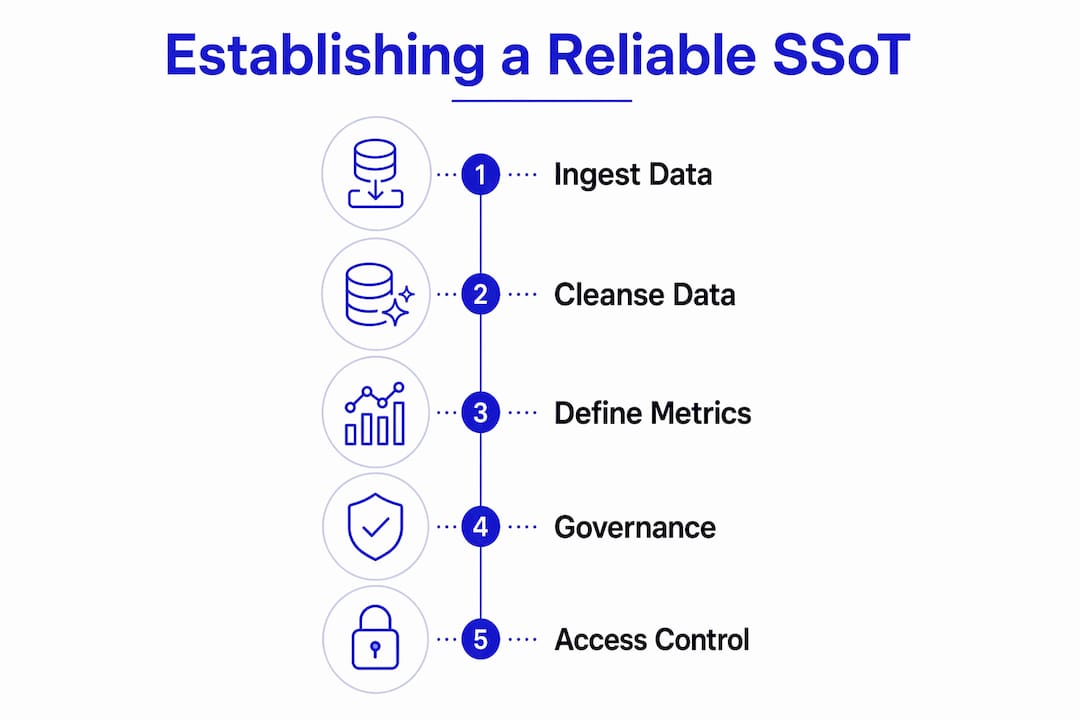
A single source of truth (SSoT) is not a software product you purchase. It is a data architecture state where every piece of organizational data is unified into one authoritative reference point, eliminating the conflicting versions that plague dealership reporting. Every department, from finance to marketing to sales, reads from the same governed layer rather than maintaining its own copy of the numbers.
The distinction matters because most dealerships already own tools that could theoretically centralize data. What they lack is the architectural discipline to make those tools function as a true unified data platform. An SSoT requires four conditions to hold simultaneously:
-
Centralization: one canonical location per data entity, not one per department
-
Consistency: updates happen only at the source; downstream systems read, never write independently
-
Accessibility: any authorized team can query the data without requesting manual extracts
-
Zero redundancy: no silent forks, no conflicting copies living in separate spreadsheets
Autoroiq’s perspective aligns with enterprise architecture standards on this point: SSoT is an ongoing operational discipline, not a one-time IT project. The architecture must be designed to accommodate change, not just to capture a static snapshot of today’s data.
Why data accuracy, consistency, and timeliness all have to work together
Data accuracy measures how closely information reflects the real-world condition it represents. For a dealership, that means your lead counts, cost per sale figures, and VDP view metrics must match actual events, not artifacts of how a vendor filtered its report.
Consistency is the dimension that most dealerships underestimate. Two departments can each have “accurate” data and still produce irreconcilable reports if they define the same metric differently. When marketing counts a form submission as a lead and sales counts only a confirmed phone contact, neither number is wrong in isolation. The problem is the absence of a standardized definition enforced across both systems.

Timeliness adds a third layer of complexity. Data depreciates from the moment it is captured, meaning a report that was accurate last Tuesday may misrepresent current conditions by Friday. For marketing decisions tied to inventory levels, pricing, or campaign pacing, stale data produces the same bad outcomes as inaccurate data. Continuous automated validation, not periodic manual audits, is the only practical answer at dealership scale.
Systematic data quality testing uses techniques including data profiling, sampling, and business-rule algorithms to catch anomalies before they reach a dashboard. Building these checks into the data pipeline, rather than applying them after the fact, keeps the truth source reliable without adding manual overhead.
Common dealership data challenges that an SSoT resolves
The root cause of most dealership data problems is coordination failure, not technology failure. Finance runs revenue from the DMS. Marketing pulls performance from vendor portals. Sales tracks activity in the CRM. When those three systems use different date ranges, different attribution windows, or different definitions of “sold unit,” the numbers will never reconcile in a board meeting.
Semantic layer failures are the specific mechanism behind most of these conflicts. A metric like “ROI” or “cost per lead” can be calculated five different ways across five vendor systems, each technically defensible, none of them comparable. Without a governed semantic layer that enforces one definition per metric, centralized data storage alone does not solve the problem.
The practical consequences show up in wasted time and misdirected budget:
-
Reconciliation delays when conflicting numbers surface in leadership meetings
-
Marketing spend decisions based on vendor-reported metrics that overstate performance
-
Sales and marketing misalignment on lead quality because neither team shares a definition of “qualified”
-
Inability to produce auditable reports for manufacturer co-op compliance or internal review
A governed single data source resolves these issues by making the semantic layer explicit. Every metric has one definition, stored in one place, applied consistently to every report regardless of which team is reading it.
How to establish and maintain a reliable SSoT at your dealership
Centralized data management works best when it is built on a multi-layer architecture: a raw ingestion layer, a cleansing and conformance layer, and a governed semantic layer that business users actually query. Each layer has a specific job, and keeping them separate prevents the kind of ad hoc transformations that introduce inconsistency.
Standardized metric definitions belong in the semantic layer, not in individual reports. When “gross profit per unit” is defined once and referenced everywhere, you eliminate the version drift that forces analysts to spend hours reconciling outputs before a meeting.
Continuous governance is what separates a functioning SSoT from a data warehouse that gradually becomes unreliable. Executives who treat SSoT as a completed project rather than an ongoing discipline find that data quality erodes within months as systems change and new vendors are added.
Pro Tip: Apply a specification-first approach, as described by Red Hat, where all data definitions and integration contracts are version-controlled in a central repository. When a definition changes, automated notifications propagate the update to every connected system, keeping documentation and live data in sync without manual intervention.
Access control and compliance belong in the architecture from day one. Role-based permissions, audit logging, and data lineage tracking are not optional additions; they are the governance foundation that makes the SSoT auditable and defensible under manufacturer audits or regulatory review.
How Autoroiq helps dealerships build a trusted marketing data foundation
Autoroiq’s independent marketing intelligence methodology addresses the exact coordination failures described above. Because Autoroiq does not sell advertising and has no financial relationship with any vendor, its analysis of vendor performance and channel attribution is free from the conflicts of interest that distort most dealership reporting.
The practical value shows up in several specific ways:
-
Vendor accountability scorecards that evaluate each marketing partner against a consistent set of metrics, using definitions the dealership controls rather than definitions the vendor sets
-
Cross-source data synchronization across finance, sales, and marketing to produce a unified view of cost per lead, cost per sale, and gross profit contribution by channel
-
Executive-level recommendations that translate data findings into budget decisions, not just dashboards
-
Ongoing advisory that treats the marketing data foundation as a continuous discipline, not a one-time audit
For dealership executives who have sat through meetings where marketing and finance cite different revenue figures, Autoroiq’s approach provides the governed layer that makes those conflicts stop. The methodology is designed to work alongside existing DMS and CRM systems rather than replacing them, which means implementation does not require a full technology overhaul.
Key takeaways on single source of truth for automotive dealerships
A reliable SSoT is the foundation that makes every other dealership data initiative, from attribution modeling to co-op compliance, actually work.
| Point | Details |
|---|---|
| SSoT is an architecture, not a product | It is a governed data state requiring ongoing discipline, not a one-time software purchase. |
| Three quality dimensions must align | Accuracy, consistency, and timeliness each fail independently and must be maintained together. |
| Coordination failures drive most data problems | Conflicting metric definitions across departments cause more reporting errors than technology gaps. |
| Governance must be built in from the start | Access control, audit logging, and standardized definitions belong in the architecture, not added later. |
| Autoroiq provides vendor-agnostic oversight | Independent analysis resolves vendor reporting conflicts and connects marketing spend to actual sales outcomes. |
How to integrate CRM, DMS, and inventory data into one governed layer
Integrating disparate dealership systems requires a clear data flow architecture before any connector is configured. The DMS is typically the authoritative source for transactional data: sold units, gross profit, and finance and insurance figures. The CRM owns the customer interaction record. Inventory management systems hold real-time vehicle availability. Each system should feed a central data warehouse or governed data lake, never write directly to another operational system.
Change Data Capture (CDC) mechanisms are the most reliable method for keeping these feeds current. CDC detects row-level changes in source systems and propagates them to the central layer in near real time, which is critical for inventory and pricing data that changes throughout the day. Master Data Management (MDM) tools then reconcile customer records across the DMS and CRM, resolving duplicate entries and maintaining a single customer profile that both systems reference.
The semantic layer sits above the integrated data and enforces consistent metric definitions before any report is generated. Without it, even a technically successful integration still produces conflicting outputs because each team applies its own filters and calculations downstream.
How to measure the ROI of an SSoT investment at your dealership
The business case for a unified data platform is most clearly measured by tracking three categories of improvement: time recovered, budget redirected, and decision quality.
Time recovered is the most immediate and quantifiable gain. When reconciliation work disappears because every team reads from the same source, the hours previously spent tracing discrepancies back to a misapplied filter become available for analysis and planning. Tracking the reduction in pre-meeting data preparation time highlights the efficiency gained as the architecture takes effect.
Budget impact shows up in marketing spend accuracy. When vendor-reported metrics are replaced by independently governed attribution data, dealerships routinely find that spend is concentrated in channels that look strong in vendor dashboards but underperform against actual sold units. Redirecting that budget based on reliable data produces measurable gross profit improvement per marketing dollar.
Decision quality is harder to quantify but visible in outcomes: fewer pricing errors tied to stale inventory data, faster response to market shifts because the data is current, and cleaner manufacturer co-op submissions because the reporting is auditable and consistent.
Real-world patterns in successful dealership SSoT implementations
Dealerships that have successfully established a reliable truth source share a consistent pattern: they started with the semantic layer, not the technology stack. Before selecting a data warehouse or integration tool, they documented exactly what each metric meant, who owned it, and which system was authoritative for it. That definitional work, often done in a simple version-controlled document, became the specification that every subsequent technical decision referenced.
The second consistent pattern is phased integration. Rather than attempting to connect every system simultaneously, successful implementations start with the highest-conflict data relationship, typically the gap between DMS gross profit figures and marketing-reported cost per sale. Resolving that one conflict, with a governed definition and a single authoritative feed, builds organizational confidence and demonstrates measurable value before the project expands.
The third pattern is executive sponsorship with teeth. Data governance policies only hold when leadership enforces them. Dealerships where the general manager or CFO actively requires all reporting to reference the governed layer see sustained data quality. Those where governance is delegated entirely to IT find that departments gradually revert to their own spreadsheets within a year.