
A dealership marketing audit is a structured, vendor-agnostic review that identifies exactly where paid media, creative, CRM, inventory feeds, and lead routing fail to convert demand into vehicle sales. The immediate outputs are a prioritized list of issues, a quick-win action list, an ROI estimate by channel, and a 90-day implementation roadmap.
The six core components every audit must cover:
- Paid media performance (Google Ads, Meta, third-party marketplaces)
- SEO and Google Business Profile accuracy and activity
- Inventory feed and DMS health (feed errors, stale pricing, missing photos)
- Website conversion (VDP engagement, form friction, chat routing)
- CRM and lead routing (speed-to-contact, assignment logic, follow-up sequences)
- Analytics and attribution (GA4 configuration, call tracking, cross-channel measurement)
A quick 48–72 hour scan is enough to surface the top three waste signals. If your vendors control the measurement, or if you have not reviewed attribution in over six months, an independent audit from Autoroiq will uncover what internal reviews routinely miss.
Key Takeaways
A dealership marketing audit delivers the most value when it measures the full system from media spend to closed sale, not just individual channel metrics.
| Point | Details |
|---|---|
| Start with a rapid scan | A 48–72 hour scan surfaces the top issues and quick wins before committing to a full audit. |
| Secure all account access first | Pull ad platforms, CRM, DMS, GA4, and call tracking data covering at least 90 days before auditing. |
| Prioritize high-impact, low-effort fixes | Correct GBP data, fix CRM routing under 15 minutes, and align inventory feeds to paid campaigns first. |
| Include reputation and compliance | FTC scrutiny and negative review patterns are connected; both belong in every dealership advertising review. |
| Choose Autoroiq for structural issues | When vendor reports conflict or attribution is broken, Autoroiq's vendor-agnostic audit identifies the real cost-per-lead picture. |
Table of Contents
- What does a dealership marketing audit actually cover?
- A 14-point inspection checklist you can run right now
- What data and account access do you need before you start?
- How long does an audit take, and what will you get?
- How do you prioritize audit findings for maximum sales impact?
- How does customer feedback fit into a dealership marketing audit?
- What audits consistently reveal that vendor reports miss
- Autoroiq delivers the independent audit your vendors cannot
- Sources
What does a dealership marketing audit actually cover?
A thorough automotive marketing analysis spans eight distinct domains. Each one maps directly to a measurable outcome, and each one is where vendor accountability most often breaks down.
Paid media performance. The core diagnostic questions: Are campaigns segmented by new, used, and service? Are bids aligned to actual inventory on the lot? Are you paying for branded search clicks that would have arrived organically? A digital marketing gap analysis built specifically for dealerships consistently identifies paid search inefficiencies and templated creative as the top conversion leaks.
Inventory feed and DMS health. Stale pricing, missing trim photos, and feed sync delays directly suppress VDP views and inflate cost per lead. The audit checks feed accuracy, photo completeness, and the lag between a vehicle arriving on the lot and appearing in paid campaigns.
SEO and Google Business Profile. Is GBP verified, posting regularly, and showing accurate hours and phone numbers? Are VDP pages indexed and ranking for model-level searches? Neglected local listings are among the most common and fastest-to-fix failures in a dealership advertising review.
Creative and messaging. Are ads spec-driven when the audience responds to emotional fit? Mintel's research on auto marketing to Gen Z and Millennials shows younger buyers increasingly discover vehicles through social and creator-led channels, where cultural relevance outperforms feature lists. An audit checks whether creative strategy reflects that shift.
CRM and lead routing. Are leads assigned within 15 minutes? Are duplicate leads creating double-billing? Is follow-up sequenced or ad hoc? CRM failures are often invisible in vendor reports because vendors measure impressions and clicks, not what happens after the form submit.
Web analytics and attribution. Is GA4 configured to track VDP views, form submissions, and phone calls as conversions? Are call-tracking numbers consistent across all listings? Broken attribution means you cannot trust any channel-level ROI figure.
Reputation and reviews. Dealership groups that received FTC warning letters over advertising practices also showed elevated negative review counts and complaint patterns, as Automotive News reported. Review profile health is both a trust signal and a compliance indicator.
Lead response time and ad compliance. FTC scrutiny of dealership advertising makes it necessary to include an ad-compliance check in every marketing strategy evaluation, not just a performance review.
A 14-point inspection checklist you can run right now
-
Google Ads account structure. Check campaign segmentation by new, used, and service. Quick win: Separate branded and non-branded campaigns to stop overpaying for your own name.
-
Meta campaign alignment. Verify that Facebook Automotive Inventory Ads are pulling from a live, accurate inventory feed. Signal: Ads showing sold or unavailable vehicles.
-
Google Business Profile accuracy. Confirm hours, phone number, address, and photos are current. Quick win: Add a weekly post and respond to the last 10 reviews.
-
Local SEO and citations. Check for duplicate or inconsistent NAP (name, address, phone) across Yelp, Bing Places, and Apple Maps. Signal: Multiple listings with different phone numbers.
-
VDP page SEO. Confirm model-level pages are indexed and include structured data. Quick win: Add schema markup for vehicle listings if missing.
-
Inventory feed health. Pull a feed export and check for missing photos, stale pricing, and sync lag. Signal: Vehicles on the lot for more than 48 hours with no digital presence.
-
Website conversion paths. Test every lead form, chat widget, and phone click-to-call on mobile. Quick win: Remove any form field that is not required for follow-up.
-
GA4 configuration. Verify that VDP views, form completions, and phone calls are tracked as conversion events. Signal: GA4 showing zero conversions or mismatched totals vs. CRM.
-
Call tracking consistency. Confirm that tracking numbers match across GBP, the website, and third-party listings. Signal: Different numbers on GBP vs. the website homepage.
-
CRM lead routing. Audit assignment rules and time-to-first-contact logs. Quick win: Set a hard routing rule so every internet lead gets a response within 15 minutes.
-
Follow-up sequence audit. Review the first five touchpoints after a lead submits. Signal: Sequences that go silent after 72 hours.
-
Review profile health. Check Google, DealerRater, and Cars.com for unanswered negative reviews. Quick win: Respond to every review from the past 90 days within one week.
-
Ad compliance check. Review current ads for pricing claims, APR disclosures, and incentive language against FTC guidance. Signal: Ads with promotional pricing that lack required disclosures.
-
F&I and price transparency. Confirm that advertised prices match what customers see on VDPs and in the F&I office. Signal: High complaint volume around pricing surprises.
Pro Tip: Most internal audits stop at channel metrics — impressions, clicks, cost per click — and never connect those numbers to CRM-confirmed leads or closed sales. The highest-value diagnostic is the lead-to-sale conversion rate by channel, not the click-through rate.
What data and account access do you need before you start?
Gathering the right access before the audit begins prevents the most common delay: repeated back-and-forth requests that stretch a 48-hour scan into two weeks.
Required account access:
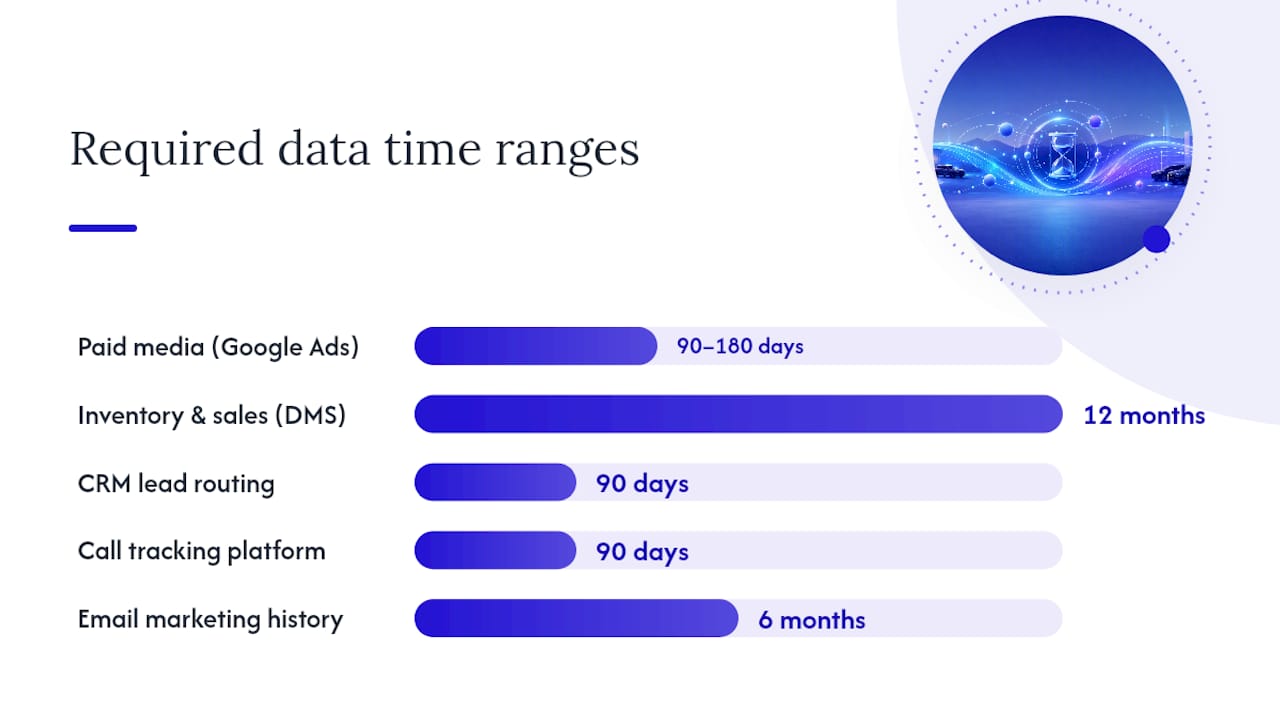
- Google Ads (read-only admin access, 90–180 days of data)
- Meta Business Manager (ad account and pixel access)
- Google Business Profile (manager access)
- GA4 property (read access, 12 months preferred)
- CRM export (lead source, assignment timestamps, first-contact time, close rate by source, 12 months)
- DMS or inventory feed export (current lot, pricing, photo count, feed sync log)
- Call tracking platform (call logs with source attribution, 90 days minimum)
- Email marketing platform (send history, open and click rates, 6 months)
- Recent specials and promotions (OEM and dealer-level, current month and prior quarter)
Recommended analysis tools: Google Ads console reports, Looker Studio for cross-channel visualization, a basic inventory feed validator, and a review-monitoring dashboard such as Widewail or Podium for reputation data.
On date ranges: Use 90–180 days for paid media to capture enough volume for statistical confidence. Pull 12 months for inventory and sales patterns to account for seasonality. For CRM lead routing, 90 days is sufficient to identify systemic assignment failures.
Pro Tip: Request a consent and tracking integrity check as part of the analytics pull. Verify that GA4 tags and any cookie consent tools are firing correctly on all pages, including VDPs and thank-you pages, before drawing any conversion conclusions from the data.
How long does an audit take, and what will you get?
| Audit type | Timeline | Primary deliverable |
|---|---|---|
| Rapid scan | 48–72 hours | Top 3–5 issues, elevator summary, immediate quick wins |
| Focused audit | 1–2 weeks | Prioritized issue list, channel-level ROI estimates, 30-day action plan |
| Full audit | 2–6 weeks | Complete gap analysis, 90-day implementation roadmap, KPI baseline, vendor scorecards |
A rapid scan is the right starting point when you suspect a specific problem, such as a paid media budget that is not producing leads, or a GBP listing that looks wrong. It produces an elevator summary and a short quick-win list you can act on immediately.
A full audit is warranted when structural issues are suspected across multiple channels, when vendor reports conflict with each other, or when a dealership is preparing for a significant budget reallocation. Standard deliverables include a prioritized issues list ranked by impact, a quick-win action list with estimated effort, a 90-day implementation plan with owner assignments, a measurement baseline, and recommended KPI changes by channel.
How do you prioritize audit findings for maximum sales impact?
Not every finding deserves the same urgency. An impact-versus-effort matrix is the most practical tool for sequencing fixes. Plot each finding on two axes: revenue impact (high to low) and implementation effort (low to high). Items in the high-impact, low-effort quadrant are your immediate priorities.
Quick wins that consistently appear in dealership audits:
- Correct GBP hours, phone number, and address (30 minutes, high local search impact)
- Fix duplicate tracking phone numbers across listings (eliminates attribution errors immediately)
- Align inventory feed to paid campaigns so ads only show in-stock vehicles
- Tighten CRM lead routing to under 15 minutes for all internet leads
- Respond to unanswered negative reviews on Google and DealerRater
- Pause or restructure branded search campaigns that cannibalize organic traffic
- Add missing conversion events in GA4 for VDP views and form submissions
Once quick wins are sequenced, convert each prioritized finding into a KPI with a baseline and a target. Tie each KPI to a responsible owner and a review date. That structure turns an audit report into an implementation plan rather than a document that sits in a shared drive.
The connection problem in automotive marketing is structural: siloed vendors, disconnected measurement, and creative teams that never see CRM data. Fixing the system, not just individual channels, is where the largest cost-per-lead gains come from.
How does customer feedback fit into a dealership marketing audit?
Customer satisfaction data is one of the most underused inputs in a dealership performance audit. Review scores, survey responses, and complaint patterns reveal where the marketing promise diverges from the actual buying experience, and that gap is often invisible in ad platform reports.
Start with Google reviews, DealerRater, and Cars.com ratings. Look for recurring themes in negative reviews: pricing surprises, F&I pressure, long wait times, or unresponsive follow-up. Each theme maps to a specific part of the marketing and sales funnel. Pricing complaints often trace back to advertised specials that do not match the in-store experience, which is both a conversion problem and an FTC compliance risk.
CSI scores from OEM surveys add another layer. A dealership with strong paid media metrics but declining CSI scores is likely generating leads it cannot convert at the expected rate, which inflates cost per sale even when cost per lead looks acceptable.
Net Promoter Score data, where available, helps identify which customer segments are most likely to return and refer. Audits that incorporate NPS by lead source can reveal which channels attract buyers who become repeat customers versus one-time transactions. That distinction matters for budget allocation decisions that go beyond the 90-day window.
What audits consistently reveal that vendor reports miss
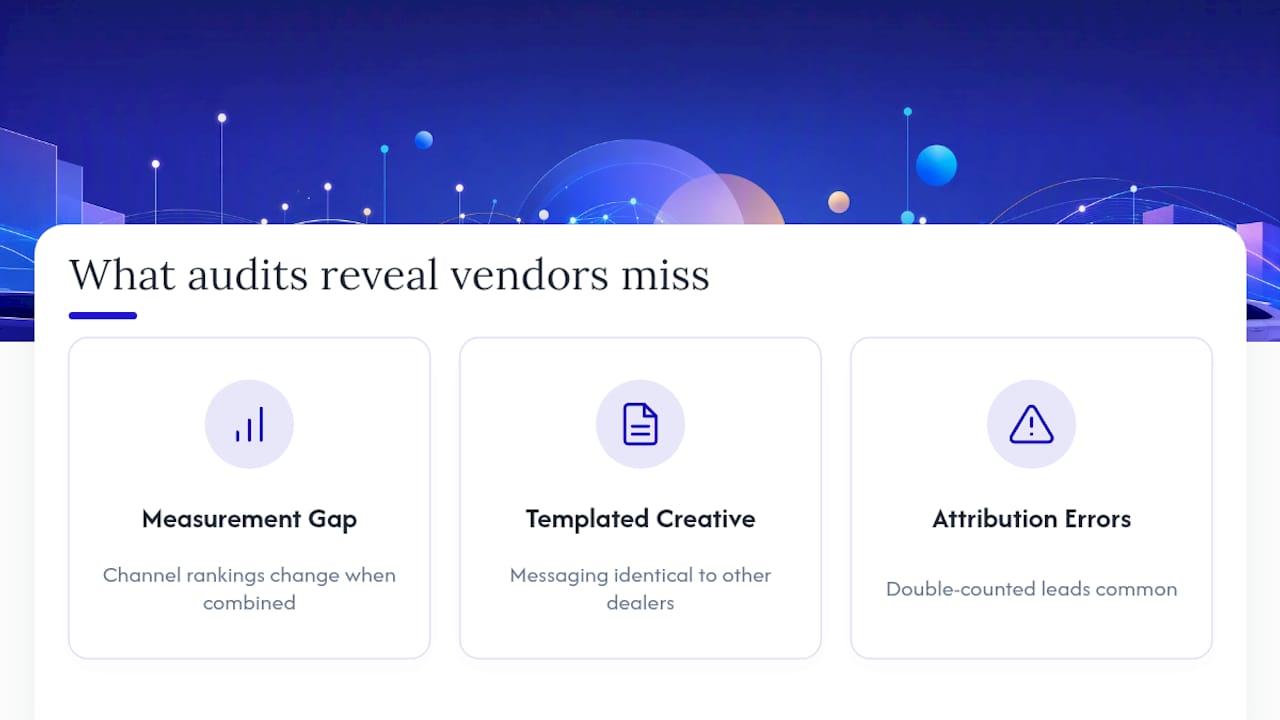
The most consistent finding across dealership marketing reviews is not a single broken channel. It is a measurement architecture that was built by vendors, for vendors. Each vendor optimizes for the metrics it controls, which means the system as a whole is never measured.
Paid search vendors report click volume and cost per click. CRM vendors report lead counts. Neither connects those numbers to closed sales by original lead source. When you pull those data sets together in a single view, the channel rankings almost always change. Channels that look expensive on a cost-per-click basis often produce the highest close rates. Channels that generate high lead volume frequently show the lowest close rates and the highest cost per sale.
The second structural problem is templated creative. Dealerships running OEM co-op campaigns often have little control over ad creative, which means their messaging is identical to every other dealer in the region. An audit that checks creative differentiation against the competitive set, and against the discovery patterns of younger buyers, surfaces channel opportunities that a standard media report will never flag.
Vendor-agnostic audits also uncover billing and attribution discrepancies that vendors have no incentive to flag themselves. Double-counted leads, overlapping retargeting audiences, and misattributed phone calls are common. The automotive marketing insights Autoroiq publishes document these patterns across dealership groups of different sizes and markets.
Autoroiq delivers the independent audit your vendors cannot
Autoroiq's independent marketing intelligence service gives dealership executives the one thing vendor reports cannot: an objective view of the entire system. No ad sales, no agency retainer, no conflict of interest.
The Autoroiq methodology pulls data directly from your ad platforms, CRM, DMS, and analytics, then benchmarks your performance against market standards. Every finding is ranked by revenue impact and paired with a specific fix and an ROI estimate. The deliverable is an executive-ready report your team can act on in the first week.
Dealerships that engage Autoroiq for a full audit receive a prioritized issues list, a quick-win action plan, vendor accountability scorecards, and a 90-day implementation roadmap. If you want to know exactly where your marketing budget is working and where it is not, request an independent audit from Autoroiq to get started.
Sources
- Digital Marketing Gap Analysis for Car Dealerships | C-4 Analytics
- Automotive marketing has a connection problem, and it’s costing brands growth | The Drum
- US Marketing Auto to Gen Z and Millennials: 2026 | Mintel Store
- More negative customer reviews at dealership groups warned by FTC - Automotive News