
Yes, local SEO ROI is measurable, and the formula is simpler than most agencies make it sound: (Revenue attributed to local SEO minus cost of local SEO) divided by cost, times 100. The hard part isn't the math. It's building the tracking that feeds it. You need three things running before you can trust any number this formula spits out.
- Instrument every channel with call tracking and UTMs so you know where a lead came from.
- Attribute each lead to a source by mapping it into your CRM at the moment of creation, not after the fact.
- Model the path from lead to close to dollar value so you can defend the number to anyone who questions it.
Skip any one of these three, and your ROI figure is a guess dressed up as data.
Key Takeaways
Local SEO ROI is measurable and defensible once you instrument every lead source, attribute it through a CRM, and model revenue against total local SEO cost.
| Point | Details |
|---|---|
| Use the core formula | Calculate (revenue attributed minus cost) divided by cost, times 100, for a clear ROI percentage. |
| Track all four KPI tiers | Monitor visibility, engagement, conversion, and reputation metrics, not rankings alone. |
| Build attribution before reporting | Set up tracked numbers, UTMs, and CRM source fields before trusting any ROI figure. |
| Match benchmarks to ticket size | Expect faster ROI on high-ticket services and longer payback on low-ticket volume businesses. |
| Report outcomes, not jargon | Lead executive updates with net attributed revenue and percent ROI, not raw ranking changes. |
Table of Contents
- Which Local SEO Metrics Actually Predict Revenue?
- How Do You Attribute Revenue to Local Search?
- What's a Realistic Local SEO ROI Formula and Benchmark?
- What Tools Do You Need to Track Local SEO Performance?
- How Should You Report Local SEO ROI to Leadership?
- How Does Independent Analysis Make ROI Numbers Defensible?
- What Actually Matters in Local SEO Measurement?
- Sources
Which Local SEO Metrics Actually Predict Revenue?
Local SEO metrics fall into four tiers, and confusing them is the single biggest reason small business owners misjudge their own performance. Search Engine Land groups local SEO KPIs into visibility, engagement, conversion, and reputation and foundation, and each tier answers a different question about your marketing.
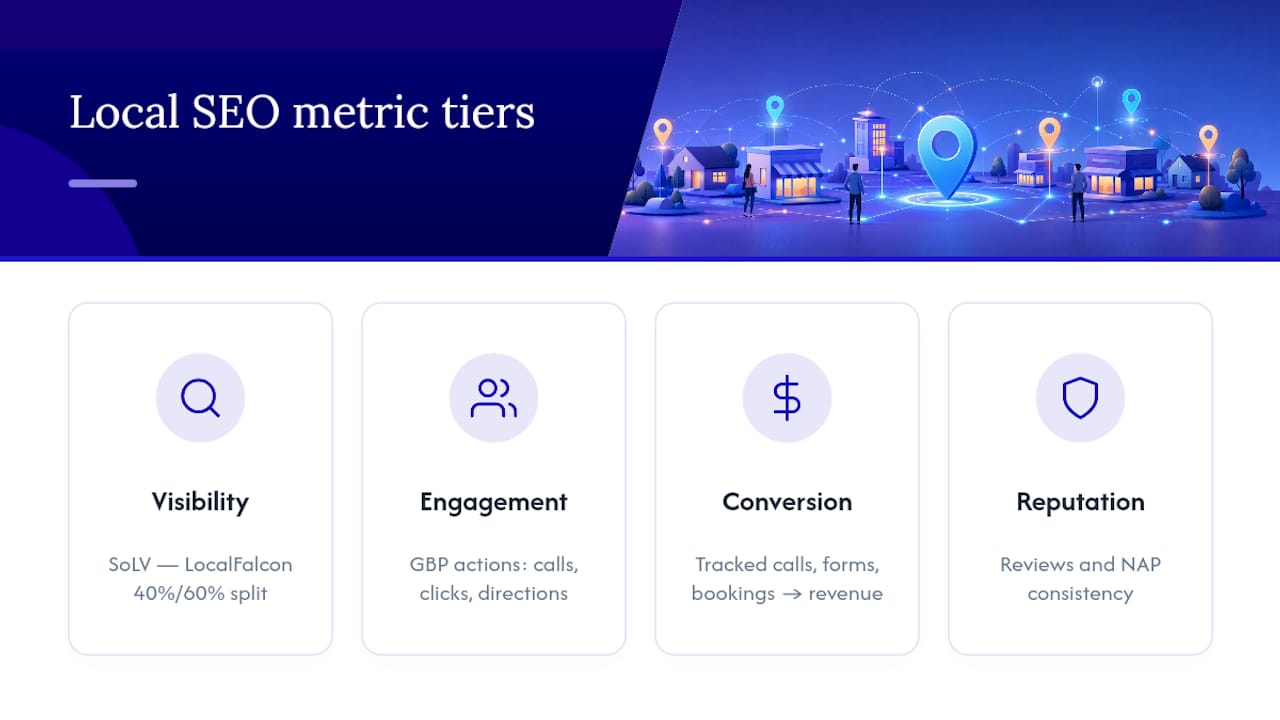
Visibility metrics tell you whether people can find you at all. Share of Local Voice (SoLV) measures the percentage of possible local search appearances you capture across your service area. LocalFalcon considers 40% competitive and 60% dominant. Pair SoLV with 3-Pack presence and Google Business Profile (GBP) profile views for a full visibility picture.
Engagement metrics measure what happens once someone finds you: GBP actions like phone calls, website clicks, and direction requests, plus your click-to-action rate. This tier is where most owners stop looking, and that's a mistake, because visibility and engagement don't pay bills. Conversion does.
Conversion metrics are tracked calls, form submissions, and bookings, measured as a rate against total engaged visitors. This is the number that actually connects to revenue.
Reputation and foundation metrics round out the picture: review volume, review velocity, average rating, and NAP (name, address, phone) consistency across directories. Weak foundations quietly cap everything above them.
Pro Tip: Check visibility metrics weekly, conversion metrics monthly, and reputation metrics on a rolling basis, since review patterns shift slower than rankings do.
How Do You Attribute Revenue to Local Search?
Attribution is where most small business owners lose the thread, mainly because they try to track everything manually instead of building a system that does it automatically.
- Set up tracked phone numbers. Assign a dedicated tracking number to your GBP listing and another to your local landing pages, then route both into a call tracking platform that logs source data on every call.
- Tag every local link with UTMs. Local campaign links, GBP posts, and citation listings should all carry UTM parameters so your analytics platform can isolate local-organic traffic from paid or referral traffic.
- Capture lead source on every form. Add a hidden source field to landing page forms and push that value directly into your CRM at lead creation, not at close, since sales reps often forget to backfill it.
- Handle multi-touch and dark traffic honestly. Use last non-direct click as your fallback attribution model, and run a short manual lead survey ("How did you find us?") to catch the calls and visits your tracking misses.
The full flow looks like this: GBP listing to tracked phone number or UTM link, into analytics, into CRM, into sales opportunity, into closed deal. Break any link in that chain and you lose the ability to trace revenue back to local SEO.
Pro Tip: If you use a dealership call tracking platform, confirm it passes source data into your CRM automatically. Manual re-entry is where attribution accuracy usually falls apart. Reviewing dealership-specific call tracking options before you commit saves rework later.
What's a Realistic Local SEO ROI Formula and Benchmark?
The core calculation is straightforward once your tracking is in place: new leads multiplied by close rate multiplied by average sale value, minus your total local SEO cost. That's 10 closed deals worth $12,000.
For businesses with repeat customers, factor in customer lifetime value (LTV) instead of a single sale, since a lead worth $1,200 today might be worth $4,000 over three years of repeat visits.
Benchmarks vary sharply by ticket size. Good Company AI's analysis of local SEO returns notes that local SEO tends to compound over 12 to 24 months and often outperforms paid channels on long-term return, particularly for higher-ticket services where one closed deal covers months of spend.
| Ticket Size | Leads Needed to Break Even | Typical Time to Positive ROI |
|---|---|---|
| High-value services | Few closed deals | Relatively short time |
| Mid-range services | Moderate number of closed deals | Moderate time |
| Low-value services | Many closed deals | Longer time |
Run sensitivity checks by adjusting close rate and ticket size up and down 10%. If a 10% drop in close rate pushes you from profitable to break-even, you're closer to the edge than your headline ROI number suggests.
What Tools Do You Need to Track Local SEO Performance?
You don't need an expensive stack to capture the signals that matter. You need the right categories covered.
- Free essentials: Google Business Profile, Google Search Console, and GA4 cover visibility and organic traffic at no cost.
- Attribution essentials: a call tracking platform, form tracking on every landing page, and a CRM with a mandatory lead-source field.
- Visibility tools: a geo-grid rank tracker to see rankings across your actual service area, plus a Share of Local Voice measurement to benchmark against competitors.
- Reporting tools: a simple dashboard, even a shared spreadsheet, pulling the metrics above into one view.
Semrush's guide to tracking local SEO performance recommends pairing GBP Insights and rank tracking with call tracking and review analytics, since visibility data alone can't tell you whether a lead converted.
Build versus buy comes down to volume. If you're tracking a single location, free tools plus one paid call tracking subscription usually covers it. Multi-location businesses need a platform that consolidates data across sites, or the reporting burden grows faster than the insight it produces.
How Should You Report Local SEO ROI to Leadership?
Executives don't want a rankings report. They want one number and the context behind it.
- Lead with the executive one-liner: net attributed revenue and percent ROI for the reporting period, stated in the first sentence.
- Show the dashboard essentials: attributed revenue, new leads, close rate, average ticket, SoLV trend, and total spend, all on one screen.
- Add context lines: what changed this period, what actions you took, and what experiment you're running next.
- Set a cadence: weekly ops checks for your own team, a monthly brief for stakeholders, and a quarterly strategic review tied to budget decisions.
Moz's guidance on demonstrating local SEO ROI emphasizes leading with conversions and business outcomes rather than raw ranking movement, and skipping jargon that forces a stakeholder to ask what a metric even means. If your monthly brief needs a glossary, it's failed its job.
How Does Independent Analysis Make ROI Numbers Defensible?
Dealership marketing budgets get pulled in a dozen directions by vendors who each claim credit for the same lead. That's the exact problem AutoROIQ's independent marketing intelligence approach is built to solve. Because AutoROIQ doesn't sell advertising and isn't tied to any single channel or vendor, its scorecards evaluate local SEO alongside every other marketing line item without a stake in which one wins.
When three vendors each claim they generated the same closed deal, the dealership doesn't need another opinion. It needs vendor-agnostic data that traces the lead back to its actual source and settles the argument.
That's the difference between a vendor's self-reported ROI and a number a general manager can defend to ownership.
What Actually Matters in Local SEO Measurement?
Most local SEO advice stops at rankings and traffic, and that's exactly where it becomes useless to a business owner trying to justify spend. Rankings don't pay invoices. Attributed revenue does. The gap between what agencies report and what actually moves through your CRM is where most ROI claims fall apart under scrutiny.
The conventional advice to "track your rankings and traffic" isn't wrong, it's incomplete. A number one ranking with a broken call tracking setup tells you nothing about whether that ranking made you money. Prioritize attribution infrastructure before you prioritize rank position. Get UTMs, call tracking, and CRM source fields working correctly first, even if that means your first month of "ROI reporting" is really just a tracking audit.
The businesses that report ROI with confidence aren't the ones with the best rankings. They're the ones who can trace a dollar back to a click without guessing. Build that trace first, and everything else, including the formula, becomes trivial arithmetic.
Sources
- What is SoLV and how can you use it to optimize local search rankings | LocalFalcon
- Tracking local SEO performance | Semrush blog