
Phone call attribution connects an inbound call to the exact marketing channel, campaign, or keyword that generated it. That match closes the gap between online spend and offline conversion, so a dealership or brand can see which dollars actually produced a phone lead instead of guessing. The mechanics rest on three pieces: dynamic number insertion (DNI) to capture the session, GCLID and CRM integration to confirm outcome, and server-side uploads to feed that outcome back to ad platforms like Google Ads.
TL;DR:
- Campaign-level attribution is simple and cost-effective but only indicates which campaign generated a call, not the specific keyword or ad.
- Session and click-level attribution provide greater granularity, with click-level being the most precise but limited to paid click data with GCLID.
- Robust server-side conversion uploads and outcome tagging are critical, as they improve data accuracy and allow bid adjustments based on call value.
- Pool exhaustion, missing conversion uploads, and inconsistent cross-channel data can significantly distort attribution reliability.
- Call scoring and transcription enhance attribution by providing outcome insights, helping prioritize high-value calls over just call volume.
Table of Contents
- How Phone Call Attribution Works: DNI, Captured Parameters, and Signal Flow
- Attribution Types: Campaign, Session, and Click-Level Precision
- Metrics and Benefits: What Call Attribution Changes About Budget Decisions
- Implementation Checklist: Deploying Call Attribution Step by Step
- Common Pitfalls That Wreck Call Attribution Data
- AutoROIQ's Take: When to Bring in an Independent Advisor
- Comparing Call Tracking Software and Platforms
- How to Read Call Attribution Data for Marketing Decisions
- Where Phone Call Attribution Still Falls Short
- Why Call Scoring and Transcription Sharpen Attribution Accuracy
- An Editorial Take on Where Attribution Efforts Should Actually Focus
- Sources
How Phone Call Attribution Works: DNI, Captured Parameters, and Signal Flow
Dynamic number insertion swaps the phone number displayed on a page based on where the visitor came from. A visitor arriving from a Google Ads campaign sees one number; someone from an organic listing sees another. Each number ties to a session, so when the phone rings, the system already knows the source. Twilio's technical documentation describes DNI as assigning unique numbers at the campaign, channel, or visitor level, which is what makes tracking precision possible from broad channel data down to individual keywords.
A JavaScript snippet on the site does the actual swap. It pulls a number from a pool reserved for that traffic source and writes it into the page before the visitor sees the number. The pool has to be large enough that no two concurrent visitors get the same number, or the system can't tell which session triggered which call.
What gets captured alongside the number matters just as much as the number itself:
- UTM parameters (source, medium, campaign, term) from the landing page URL
- Referrer data showing the last site visited before arrival
- GCLID, the click identifier Google Ads attaches to paid search clicks, when present
- Session duration, pages viewed, and device type
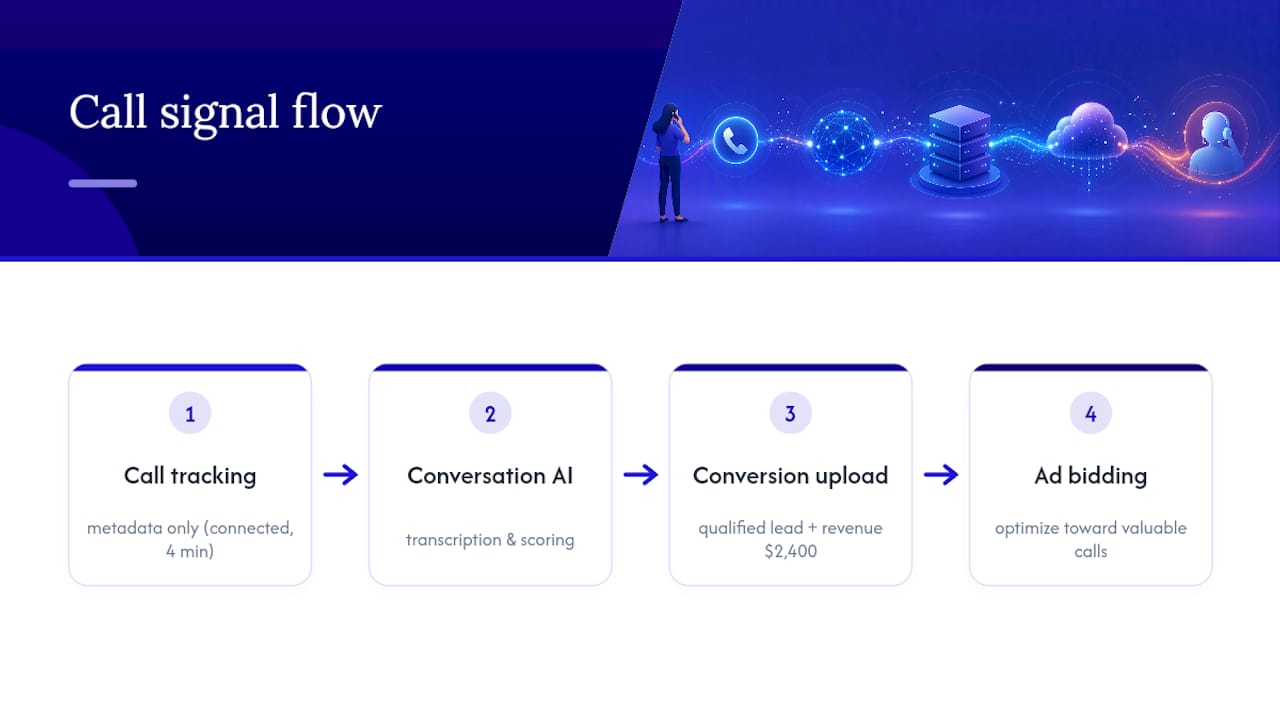
The signal moves from browser to server to system of record. The browser captures the session data, the server matches it to the ringing number and logs the call, and that record then syncs to a CRM and, ideally, back to the ad platform as a conversion event. Server-side capture matters more every year because browser cookies expire faster and mobile browsers increasingly restrict client-side tracking. A call logged and confirmed server-side survives those restrictions in a way a purely cookie-based match does not.
Attribution Types: Campaign, Session, and Click-Level Precision
Not every attribution setup delivers the same resolution. Twilio's glossary outlines three common tiers, and most mature call tracking software supports at least the first two.
- Campaign-level attribution maps a single tracking number to a campaign or landing page. It's the simplest to deploy and the cheapest to run, since it needs only a handful of numbers. The tradeoff is resolution: you know a call came from "Google Ads Search" but not which keyword or ad group drove it.
- Visitor or session-level attribution uses DNI with a larger number pool so each unique visitor session gets its own number. This is where you see the page a caller viewed right before dialing, according to Nimbata's breakdown of call attribution. It requires more numbers, more careful pool management, and more setup time, but the payoff is keyword-level and even ad-level granularity.
- Click-level attribution goes further by capturing the GCLID from a paid search click and tying it directly to the eventual call and conversion. This is the tightest match available, but it only works when the visitor actually clicked a paid ad with a GCLID intact. Organic visits, direct traffic, and some in-app browsers won't carry one.
When none of those deterministic signals survive (a cleared cookie, a lost session, a call placed days after the click), platforms fall back to probabilistic matching, inferring the source from timing and device patterns. It's useful for filling gaps but should never be your primary attribution layer, since it trades certainty for coverage.
Metrics and Benefits: What Call Attribution Changes About Budget Decisions
Attribution data is only valuable if you're tracking the right numbers against it. The core set marketing teams should watch:
- Cost-per-call, broken out by channel and campaign, not just blended across all sources
- Call-to-appointment rate, which flags whether calls are converting into real pipeline
- Revenue-per-call, tying phone leads to actual closed dollars
- Call conversion rate compared against form-fill conversion rate on the same campaigns
- Call quality or outcome (qualified, sale, no-show, spam), which separates a good call from a wasted one
Pro Tip: Don't judge a campaign on call volume alone. A channel producing fewer calls with a higher revenue-per-call is usually the better spend, even when its cost-per-click looks worse on paper.
Once calls carry these labels, they behave like any other conversion event, which means bidding algorithms can optimize toward them. Google Ads and other platforms adjust bids and budget allocation based on the conversion signals they receive, so a campaign generating high-value calls but few form fills can finally get credit and budget instead of getting cut. This shows up most clearly in three places: paid search bid optimization, offline and broadcast campaign measurement, where a call is often the only trackable response, and agent performance review, since call-level data reveals which reps convert leads and which don't. Attribution done well also lets marketers reallocate budget across the full media mix rather than crediting only the channels that happen to leave a digital trail.
Implementation Checklist: Deploying Call Attribution Step by Step
Standing up reliable call tracking follows a fairly predictable sequence, and skipping steps is what causes the messy data most teams end up fighting six months in.
- Pick your attribution tier first. Decide whether campaign-level, session-level, or click-level precision matches your budget and traffic volume, then size your number pool to match. A high-traffic paid search program needs a much larger pool than a single landing page campaign.
- Deploy the DNI snippet and verify capture. Confirm that UTMs and GCLID values are actually persisting through to the call record, not just theoretically supported by the platform.
- Integrate call events with your CRM. Every call needs an outcome label (qualified, sale, no-show, spam) attached at the point of logging, not added later from memory.
- Set up server-side conversion uploads to Google Ads and any other platform you're bidding on, then test the full loop end to end with a real call before trusting the data.
- Monitor pool usage and coverage weekly. Watch how many numbers are active versus available, and build a fallback matching process for the sessions that don't get a clean deterministic match.
Improving closed-loop attribution practice across all these steps is what separates teams that trust their call data from teams that are still arguing about it in budget meetings.
Common Pitfalls That Wreck Call Attribution Data
Most attribution failures trace back to a handful of repeat offenders, and they're worth checking on a recurring schedule, not just at launch.
- Number pool exhaustion. When a pool is too small for traffic volume, numbers get recycled faster than sessions expire, and two different visitors end up sharing credit for one call. Cometly's guide to phone attribution flags this as one of the most common causes of misattributed calls.
- Skipped conversion uploads. If call outcomes never make it back to Google Ads or Meta as conversion events, the ad platform is optimizing blind to your best leads. Run periodic GCLID matching tests to confirm the loop is actually closed.
- Channel-only reporting. Looking at calls in isolation from form fills and purchases hides the real picture. Attribution should live in one unified view, not three separate dashboards nobody cross-checks.
- Consent and privacy gaps. Server-side fallback helps when browser signals disappear, but it doesn't replace clear consent capture. Document what's collected and why, especially for any call recording tied to attribution.
AutoROIQ's Take: When to Bring in an Independent Advisor
Building call attribution internally works fine when the setup is simple: one number pool, one CRM, one ad platform. It gets harder fast once you're reconciling data across multiple vendors, each reporting different numbers for the same campaign.
That's the point where an independent advisor earns its cost. An independent advisor evaluates vendors and channels without selling media, which means the recommendation isn't shaped by which platform pays the bill. When you're choosing between call tracking software and platforms, judge them on data completeness, transparency about how matches are made, integration coverage across your actual CRM and ad stack, and whether the numbers are reproducible when someone checks the math independently.
Comparing Call Tracking Software and Platforms
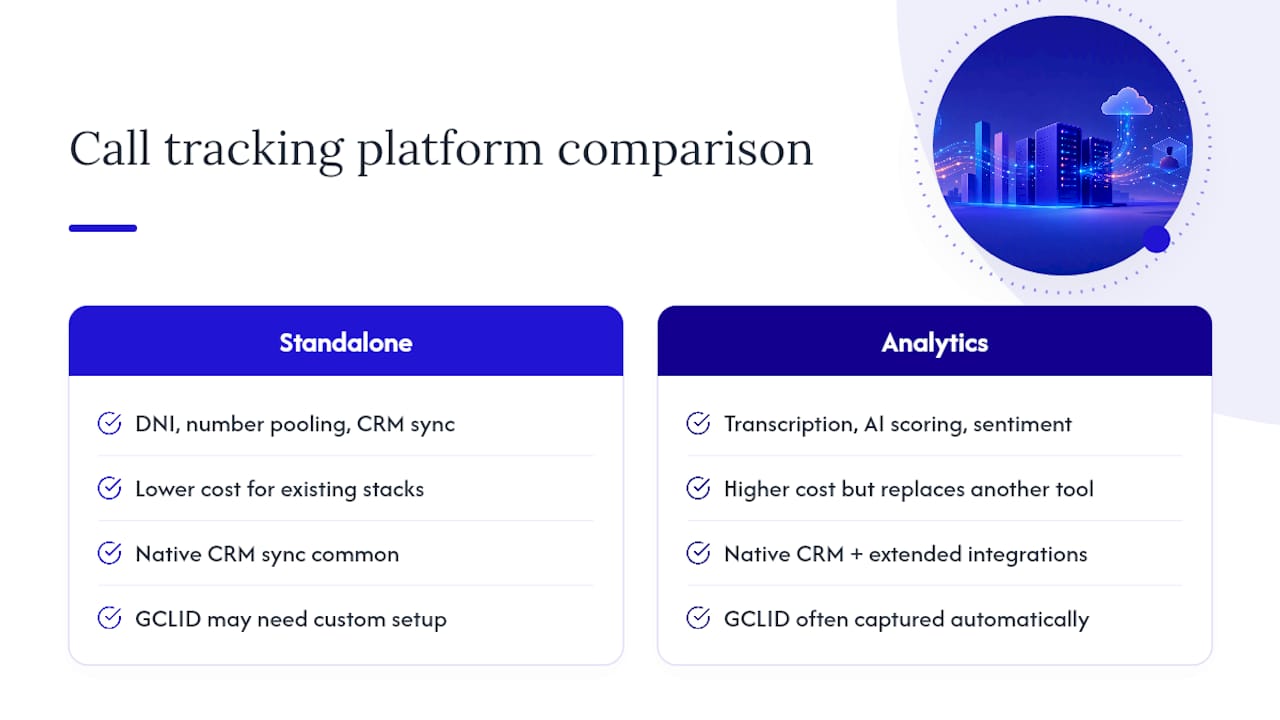
Call tracking platforms generally split into two categories: standalone tracking tools focused on attribution mechanics, and broader analytics platforms that layer conversation intelligence on top. Standalone tools tend to do DNI, number pooling, and CRM sync well, and they're usually priced for teams that already have their reporting stack sorted out. Broader platforms add AI-driven scoring, transcription, and sentiment analysis, which costs more but replaces a second tool you'd otherwise need to buy separately.
The features worth comparing line by line: number pool size and recycling policy (ask directly how long a number sits idle before reuse), native integrations with your specific CRM rather than generic webhook support, whether GCLID capture is automatic or requires custom setup, and how server-side conversion uploads are handled for the ad platforms you actually use. Reporting depth varies a lot too. Some platforms stop at "call received from paid search," while others break it down to ad group and keyword.
Price often correlates with number pool flexibility more than with reporting features. A platform charging a premium for "unlimited numbers" may still cap concurrent session tracking in ways that force campaign-level attribution when you wanted session-level. Read the technical specs on pool sizing before comparing sticker price. For dealership-specific criteria and examples, AutoROIQ's guide to call tracking for automotive dealerships walks through vendor-agnostic evaluation points in more depth.
How to Read Call Attribution Data for Marketing Decisions
Raw call counts tell you almost nothing on their own. The useful analysis starts by segmenting calls the same way you'd segment any other conversion: by campaign, ad group, keyword, and device, then layering in outcome data so you're not treating a five-minute sales call the same as a ten-second hang-up.
Look for divergence between channels that drive volume and channels that drive revenue-per-call. It's common to find that a channel with a mediocre cost-per-click actually produces disproportionately valuable calls once you filter for outcome. That's a signal to shift budget, not cut it. Compare call conversion rate against form conversion rate for the same campaigns too. A campaign that underperforms on form fills but overperforms on calls isn't underperforming at all; it's just attracting a phone-first audience your form-based reporting was blind to.
Trend the data monthly rather than reacting to daily swings, since call volume tends to be noisier day to day than digital conversions. Watch attribution coverage as its own metric: what percentage of total calls get a clean deterministic match versus falling into probabilistic or unattributed buckets. A dropping coverage rate usually means a technical problem (pool exhaustion, a broken snippet) rather than a real shift in traffic behavior, and it should be the first thing you check before trusting any conclusion the data seems to be telling you.
Where Phone Call Attribution Still Falls Short
Call attribution has real limits, and pretending otherwise leads to bad decisions. Click-level precision depends on the GCLID surviving the full path from ad click to call, and it frequently doesn't. Multi-device journeys break the chain too: someone researches on a desktop, then calls from a mobile number hours later, with no cookie or session link connecting the two.
Attribution windows create their own distortion. A call placed three weeks after the last ad click may get credited to whichever touchpoint the system's window allows, even if a dozen other interactions happened in between. Longer windows capture more of the real influence but muddy the specific channel credit; shorter windows are cleaner but undercount slower-moving buyers.
There's also a data quality ceiling tied to human behavior. Callers hang up, get transferred, or call the wrong department, and none of that shows up cleanly as a "conversion" without manual outcome tagging. And because number pools cost money to scale, smaller advertisers often can't afford the visitor-level granularity that would give them the clearest picture, leaving them stuck at campaign-level attribution even when they'd benefit from more precision.
Why Call Scoring and Transcription Sharpen Attribution Accuracy
Attribution tells you where a call came from. It doesn't tell you whether the call was any good, and that gap is exactly what call scoring and transcription close.
Call analytics applies AI to the actual conversation rather than just the metadata around it, surfacing sentiment, intent, and agent performance in ways raw call logs can't. A call tagged simply as "connected, 4 minutes" looks identical whether it ended in a sale or a hang-up. Transcription and scoring separate those outcomes automatically instead of relying on a rep to log it accurately after the fact, which happens inconsistently at best.
This matters for attribution specifically because outcome data is what makes a conversion upload meaningful to an ad platform. Uploading "call received" as a conversion signal is far weaker than uploading "call received, scored as qualified lead, revenue $2,400." Platforms that pair tracking with AI-driven conversation analysis let bidding algorithms optimize toward calls that actually matter, not just calls that happened. The combination of tracking (source) and analytics (outcome) is what turns a call log into a genuine marketing signal.
An Editorial Take on Where Attribution Efforts Should Actually Focus
Most guidance on this topic treats DNI setup as the finish line. It isn't. Teams that nail the snippet but skip disciplined outcome tagging end up with clean-looking dashboards that still can't answer "which channel actually made us money."
The conventional advice also overstates click-level precision as the goal every business should chase.
If you're prioritizing one thing first, make it this: get server-side conversion uploads working end to end before investing in a bigger number pool or fancier scoring model. Precision without a closed feedback loop back to the ad platform is just a more detailed spreadsheet.
— AutoROIQ
Sources
- Call Attribution | Twilio Docs
- What is call analytics? | Outreach AI
- Marketing attribution for phone calls: Track ads now | Cometly
- Call attribution | Nimbata