
Lead source accuracy comes down to four disciplines applied together: preserve first-touch attribution, automate capture, standardize your taxonomy, and audit the data monthly. Skip any one of these and the other three lose most of their value. A locked "Original Source" field means nothing if half your forms lack UTM parameters, and a clean taxonomy collapses the moment a CRM workflow silently overwrites the field it was built to protect.
Start with these six moves this week:
- Lock the "Original Source" field in your CRM so no later integration, import, or manual edit can overwrite it.
- Create a separate "Latest Source" field to track the most recent touch without disturbing first-touch data.
- Persist UTM parameters in a first-party cookie or
sessionStorageand carry them across pages until form submission. - Add hidden fields to every web form that capture landing page, referrer, and campaign ID automatically.
- Turn on call tracking with dynamic number insertion for any paid channel that drives phone leads.
- Publish a campaign-naming dictionary so every team member tags UTMs the same way.
Teams that implement locked first-touch tracking alongside these capture fixes typically see two measurable wins within 30 to 90 days: a visible drop in leads tagged "Direct" or "Unknown," and a pipeline-by-source report that finally lines up with what marketing actually spent. Those two signals are the fastest way to know the fix is working before you wait for a full quarter of data.
Key Takeaways
Locked first-touch attribution combined with automated UTM capture and monthly completeness audits is the single most reliable path to accurate lead source data.
| Point | Details |
|---|---|
| Lock the original source field | Prevent CRM workflows and integrations from overwriting first-touch data after creation. |
| Separate first-touch from last-touch | Track "Original Source" and "Latest Source" as distinct fields serving different reporting needs. |
| Instrument non-browser channels | Add call tracking, chat metadata capture, and event-scan workflows beyond standard web tagging. |
| Audit monthly, deep-dive quarterly | Check source completeness monthly and trace sample records manually every quarter. |
| Backfill with documented uncertainty | Session-matching can recover 20% of unattributed contacts; label confidence and never overwrite locked fields. |
Table of Contents
- What Lead Source Accuracy Actually Means in Practice
- Why Accurate Source Data Drives Forecasting, Budget, and Routing
- Where Lead Source Data Actually Comes From
- Common Failure Modes That Corrupt Source Data
- The Tactical Playbook: A Six-Step Build Order
- Metrics, Targets, and How Often to Audit
- Recovering Historical Attribution Through Backfill
- How AutoROIQ Validates Source Data and Vendor Claims
- Get an Independent Read on Your Dealership's Lead Data
- What Most Attribution Advice Gets Backward
- Frequently Asked Questions
- Sources
What Lead Source Accuracy Actually Means in Practice
Lead source accuracy starts with a distinction most CRMs get wrong by default: first-touch versus last-touch. First-touch, often labeled "Original Source," records the very first channel that brought a contact into your database, whether that's a Google search, a trade show scan, or a referral. Last-touch, sometimes called "Latest Source" or "Most Recent Source," records whatever touchpoint immediately preceded conversion or the most recent CRM update.
Both fields serve a purpose, but they answer different questions. First-touch tells you which channel is generating demand from scratch. Last-touch tells you which channel is closing the loop on leads that already knew about you. Confuse the two, or worse, let one overwrite the other, and your channel attribution becomes fiction.
Channel, campaign, medium, and self-reported source are not interchangeable terms, even though sales teams often use them that way:
- Channel is the broad category: paid search, organic social, referral, direct.
- Campaign is the specific initiative within that channel, like a named Google Ads push or an email drip.
- Medium describes the delivery mechanism, such as CPC, email, or organic.
- Self-reported source is whatever the lead typed into a "How did you hear about us?" field, which frequently diverges from tracked data.
In a typical CRM, this looks like four distinct fields: original_source, original_campaign, latest_source, and self_reported_source. Locking the original source field operationally matters because everything downstream, forecast models, budget justification, SDR routing rules, depends on that first classification staying stable for the life of the contact record.
Why Accurate Source Data Drives Forecasting, Budget, and Routing
Forecast confidence collapses when the underlying source data shifts under your feet. A pipeline report generated in January that gets silently rewritten by a March CRM sync produces two different stories about which channels are working, and executives lose trust in both. That erosion of confidence is often more damaging than the original tracking gap, because it makes leadership question every number RevOps produces afterward.
Bad source data pushes cost-per-lead and cost-per-sale calculations in the wrong direction. Budget gets pulled from a channel that's actually performing and shifted toward one that's coasting on borrowed credit. SDR routing suffers the same distortion: if a lead scoring model weights source as a signal of intent, and the source field is wrong, high-value leads get routed to the wrong queue or the wrong follow-up cadence.
The KPIs that improve fastest once source data is accurate are the ones that combine attribution with revenue outcomes: pipeline generated by source, win rate by source, and margin per sales-accepted lead. That last metric matters more than raw cost-per-lead, because 2026 B2B benchmark data shows wide swings in CPL and conversion rate across channels, and top-quartile teams are the ones evaluating channels on downstream margin rather than upfront cost. A channel with a high CPL but excellent close rate can easily outperform a cheap channel that fills the funnel with unqualified leads. You cannot see that difference if the source field feeding both calculations is unreliable.
Where Lead Source Data Actually Comes From
Every lead source signal traces back to a specific capture point, and each capture point has its own instrumentation requirements. Web forms are the easiest: a UTM-tagged landing page combined with hidden form fields captures channel, campaign, and referrer automatically, assuming the tracking script fires before the visitor navigates away.
Phone calls are harder. Without dynamic number insertion or a call-tracking platform, a call converts with no source data attached at all, landing in the CRM as "Phone Inquiry" with nothing upstream. Chat and live-chat widgets need the same referrer capture logic as forms, but many chat tools default to stripping query parameters, so verify that your chat vendor passes UTM data into the transcript metadata.
Events, trade shows, and list imports depend entirely on manual tagging discipline. A badge scan or spreadsheet upload only carries source data if someone assigns a campaign code before the import runs, and PDFs or gated content downloads need their own tracking pixels or redirect URLs to avoid landing as untracked traffic.
Two gaps show up again and again:
- Dark social and mobile app traffic strip referrer data almost entirely, so a lead who clicked a link inside a text message or a native app frequently lands as "Direct" even though a specific channel drove the click.
- Cross-device sessions break UTM persistence when a visitor researches on mobile and converts on desktop, since most first-party cookies don't span devices.
Capture points that need extra instrumentation beyond a standard tag manager setup include call tracking, in-person event scanning, and any PDF or content-gate download, all of which require a deliberate tracking layer rather than relying on default analytics behavior.
Common Failure Modes That Corrupt Source Data
Most lead source accuracy problems trace back to one of five repeatable failure modes. Diagnosing which one is active in your CRM is the fastest way to know what to fix first.
-
CRM field overwrites. Marketing automation platforms and native CRM workflows often update the "lead source" field on every sync, replacing a valid first-touch value with whatever the most recent integration touched last. This is the single most damaging failure mode because it destroys historical attribution silently, with no error message and no audit trail unless you're specifically logging field-level changes.
-
Missing UTM parameters. Sales reps forwarding email links, PR mentions without tracking codes, and social posts published outside the marketing calendar all generate traffic with no campaign data attached. The diagnostic signal is a spike in "Organic" or "Direct" traffic that doesn't correlate with any actual increase in brand search volume.
-
Session loss. Browser privacy settings, ad blockers, and cross-device journeys break the cookie or
sessionStoragevalue carrying UTM data before the visitor reaches the form. Watch for a sudden jump in "Unknown" or blank source fields immediately after a browser update cycle or a privacy policy change from a major browser vendor. -
Manual data entry errors. Sales reps logging leads from a business card or a voicemail often default to typing "Referral" or "Other" rather than digging for the actual originating campaign. A telltale sign is a source field that's disproportionately full of free-text entries instead of picklist values.
-
Vendor and third-party import errors. Lead vendors, list brokers, and third-party call-tracking platforms sometimes push data into the CRM using their own default source labels, overwriting whatever value already existed. If your "Direct" or "Other" bucket grows every time a specific integration runs its sync, that integration is the likely culprit.
A monthly completeness check, comparing the percentage of leads with a populated, non-generic source field against the prior month, catches most of these before they compound into a quarter of unreliable reporting.
The Tactical Playbook: A Six-Step Build Order
Fixing lead source accuracy is not a single project, it's a sequence, and the order matters because later steps depend on earlier ones holding.
Step 1: Define and publish a lead source taxonomy. Before touching any field configuration, write down every valid channel, campaign type, and medium your organization uses, and circulate it as a living document. Sales, marketing, and any outside agency touching lead data need the same dictionary, or you'll spend the next year reconciling "PPC" against "Paid Search" against "Google Ads" as three separate values meaning the same thing.
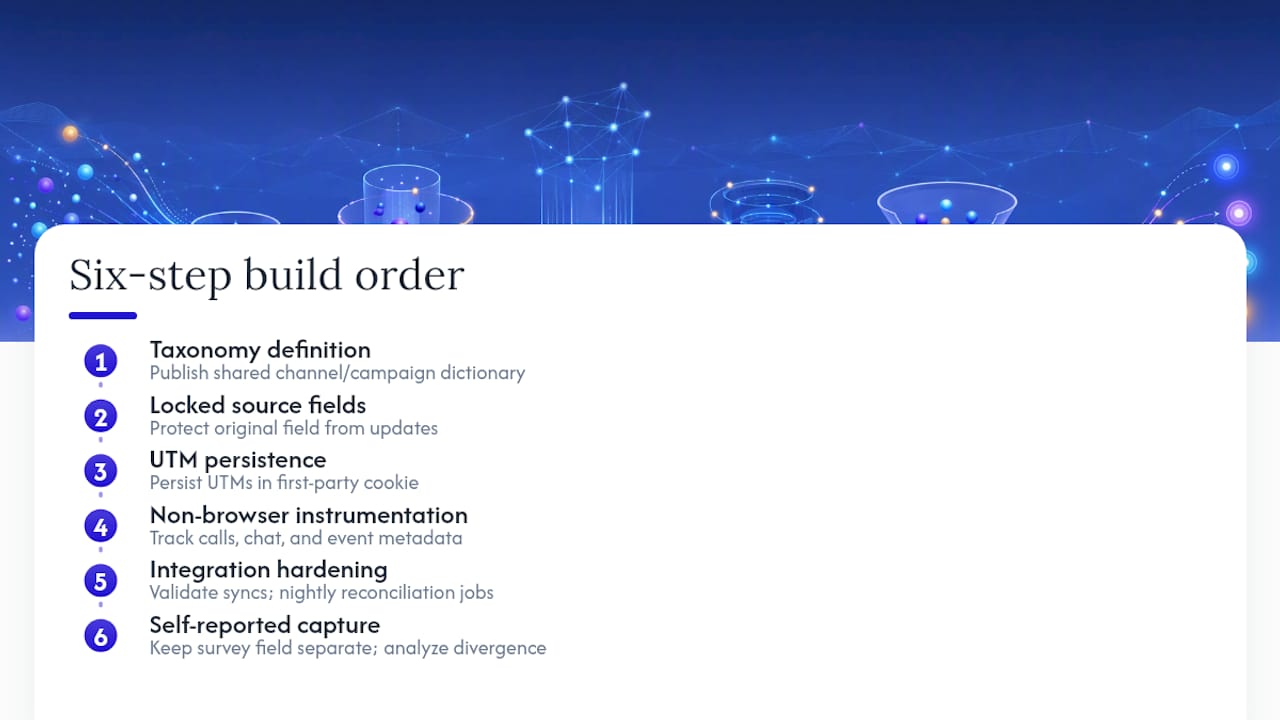
Step 2: Implement locked Original Source and Latest Source fields. Build these as two distinct fields in your CRM, with the original field protected by a workflow rule that blocks any update after initial creation. The locked first-touch approach is the single highest-leverage architectural control available, because it removes the most common failure mode, accidental overwrite, at the schema level rather than relying on process discipline.
Step 3: Persist UTMs and first-touch data client-side. Use a first-party cookie or sessionStorage to hold UTM values across the visitor's session, and add hidden fields to every form that pull from that stored value at submission. This step is what actually feeds Step 2's locked field with accurate data in the first place.
Step 4: Instrument non-browser sources. Call tracking with dynamic number insertion, chat transcript metadata capture, and event-scanning workflows all need their own tracking layer, since none of them inherit browser-based UTM persistence automatically. Dealerships and other phone-heavy sales environments should treat call tracking as a core instrumentation requirement, not an optional add-on, given how much lead volume phone channels generate.

Step 5: Harden integrations and imports. Every middleware connection, list import, and third-party sync should run through a validation layer that checks for existing source values before writing, and a nightly or weekly reconciliation job should flag any record where the source field changed outside an approved workflow.
Step 6: Capture and analyze self-reported source separately. Keep "How did you hear about us?" as its own discrete field rather than merging it into tracked source data. When the two diverge, that divergence is itself useful information, often pointing to dark-social or offline influence your tracking stack can't see directly.
Pro Tip: Run Step 2 and Step 5 in the same sprint. A locked field with no integration guardrails just moves the overwrite problem from the field level to the sync level, and you'll be back here in six months debugging the same symptom with a different root cause.
Metrics, Targets, and How Often to Audit
You can't manage lead source accuracy without measuring it on a fixed cadence, and the metrics worth tracking are narrower than most dashboards suggest.
- Percentage of leads missing a source value. This is the single cleanest health check, and it should be the first number you pull every month.
- Percentage tagged "Direct" or "Other." A rising trend here usually means UTM loss or session breakage somewhere upstream, not organic growth.
- Percentage of sources normalized against your taxonomy. Free-text or inconsistent values that don't map cleanly to your published dictionary count against this number.
- Pipeline generated by source and pipeline won by source. These translate tracking accuracy into revenue language executives actually act on.
- Cost-per-pipeline-dollar by channel. This is the metric that replaces a raw CPL comparison with something margin-aware.
On thresholds, operational guidance suggests that channel-level budget decisions become credible once missing source data drops below roughly 10%, and Direct/Unknown volume stays under about 20% of total leads.
Audit cadence should run on three timers. A monthly automated check compares completeness percentages against the prior month and flags any sudden shift. A quarterly deep-dive walks through a sample of records manually, tracing each one back through its capture point to confirm the source field matches reality. And a targeted sample QA pass after every major campaign launch catches new tracking gaps before they've had time to compound across a full reporting cycle.
Recovering Historical Attribution Through Backfill
Not every gap in historical lead source data is permanent. Session-to-contact matching, cross-referencing analytics session data against CRM timestamps and IP or device signals, can recover a meaningful share of previously unattributed contacts when your analytics platform and CRM share a linkable identifier.
Realistic yield matters here more than optimism. That's a meaningful improvement, not a complete fix, and treating it as anything more sets up bad decisions later.
A few rules keep backfill from creating a new accuracy problem:
- Use enrichment and inference tools only with clear confidence labeling, and never let inferred data overwrite a locked original-source field.
- Document every backfill assumption directly in the report where recovered data appears, so anyone reading the numbers later understands which figures are observed and which are estimated.
- Run a sensitivity analysis before using backfilled data to justify a budget shift, checking whether the recommendation holds if the recovered records turn out to be wrong.
This same discipline, documenting assumptions and making data provenance visible, mirrors how journalism ethics guidance treats source attribution: readers and stakeholders alike need to see clearly what's confirmed versus inferred before they act on it. Analytics platform choice affects how much of this backfill is even possible, which is worth weighing when comparing GA4 against Adobe Analytics for session retention and identity resolution.
How AutoROIQ Validates Source Data and Vendor Claims
AutoROIQ approaches lead source accuracy the same way it approaches every marketing claim a dealership vendor makes: independently, without a stake in any specific channel or platform. Because AutoROIQ doesn't sell advertising, its diagnostics have no incentive to protect one channel's numbers over another's, which matters most when a vendor's self-reported attribution conflicts with what the dealership's own CRM shows.
The diagnostic process typically includes:
- A data completeness audit that measures the percentage of leads missing a valid source, broken out by month and by originating vendor.
- A source divergence analysis comparing self-reported source against tracked source, flagging patterns that suggest dark-social influence or vendor misattribution.
- Revenue-by-source validation that traces pipeline and closed deals back to their original capture point, independent of whatever attribution a vendor's own dashboard claims.
Third-party call and lead vendors deserve particular scrutiny, since their feeds can silently overwrite CRM source fields during a routine sync. Rating vendor feeds against an established source-evaluation framework, the kind used to grade reliability and confidence in intelligence and data-sharing contexts, gives dealership leaders a defensible standard for deciding which vendor claims to trust before they enter a primary report.
A vendor's self-reported attribution is a claim, not a fact, until it's been reconciled against the dealership's own CRM and analytics data. Treating every feed as equally trustworthy is how budget decisions go wrong quietly, over months, rather than all at once.
,, and belong here as concrete proof points once available.
Get an Independent Read on Your Dealership's Lead Data
Fixing the technical side of lead source accuracy only pays off if the resulting reports actually change how budget gets allocated, and that's where an outside, vendor-agnostic review earns its cost. AutoROIQ's marketing intelligence and advisory services exist specifically to reconcile conflicting vendor claims against a dealership's own CRM and revenue data, without any incentive to favor one media channel or platform over another. If your team suspects the "Direct" bucket is quietly absorbing paid traffic, or a vendor's reported cost-per-lead doesn't match what closed deals actually show, an independent diagnostic surfaces that gap before it shapes next year's budget. Explore AutoROIQ's broader marketing intelligence insights for more on how dealership leaders are auditing vendor performance heading into 2026.
What Most Attribution Advice Gets Backward
Most guidance on this topic treats lead source accuracy as a tooling problem, buy a better attribution platform, add more integrations, and the data sorts itself out. That's backward. The research points to something simpler and less glamorous: a locked field and a documented taxonomy fix more attribution damage than any new software layer, because the failure modes are structural, not technological. CRM overwrites happen because nothing stops them, not because the CRM lacks sophistication.
The overrated fix is chasing perfect real-time attribution across every channel. The underrated fix is a monthly fifteen-minute completeness check that catches a broken integration before it corrupts a full quarter of reporting. If you do only one thing this month, lock the original source field and run that audit. Everything else in this guide compounds on top of that single decision.
Frequently Asked Questions
What is the difference between first-touch and last-touch lead source?
First-touch, or "Original Source," records the channel that first brought a contact into your database. Last-touch, or "Latest Source," records the most recent touchpoint before conversion or an update. Both matter, but conflating them into a single field is one of the most common causes of inaccurate reporting.
How often should we audit lead source accuracy?
Run an automated completeness check monthly, comparing the percentage of leads with a valid, non-generic source value against the prior month. Add a quarterly deep-dive where you manually trace a sample of records back to their actual capture point, and a targeted QA pass after any major campaign launch.
What's a realistic target for missing lead source data?
Can we recover lead source data for contacts already in the CRM?
Label any recovered data with its confidence level and never let it overwrite a locked original-source field.
Why does lead source accuracy matter more for dealerships than it seems?
Dealership sales cycles run longer than most B2B categories, which gives CRM syncs, vendor imports, and manual sales entries more opportunities to overwrite source data before a deal closes. That makes a locked first-touch field and vendor-agnostic validation especially valuable for accurately attributing which marketing spend actually drove the sale.
Sources
- Lead Source Tracking: Capturing Accurate First-Touch Data | RankWorks
- B2B Lead Generation Statistics 2026: 180 Data Points
- First
- Sources, reliability and attribution | The Society of Professional Journalists (SPJ) Ethics Guide