
Audio can deliver measurable ROI for automotive dealerships, but only when you tie exposure metrics to store visits, calls, and vehicle sales instead of stopping at reach and frequency. The single highest-impact move is implementing call tracking, unique promo codes, and location analytics, then aligning all three to your CRM so every lead traces back to the ad that generated it. Expect a mixed payback curve: some return shows up in the first few weeks, but industry benchmarking shows a large share arrives over the long tail.
- Pair audio spend with call tracking, promo codes, and location analytics from day one.
- Set expectations for both short-term lead lift and long-term profit payback.
- Reconcile vendor impression reports against your own CRM data before trusting any ROI number.
TL;DR:
- Combining call tracking, promo codes, and location analytics from the start is essential to accurately measure audio ad ROI; expecting only short-term gains can lead to undervaluing long-term profit.
- Prioritize reaction metrics such as call volume, store visits, and sales over brand lift surveys, which should only be evaluated quarterly due to their higher cost and slower feedback.
- Vendor-reported impression metrics often differ depending on measurement methodology, so cross-check these figures against your CRM data to prevent overestimating performance.
- Long-term profit payback from audio campaigns averages around 75%, with most return materializing well after the initial flight window.
- Establish clear objectives, baseline data, and testing protocols before launching campaigns, and leverage independent diagnostics to identify tracking gaps and validate results without vendor bias.
Table of Contents
- What Is the Right Framework for Measuring Audio Ads ROI?
- Which KPIs Should You Track for Audio Campaign ROI?
- How Do You Attribute Sales to Audio Exposure?
- What Creative and Testing Approach Improves Audio Ad Performance?
- How Much Should You Budget for Audio, and What ROI Should You Expect?
- What Should Your Audio Measurement Checklist Look Like This Quarter?
- Why Vendor-Reported Numbers Rarely Tell the Whole Story
- How Autoroiq Helps Dealerships Prove Audio ROI
- Key Takeaways
- Sources
What Is the Right Framework for Measuring Audio Ads ROI?
Spotify Advertising built its measurement guidance around three tiers it calls the Three Rs: Reach, Resonance, and Reaction. Dealerships get the most out of this framework by mapping each tier to a specific business outcome instead of treating it as an abstract media metric.
- Reach measures verified unique audience size, not gross impressions. Ask your audio vendor whether their reported numbers come from server-side logs or client-side events. The IAB audio measurement guide documents how the two methods produce different counts, and a dealership comparing quarter-over-quarter reach needs consistency on that definition.
- Resonance captures brand lift through pre/post surveys on awareness, favorability, or purchase consideration. Run these only around major campaign shifts (a new creative, a new station mix) since they cost time and budget you don't want spent quarterly.
- Reaction is the tier that matters most to a general manager: calls, VDP views, test-drive bookings, and closed sales. Prioritize Reaction metrics in every weekly report, and reserve Resonance for quarterly reviews.
Alignment means deciding upfront whether a given campaign is built to drive service bookings, move a specific vehicle segment, or generate showroom traffic, then choosing the KPI that reflects that goal before the ads run.
Pro Tip: Don't wait until the campaign ends to define what "success" looks like. Write the target metric and its threshold into the media plan before the first spot airs.
Which KPIs Should You Track for Audio Campaign ROI?
A handful of numbers tell you almost everything you need about audio campaign performance:
- Reach and frequency — unique listeners and average exposures per listener.
- Completion rate — percentage of the spot heard in full, a proxy for message delivery.
- Ad clicks or promo-code redemptions — direct response signals for digital audio.
- Call volume lift — tracked-line calls during flight versus a pre-campaign baseline.
- Store-visit lift — location-analytics comparison of visit rates during and before the campaign.
- Incremental sales and ROAS/ROI — gross profit generated per dollar spent, isolating the audio-attributable share.
The math is simpler than most vendors make it sound. Multiply the extra 8 visits by your historical visit-to-sale close rate, then by average gross profit per unit, to get a dollar figure you can weigh against media spend.
Radiocentre's global analysis of the Effie x System1 databank found campaigns using audio saw an average uplift of 22% across 14 brand and business measures, with profit impact up 75% and customer acquisition up 19% compared to campaigns without audio. Set a 30-day attribution window for calls and visits, and report weekly during flight, monthly for the trailing lift.
How Do You Attribute Sales to Audio Exposure?
No single tool proves audio ROI on its own. Dealerships that build defensible cases combine several attribution methods and reconcile them against each other.
- Call tracking. Use dynamic numbers by campaign and static numbers by station or platform, then feed call data into your CRM for lead scoring. Our guide to call tracking attribution walks through matching call timing to flight schedules.
- Conversion pixels. Digital audio platforms support pixel tracking on landing pages and inventory pages, letting you see which listeners clicked through to a VDP.
- Unique promo codes or VIN-level offers. Assign a distinct code to each station, podcast, or host read; redemption data ties directly to a sale.
- Location analytics. Store-visit measurement tools compare device location data during flight against a pre-campaign baseline. Spotify's own case data shows audio-only campaigns generating a 10.1% in-store visit lift when measured this way.
- Offline sales-lift studies. Reserve these for larger, sustained campaigns where the media spend justifies a formal matched-market or control-group analysis.
When vendor-reported impressions don't match your independent numbers, check definitions first. The IAB's guidance on server-side versus client-side measurement explains why two platforms can report different counts for the identical flight, and most reconciliation gaps trace back to that difference rather than fraud.
Pro Tip: Never accept a vendor's brand-lift or impression number without asking what methodology produced it. If they can't name it, treat the figure as directional, not decisive.
What Creative and Testing Approach Improves Audio Ad Performance?
Format choice matters less than most dealership marketers assume. Signal Hill Insights' benchmarking across thousands of podcast listeners found audio and video ads produce similar top-of-funnel familiarity lifts, with only small differences further down the funnel. That means creative execution, not the audio/video split, drives most of the performance gap.
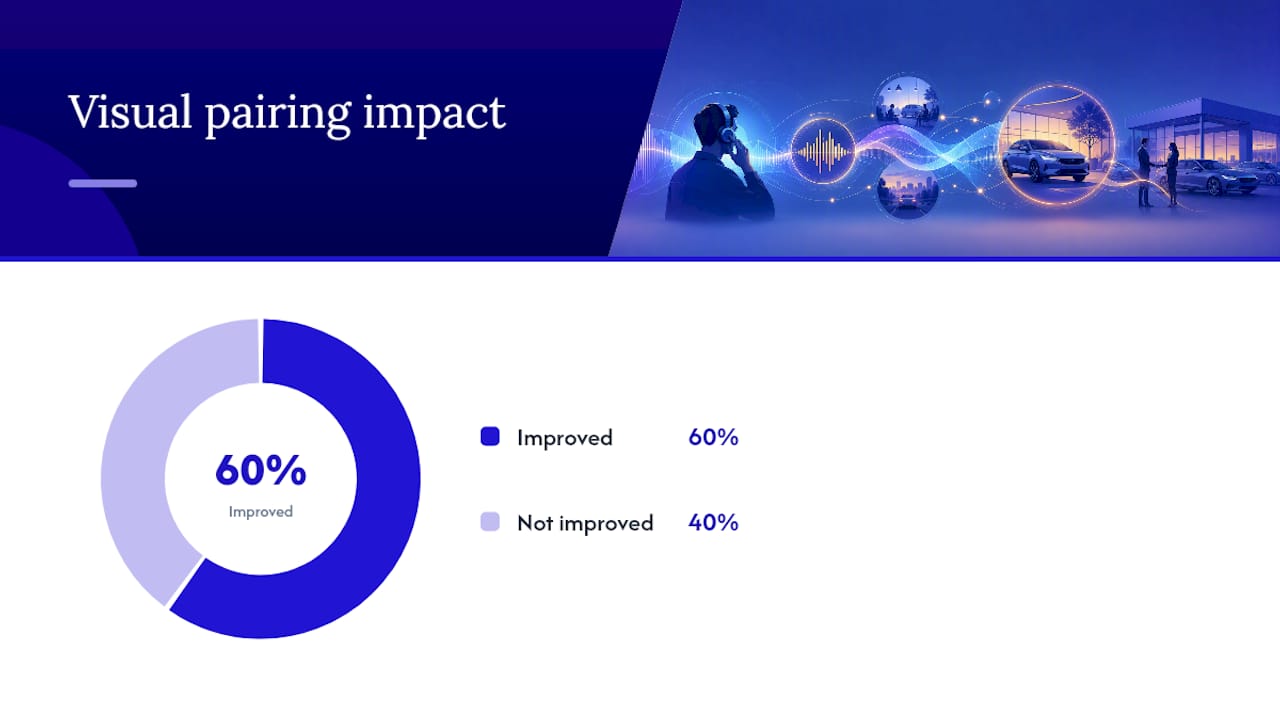
Three formats consistently work for dealerships: short 15 to 30 second spots for reach, host-read integrations for trust and local relevance, and digital audio paired with a companion display visual for click-through. Kantar's analysis found roughly 60% of tested digital audio ads performed better when paired with a visual, a detail worth building into every digital buy.
Test one variable at a time:
- CTA wording (call now vs visit online vs mention this ad).
- Offer type (percentage discount vs fixed dollar vs service bundle).
- Ad length and presence of a companion visual.
Run each variant for at least two full weeks against a stable control period, using call volume or promo-code redemption as the primary KPI. Our ad creative testing playbook covers sample-size thresholds in more detail.
How Much Should You Budget for Audio, and What ROI Should You Expect?
A multiplatform mix of broadcast and digital audio, dedicating up to roughly 25% of media budget to audio, tends to maximize short-term ROI impact for retail advertisers without crowding out other channels. That's a ceiling, not a fixed target. Test your way up to it.
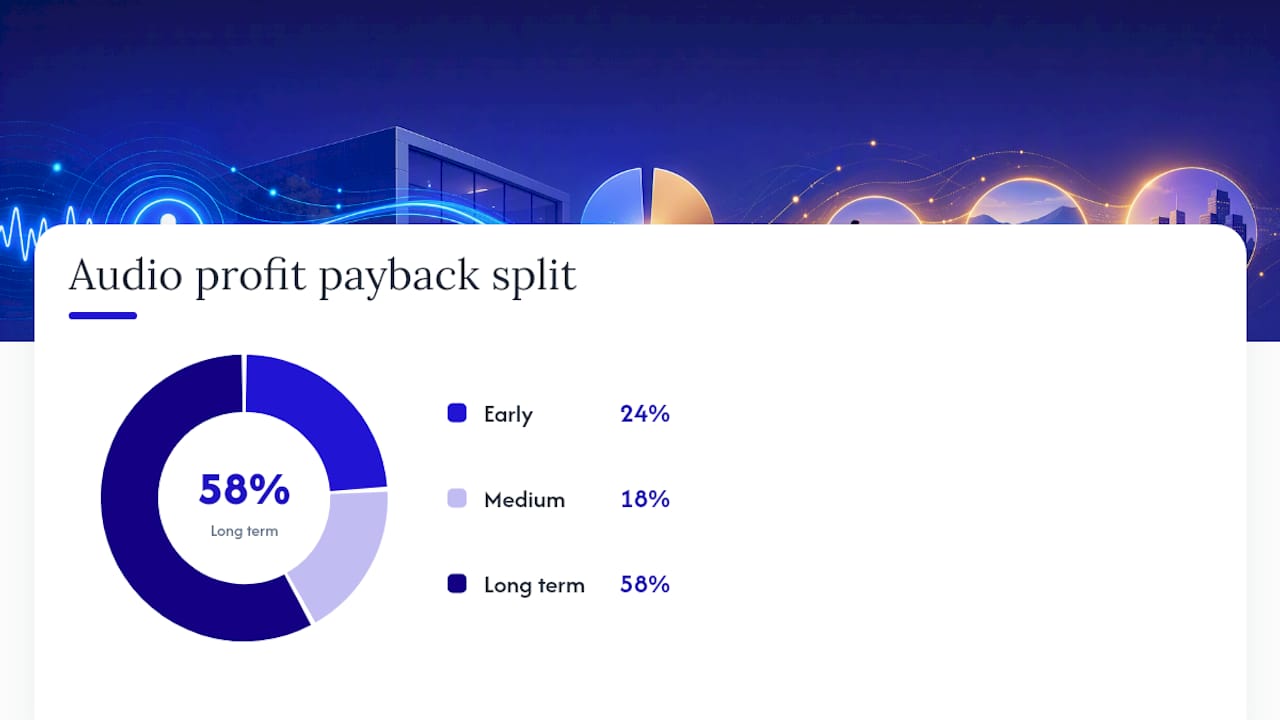
DAX's Profit Ability research describes payback arriving in a pattern often summarized as the 24%-18%-58% long-tail rule: roughly a quarter of profit payback lands early, another share in the medium term, and the largest portion accrues over the long tail. Dealerships judging audio purely on week-one lead counts routinely undervalue it because most of the return hasn't materialized yet.
Benchmark rule of thumb: compare effect sizes against your own historical baseline, not against a competitor's press release.
What Should Your Audio Measurement Checklist Look Like This Quarter?
Getting from "we bought some radio" to "we can prove the return" takes a defined sequence, not a single tool purchase.
- Pick one primary objective (test drives, service bookings, or unit sales) and its KPI.
- Pull 8 to 12 weeks of baseline data for that KPI before flight.
- Implement call tracking, unique promo codes, and conversion pixels; see our best call tracking platforms guide for setup options.
- Integrate all tracking sources into your CRM so leads, calls, and visits share one record.
- Book a brand-lift survey or store-visit study only if the campaign budget and duration justify it.
- Run your first A/B test using the creative framework above.
- Reconcile vendor-reported numbers against CRM and location-analytics data monthly.
Assign clear ownership: marketing ops owns tracking setup, the vendor owns campaign delivery, and someone on your team owns the reconciliation report. Watch for inflated vendor metrics by cross-checking impression definitions against the IAB standard every time a number looks unusually strong.
Pro Tip: Set a hard deadline for the reconciliation step. Reports that never get cross-checked against CRM data quietly become permanent vendor talking points.
Why Vendor-Reported Numbers Rarely Tell the Whole Story
Every audio vendor has an incentive to report the most favorable number available, and that's not a criticism of the medium. It's a structural fact about any media seller grading its own homework. The conventional advice to "just trust the platform dashboard" ignores that impression counting methodology alone can shift a reported number by a meaningful margin depending on server-side versus client-side logging.
What gets underestimated is how much of audio's real value shows up outside the attribution window most dealerships use. The long-tail payback pattern in the DAX research means a general manager evaluating a 30-day campaign against a 30-day sales report is only seeing part of the picture. That's not an excuse to skip measurement. It's a reason to build measurement that tracks both the immediate response and the slower brand-driven lift, and to be honest about which one you're looking at in any given report.
Autoroiq built its methodology around a simple premise: a dealership deserves an answer to "did this work" that doesn't come from the company selling the media.
— AutoROIQ
How Autoroiq Helps Dealerships Prove Audio ROI
Radio reps, streaming platforms, and podcast networks all have a stake in how their numbers get reported, which is exactly why dealerships need an independent read on the results. Autoroiq doesn't sell audio inventory or any other advertising. It specializes in independent marketing intelligence for dealerships, evaluating vendor performance and channel effectiveness with a proprietary methodology built specifically for automotive retail.
The first-step deliverable is a diagnostic review: your current audio mix, tracking setup, and vendor-reported metrics get checked against defensible attribution data, then prioritized into a recommendation list your team can act on. That includes flagging where call tracking or promo-code capture has gaps, and where a vendor's reach numbers deserve a second look. If you want a clear picture of what your audio spend is actually returning, start a diagnostic conversation with Autoroiq and get vendor-agnostic recommendations you can defend to your GM.
Key Takeaways
Audio ads ROI becomes measurable and defensible only when reach and resonance metrics are tied to tracked calls, store visits, and closed sales through your CRM.
| Point | Details |
|---|---|
| Start with call tracking and codes | Implement dynamic call tracking, unique promo codes, and pixels before judging any audio flight. |
| Use the Three Rs framework | Prioritize Reaction metrics (calls, visits, sales) for weekly reporting; save brand lift for quarterly reviews. |
| Expect a long-tail payback | Industry benchmarking suggests a large share of profit payback arrives after the initial flight window, not during it. |
| Reconcile vendor numbers monthly | Cross-check impression definitions against IAB standards to catch inflated reporting early. |
| Get an independent read | Autoroiq's vendor-agnostic diagnostic identifies tracking gaps and prioritizes fixes without selling you media. |
Sources
- Landmark global study proves audio’s impact in the marketing mix – driving profit, trust and brand outcomes - Radiocentre
- How to measure digital audio ads | Spotify Advertising
- The growing potential of emerging media platforms: how effective are digital audio ads - Kantar
- Why audio punches above its weight (Profit Ability 2) - DAX
- IAB audio measurement guide