
The fastest way to lift automotive marketing ROI is to prioritize connected, incremental measurement and align dealer operations to act on it fast. Three levers matter most: close the loop between DMS, CRM, and campaign data; run in-market experiments instead of trusting vendor-reported clicks; and shift budget toward underused, high-return channels like email. Dealers that adopt this approach can see a 20% to 40% improvement in marketing ROI.
TL;DR:
- Connecting dealership DMS, CRM, and campaign data accurately is essential for measuring true marketing impact and achieving ROI improvements of 20% to 40%.
- Relying solely on vanity metrics like impressions or clicks is ineffective; instead, focus on outcome hierarchies such as campaign-attributed revenue and customer lifetime value.
- Combining three attribution methods—market mix modeling, in-market experiments, and closed-loop tracking—provides a comprehensive, causal view of marketing effectiveness.
- Prioritize underused channels like email and marketing automation, which typically deliver higher returns than paid search and display in automotive campaigns.
- Building a high-quality, layered measurement process with clear governance and dealer collaboration significantly accelerates accurate attribution and strategic decision-making.
Table of Contents
- Key Takeaways on Automotive Marketing ROI Benchmarks
- A Practical Measurement Framework for Automotive Marketing ROI
- Key KPIs and Benchmarks Dealers Should Track
- Attribution Methods: MMM, Experiments, and Closed-Loop Approaches
- Data Integration and Tooling to Close the Loop
- Operating Model and Dealer Collaboration That Converts Measurement Into Action
- Channel-Level ROI and Tactical Levers Worth Testing
- Implementation Roadmap: Quick Wins for the Next 90 to 180 Days
- AutoROIQ's Vendor-Agnostic Approach to Measurement
- Challenges and Limitations in Measuring Automotive Marketing ROI
- Impact of Emerging Technologies on ROI Measurement
- Case Studies Showing Successful ROI Improvement in Automotive Marketing
- Perspective: Three Executive Priorities to Lead With in 2026
- How AutoROIQ Can Help You Improve Marketing ROI
- Sources
Key Takeaways on Automotive Marketing ROI Benchmarks
Digital now absorbs roughly 72% of the average dealer's ad budget, with total annual spend landing near $528,923 at a typical dealership. That number matters less than where it goes. A lot of it still chases channels that look active but convert poorly against ones that quietly outperform.
Statistic Callout: Email marketing returns roughly $40 to $44 for every dollar spent in automotive campaigns, and marketing automation can produce a strong cumulative return over multiple years.
Lead-to-sale conversion averages 5.7% industrywide, but top performers push past 9%. Phone leads still tend to close at meaningfully higher rates than web form submissions, which is one reason call tracking belongs in every measurement stack, not just the ones OEMs mandate.
Three moves you can start this quarter:
- Connect your DMS and CRM so campaign activity ties directly to closed deals.
- Enforce consistent lead source tagging across every intake point, including phone and chat.
- Launch one causal test, even a simple geo holdout, before your next budget cycle.
A Practical Measurement Framework for Automotive Marketing ROI
Most dealership reporting stacks vanity metrics on top of each other: impressions, clicks, VDP views, all reported as if they were interchangeable proof of value. They are not. The framework that actually drives budget decisions starts with a clear outcome hierarchy and works backward.
1. Define the outcome hierarchy. Campaign-attributed revenue and unit sales sit at the top. Customer lifetime value and service retention sit right underneath, because a marketing channel that generates a low-margin sale but a decade of service visits often outperforms one that generates a single high-margin sale and nothing else.
2. Separate incremental lift from vanity signals. A click or an impression tells you exposure happened. It does not tell you whether that exposure caused a sale that would not have happened anyway. BCG's analysis found that automakers pairing incremental measurement with fast decision loops captured the ROI gains; those measuring exposure alone did not.
3. Combine three methods, not one. Marketing mix modeling (MMM) handles long-run budget allocation across channels using historical spend and outcome data. In-market experiments prove causal lift for a specific tactic or channel in a defined window. Closed-loop attribution ties individual campaign touches to individual deals in your CRM and DMS, giving you operational, channel-level accountability day to day.
4. Set a governance cadence. Review closed-loop data weekly, run experiments on a rolling basis throughout the quarter, and refresh your MMM view quarterly or semiannually. Use each layer for what it is good at instead of asking one method to answer every question.
Pro Tip: Don't wait for a "perfect" MMM before you start experimenting. Run a simple treatment/control test on one campaign this month. You'll learn more from four weeks of real data than from another quarter of modeling assumptions.
Key KPIs and Benchmarks Dealers Should Track
Cost per lead (CPL) tells you almost nothing on its own. A $15 CPL from a low-intent source can cost more per sale than a $60 CPL from a high-intent one. Track it alongside the metrics that actually connect to revenue.
The core KPI set:
- Cost per lead (CPL): total channel spend divided by leads generated.
- Lead-to-sale conversion rate: deals closed divided by leads received, with the industry averaging 5.7% and top performers exceeding 9%.
- Cost per sale: total channel spend divided by units sold, the metric that should override CPL in any budget decision.
- Campaign-attributed revenue: gross revenue tied directly to a specific campaign through closed-loop tracking.
- Customer lifetime value (CLV): projected revenue across sales and service over the ownership relationship.
- Service retention and absorption rate: the share of fixed operating costs covered by service and parts gross profit, a figure NADA tracks closely because it signals dealership financial health independent of new-unit margins.
Statistic Callout: Ad-media ROI benchmarks compiled by Statista give dealers a cross-check point against vendor-reported numbers, which routinely run optimistic.
Segment every one of these by campaign objective. A sales campaign and a service campaign should never share the same CPL target, and neither should a luxury franchise and a high-volume value brand.
Attribution Methods: MMM, Experiments, and Closed-Loop Approaches
Each attribution method answers a different question, and confusing them is where most dealership measurement programs go wrong.
- Marketing mix modeling works backward through historical spend and sales data to estimate each channel's contribution to overall revenue. It is strong for annual and quarterly budget allocation across a full media mix, but it is inherently backward-looking and slow to reflect a channel change you made last month.
- In-market experiments are the closest thing automotive marketing has to a controlled trial. Split comparable markets or store groups into treatment and control, hold everything else constant, run the test for a defined window (typically four to eight weeks for a dealership-level test), and measure the lift difference. This is the gold standard for proving a tactic caused a sales increase rather than merely correlating with one.
- Closed-loop attribution connects individual ad exposures and lead sources to specific deals in your DMS and CRM. Keyloop's analysis makes the case plainly: disconnected systems turn attribution into guesswork, and unified analytics are the only way to trace revenue back to the marketing activity that generated it. The common pitfalls are inconsistent lead source tagging, missing call tracking, and CRM fields that sales staff simply do not fill in correctly.
Platforms like Experian's OmniImpact extend this further by matching campaign exposure against real-world vehicle sales data across large consumer datasets, which is particularly useful for measuring incremental lift on channels where a direct click-to-sale path does not exist, like connected TV or streaming audio.
Data Integration and Tooling to Close the Loop
None of the above works without connected data. The systems that need to talk to each other: your DMS, your CRM, every advertising platform you run spend through, call-tracking software, a customer data platform (CDP) if you operate at scale, and your analytics layer.
You have four integration paths, roughly in order of effort:
- Managed connectors built by your CRM or DMS vendor, the fastest path for most single-point or small dealer groups.
- ETL pipelines that batch-process data between systems on a schedule, workable for mid-size groups with some technical capacity.
- Direct API integration, which offers the most flexibility but requires ongoing engineering support most dealerships do not staff internally.
- Data clean rooms, useful when sharing sensitive first-party data with an OEM or ad platform without exposing raw customer records.
Pro Tip: If you have limited engineering capacity, start with a managed connector between your DMS and CRM before touching your ad platforms. That single link resolves the majority of "we can't tell which leads bought" problems dealerships report.
Whatever path you choose, run a short privacy checklist first: confirm consent language covers cross-system data sharing, restrict PII access to roles that need it, and document your data retention window before you connect anything.
Operating Model and Dealer Collaboration That Converts Measurement Into Action
Measurement that never changes a budget decision is a wasted investment. The organizations that turn data into action share a common structure.
- Name a measurement owner. One person or team owns the reporting cadence and has the authority to flag when a channel underperforms.
- Build an insights-to-action team. This group includes marketing, sales operations, and a dealer liaison who can translate findings into store-level changes.
- Assign dealer liaisons for OEM programs. These roles keep national campaigns and local dealer spend from overlapping or competing for the same in-market customers.
- Set a review cadence. Weekly tactical check-ins on lead flow and conversion, monthly reviews for budget reallocation, and a quarterly strategic session tied to your MMM refresh.
Evaluating agency and vendor performance against this same cadence, rather than trusting self-reported dashboards, is one of the more direct ways to hold spend accountable to actual results.
Channel-Level ROI and Tactical Levers Worth Testing
Not every channel deserves equal budget attention, and the evidence on this is fairly consistent across the industry. Email and marketing automation deliver outsized returns relative to spend and are routinely underallocated in dealer budgets that overweight paid search and display. Streaming audio and connected TV are harder to attribute directly but show strong incremental lift when measured properly. Local search and inventory-based messaging convert well because they meet high-intent shoppers close to the purchase decision.
Tactics worth testing this quarter:
- Personalize email sequences by vehicle interest and service history rather than blasting a single offer.
- Automate appointment-optimized bidding so search spend shifts toward hours when service bays actually have openings.
- Run a streaming audio test in one market against a control market.
- Test local inventory ad messaging that surfaces specific VINs instead of generic offers.
- A/B test creative variations on your highest-spend paid social campaign.
Scale a tactic once an experiment shows statistically credible lift over two consecutive test windows. Retire it if a channel fails to beat your baseline cost per sale after two full cycles, regardless of how good the click-through rate looks.
Implementation Roadmap: Quick Wins for the Next 90 to 180 Days
The first 90 days should fix foundational gaps: correct lead source capture, enforce consistent lead routing to sales staff, enable call tracking on every phone number in market, and run one simple creative A/B test to build organizational comfort with experimentation.
- Days 1 to 30: Audit lead source tagging and fix routing gaps.
- Days 30 to 60: Enable call tracking and launch your first A/B creative test.
- Days 60 to 90: Review initial results and confirm your CRM/DMS connection is capturing attributed revenue correctly.
- Days 90 to 180: Deploy full closed-loop attribution, run your first in-market experiment or MMM refresh, and align dealer reporting incentives to the new metrics.
Checkpoint success by conversion rate improvement and cost per sale reduction at each milestone, not by lead volume alone.
AutoROIQ's Vendor-Agnostic Approach to Measurement
Autoroiq builds its recommendations on proprietary methodology and vendor-agnostic analysis, meaning no advertising sales incentive shapes what you're told about channel performance. That independence maps directly onto the framework above: measurement discipline, layered attribution, and governance that turns findings into budget decisions.
Explore ongoing industry insights built on this methodology.
Challenges and Limitations in Measuring Automotive Marketing ROI
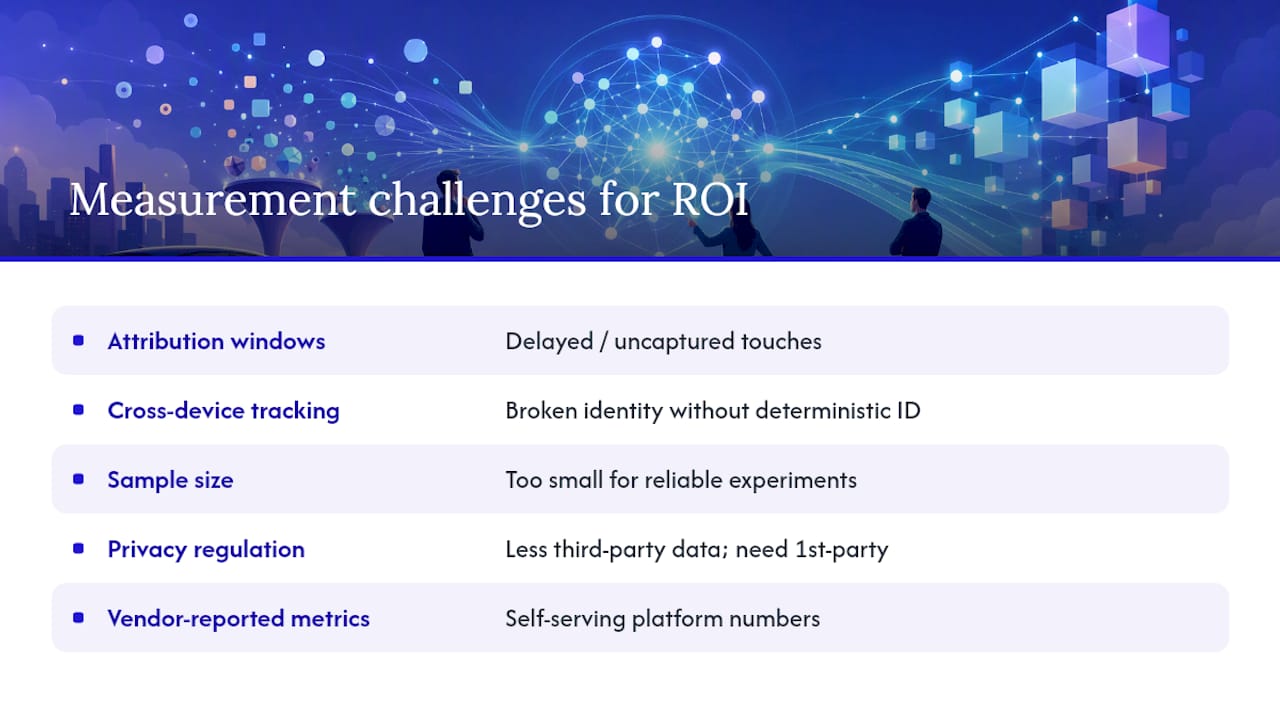
Even a well-built measurement program runs into real constraints. Attribution windows rarely match how car buyers actually shop; a customer might see a video ad in week one and walk into a showroom in week six, with three other touchpoints in between that never get credited correctly.
Cross-device tracking remains incomplete. A shopper researching on a phone and purchasing after a desktop session, or vice versa, breaks attribution chains unless you have deterministic identity resolution, which most single-point dealers do not.
Sample size is a persistent problem for smaller stores. A dealership selling 80 units a month cannot run a statistically reliable in-market experiment with the same confidence as a 40-store group, which means smaller dealers often need to pool data at the group or regional level to get a usable read.
Privacy regulation is tightening the raw data available for third-party matching, and platforms are steadily reducing what they'll share about individual ad exposure. This pushes more of the burden onto first-party data captured directly through DMS and CRM systems, which is exactly why closed-loop attribution has become less optional and more foundational.
Finally, vendor-reported metrics carry an inherent bias. A platform grading its own performance has little incentive to report a disappointing number, which is part of why cross-checking against independent benchmarks matters as much as building your own internal measurement.
Impact of Emerging Technologies on ROI Measurement
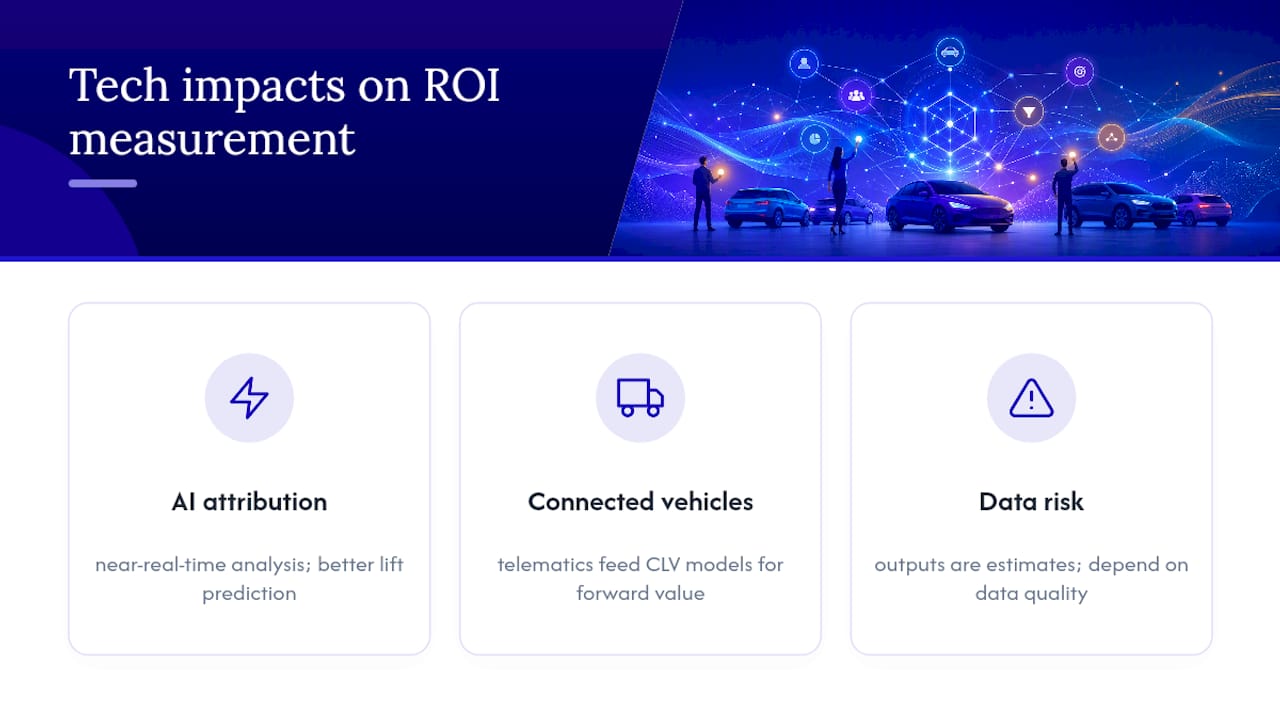
Artificial intelligence is changing measurement in two distinct ways: faster analysis and better prediction. AI-assisted attribution models can now process cross-channel touchpoint data in near real time, shortening the gap between a campaign running and a dealership knowing whether it worked from weeks to days.
Predictive models are also getting better at estimating incremental lift for channels where a direct causal test is impractical. Using historical patterns to approximate what a full in-market experiment would show matters most for channels like connected TV and streaming audio, where impression-to-sale paths are long and indirect.
Connected vehicle data introduces a new measurement layer entirely. Telematics and connected car platforms can surface service reminders, usage patterns, and ownership behavior that feed directly into CLV modeling, giving dealers a forward-looking view of a customer's value rather than relying solely on past transaction history.
The risk with all of this technology is treating a model's output as certainty rather than as an estimate. AI-driven attribution still depends entirely on the quality of the underlying data connections. A prediction built on inconsistent lead source tagging or a broken DMS integration will produce a confident-sounding number that is simply wrong. The technology accelerates good measurement programs. It does not fix broken ones.
Case Studies Showing Successful ROI Improvement in Automotive Marketing
The pattern across dealerships and automakers that improved measured ROI tends to follow the same sequence rather than a single silver-bullet tactic. Groups that connected DMS and CRM data before running a single paid media experiment consistently reported cleaner attribution and faster identification of underperforming channels once testing began.
Reallocation toward email and marketing automation, an area BCG's research and industry benchmarking both flag as underused relative to its return, has been one of the more repeatable wins across dealer groups that shifted spend deliberately rather than incrementally.
Groups running structured in-market experiments, splitting comparable stores into treatment and control before scaling a tactic chainwide, avoided the common trap of rolling out a channel change everywhere at once based on a single store's anecdotal result. That discipline alone prevented budget from following a false signal.
The through-line across these patterns is not a specific channel or vendor. It's a sequence: connect the data, prove causality on a small scale, then scale with confidence and a governance cadence that keeps reviewing the decision.
Perspective: Three Executive Priorities to Lead With in 2026
If you fund one thing this year, fund connected measurement before you fund another campaign. Incremental testing and dealer alignment matter more than any single channel choice, and both fail without people and process behind them, not just software.
The two failure modes we see repeatedly: dealerships that buy attribution tools without fixing lead source capture first, and marketing teams that generate strong insights nobody has the authority to act on. Fix data hygiene and governance before you fix your media mix.
— AutoROIQ
How AutoROIQ Can Help You Improve Marketing ROI
Autoroiq gives dealership leaders something most vendor relationships can't: an independent read on what your marketing spend is actually doing, without a sales incentive attached to the answer. Because Autoroiq doesn't sell advertising, the scorecards and channel evaluations you get reflect what the data shows, not what a media rep wants renewed.
That independence is the practical advantage here. Instead of comparing vendor claims against each other and guessing who's exaggerating, you get one clear, defensible view of where budget is working, where it isn't, and what to fix first, backed by the same measurement discipline covered throughout this piece: closed-loop attribution, incremental testing, and governance that turns findings into reallocation.
If your current reporting can't tell you cost per sale by channel with confidence, that's the place to start. Request an independent marketing performance review at AutoROIQ and see where your budget is actually working.
Sources
- Shifting Gears to Accelerate Automotive Marketing ROI
- 51 ROI Metrics in Automotive Campaign Statistics in 2025
- How to measure marketing ROI in automotive retail
- OmniImpact for Automotive / campaign measurement
- Ad media ROI, car dealerships (U.S.)