
Fixed ops marketing is the system of lifecycle campaigns, local search, and conversion plumbing that reliably converts existing customers into repeat booked repair orders. Done correctly, it is not about generating raw leads. It is about producing incremental booked repair orders from owned customers and local intent, measured at the cohort level. The single metric that separates high-performing service departments from the rest is cost per incremental booked RO — what you actually paid, across every channel, to put one additional completed job on the board that would not have happened otherwise.
KPI to watch: Cost per incremental booked RO, reviewed by campaign cohort on a 90-day rolling basis.
Table of Contents
- Why fixed-ops marketing matters more than ever for dealership service growth
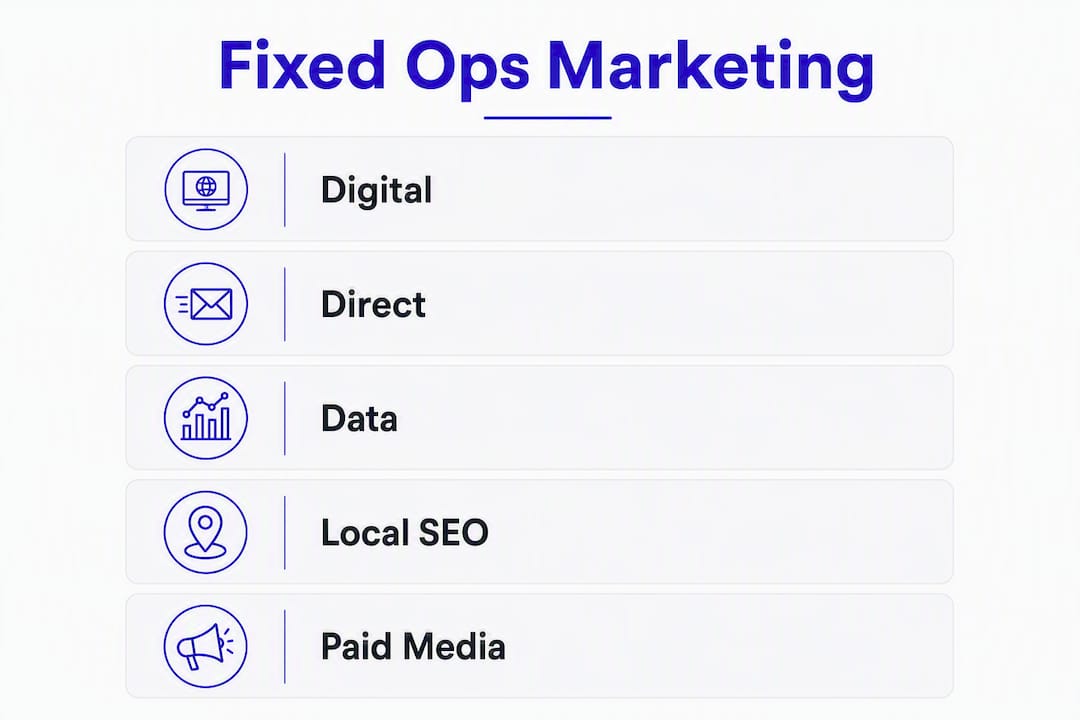
- Core channel pillars: what to do in Digital, Direct, and Data
- Paid media vs organic search: how they work together for the service drive
- Local search and reputation: the foundation to secure before scaling demand
- How to measure fixed-ops marketing correctly: cohorts, LTV, and the KPIs that matter
- A practical 90-day fixed-ops playbook you can start next week
- What results actually look like: illustrative campaign outcomes
- How fixed-ops marketing connects to your dealership's overall strategy
- How to train your fixed-ops team to support marketing initiatives
- Compliance and legal considerations for service marketing campaigns
- Key Takeaways
- The measurement gap most dealerships are not closing
- An independent fixed-ops marketing review from Autoroiq
- Useful sources and further reading
Why fixed-ops marketing matters more than ever for dealership service growth
Fixed operations consistently delivers higher gross margin per transaction than new-vehicle sales in most franchise dealership models. Yet the marketing investment directed at the service drive rarely reflects that reality. The result is predictable: customers drift to quick-lube chains and independent shops that compete on convenience and local visibility, not necessarily on price or quality.
Dealerships lose service visits to competitors that manage local search and reputation aggressively. A quick-lube location with a well-maintained Google Business Profile, numerous recent reviews, and a "book online" button captures the same customer your DMS already owns — simply because they appeared first in a local search.
The financial stakes compound over time. A customer who visits your service drive multiple times a year at an average repair order amount generates more gross profit over a multi-year ownership cycle than the margin on the vehicle sale that brought them in. Losing that customer to an independent shop after the first visit is not a minor inconvenience. Industry guidance links targeted fixed-ops marketing spend to materially higher customer-pay traffic compared to shops relying solely on OEM co-op and generic reminders.
If you neglect service marketing, the short-term consequences are concrete:
- Lost repair orders from customers who lapse between visits and never return
- Lower average repair order (ARO) because declined services are never followed up
- Technician underutilization when bays sit empty during off-peak periods
- Weakened retention that erodes the customer base your variable ops team worked to build
Core channel pillars: what to do in Digital, Direct, and Data
Run an integrated program across three pillars: Digital to capture local intent, Direct to retain owned customers, and Data to make both smarter. Each pillar has a distinct job, and they fail when treated as independent line items.
Digital: capture the customer who is ready now
Local search is the entry point. A customer searching "oil change near me" or "brake service [city]" is expressing immediate intent. Your service pages need to rank for those queries, and your Google Business Profile needs to be the first result they trust. Paid search fills the gaps where organic rankings are not yet strong enough, and retargeting re-engages customers who visited your service scheduling page but did not book.

Concrete ad messaging that works: "Your [Brand] service team is ready today — book online in 60 seconds" outperforms generic discount copy because it addresses the real barrier, which is friction, not price. Recall outreach ads that reference the specific recall by name ("Your vehicle has an open [recall name] — schedule at no charge") generate significantly higher click-through rates than generic service promotions.
Direct: own the conversation with your existing customers
Email and SMS are the highest-ROI channels in fixed ops because the audience already knows you. The campaigns that consistently produce results are first-service onboarding (triggered 30–45 days after vehicle purchase), mileage-based maintenance reminders (triggered by estimated odometer from DMS data), and declined-service recovery (triggered within 48 hours of a visit where work was declined).

Direct mail still earns its place for high-value customers, particularly for tire campaigns and multi-point inspection promotions where a physical piece with a specific offer drives appointment volume. Keep it targeted. Blanket coupon mailers sent to your full customer list without segmentation dilute response rates and train customers to wait for discounts.
Pro Tip: Never send a capacity-unaware campaign. If your shop is already booked out for the next two weeks, a mass email blast creates call volume you cannot convert and damages the customer experience. Tie campaign sends to your actual available capacity.
Data: make every campaign smarter
Bad customer and vehicle data is the single largest cause of campaign failure. Before any campaign launches, your DMS records need clean VIN data, accurate last-RO dates, estimated mileage, declined-service flags, open recall status, and consent fields. Sending a tire promotion to a customer who traded their vehicle six months ago does not just waste spend — it signals to that customer that you do not know them.
VIN-level segmentation lets you build audiences that are genuinely actionable: customers overdue for an oil change by 2,000+ miles, customers with a declined brake inspection from the last 90 days, customers with an open recall who have not scheduled. Each of those segments has a different message, a different urgency, and a different expected conversion rate.
Paid media vs organic search: how they work together for the service drive
Use organic and local SEO to build stable Maps visibility, and use paid search to capture immediate "ready-now" demand. Both are required. Neither replaces the other.
A shop with strong organic rankings and a well-managed GBP can reduce paid spend over time, but paid search fills the gap while organic authority builds and covers high-intent queries where competitors are bidding aggressively. Choosing between Facebook and Google for paid allocation depends on your shop's current visibility and capacity stage.
Decision rules by shop stage:
- Weak tracking, low visibility: Fix GBP, add call tracking and dynamic number insertion, and confirm DMS attribution before spending on paid. Paid spend without closed-loop tracking produces unverifiable ROI claims.
- Good local visibility, available capacity: Add paid search for high-intent service queries. Start with a modest daily budget, measure booked ROs, and scale only what converts.
- Booked out: Pause broad acquisition paid campaigns. Run owned-data retention campaigns to maximize ARO on existing appointments rather than adding unmanageable volume.
Campaign flow example:
- Customer searches "transmission service [city]"
- Paid ad appears with booking CTA
- Customer calls or clicks to schedule
- Call is tracked via dynamic number insertion; SMS confirmation sent
- Appointment is logged in DMS
- After job closes, DMS record is matched to the originating campaign source
- Cost per closed RO is calculated at the campaign level
Pro Tip: Start every new paid campaign with a 30-day measurement window before scaling spend. The metric to confirm is booked and completed ROs attributed to that campaign, not click volume or form fills.
Local search and reputation: the foundation to secure before scaling demand
Google Business Profile and review management are the baseline for capturing local service demand. Analysts confirm that dealerships lose service visits to competitors that manage local search aggressively. You cannot out-spend that problem with paid ads if your GBP is incomplete or your review score is below 4.2.
GBP fields to complete and maintain:
- Business name, address, and phone number consistent with your website and DMS
- Service hours (including Saturday and any express lane hours)
- Service categories listed explicitly (oil change, brake service, tire rotation, etc.)
- Photos of the service drive, waiting area, and team (updated quarterly)
- Booking link connected to your online scheduler
- Google Posts for current promotions (at least twice per month)
- Q&A section monitored and answered by service management
Review strategy: Request a review at the point of vehicle pickup, not via a generic email blast three days later. A service advisor handing keys back to a satisfied customer and saying "We'd really appreciate a Google review — it takes 30 seconds" converts at a higher rate than any automated follow-up sequence.
Respond to every review within 24 hours. Negative reviews that go unanswered for more than 48 hours signal to prospective customers that the experience described is the norm.
Pro Tip: Use this response template for negative reviews: "Thank you for sharing your experience. We'd like to make this right — please contact [Service Manager name] directly at [phone/email]. We take this seriously." Then move the conversation offline immediately. Never argue in a public response.
How to measure fixed-ops marketing correctly: cohorts, LTV, and the KPIs that matter
Measure booked and completed repair orders matched to marketing source, then analyze by cohort and lifetime value rather than raw monthly lead counts. Monthly ROI reviews are misleading for service marketing because most profitability is realized over time through retention and referrals. A 90-day cohort minimum is the standard.
Standard web analytics miss phone-driven leads unless you have call tracking and dynamic number insertion in place. GA4 out of the box will undercount service inquiries significantly in most dealership environments.
| KPI | Definition | How to calculate |
|---|---|---|
| Qualified inquiry | A call, form, or chat that results in a scheduled appointment | Total inquiries minus wrong numbers, spam, and existing confirmed bookings |
| Booking rate | % of qualified inquiries that become confirmed appointments | Confirmed appointments ÷ qualified inquiries |
| Appointment-to-complete rate | % of booked appointments that result in a closed RO | Closed ROs ÷ confirmed appointments |
| Incremental ROs | ROs attributable to a specific campaign beyond baseline | Campaign-period ROs minus baseline RO rate for that segment |
| Average repair order (ARO) | Average revenue per closed RO | Total RO revenue ÷ number of closed ROs |
| Cost per incremental RO | Total campaign spend divided by incremental ROs | Campaign spend ÷ incremental ROs |
| Margin per RO | Gross profit per closed RO | RO revenue minus parts and labor cost |
| LTV timeframe | Customer lifetime value window for retention analysis | 12 month cohort tracking from first campaign contact |
Measurement cadence: Weekly dashboard for operational signals (booking rate, no-show rate, capacity utilization). Monthly channel performance review (spend, cost per inquiry, booking rate by channel). Quarterly cohort and LTV review to assess true campaign profitability.
Pro Tip: When a vendor presents ROI claims, ask for three things: closed-job attribution matched to DMS records, GCLID offline conversion imports into Google Ads, and a sample cohort export showing 90-day RO outcomes. If they cannot provide all three, the ROI figure is not defensible.
A practical 90-day fixed-ops playbook you can start next week
Prioritize owned-data recovery campaigns first, then add first-service onboarding and mileage maintenance, then layer in local search and paid capture. Scaling paid spend before your conversion plumbing is working is the most common and most expensive mistake in service department advertising.
Days 1–30: Launch
| Task | Owner | Notes |
|---|---|---|
| Audit DMS data quality: VIN, last RO, mileage, consent flags | Fixed ops manager + CRM admin | Flag records missing consent or with stale mileage data |
| Implement call tracking and DNI on service pages | Marketing manager + web vendor | Required before any paid spend |
| Complete and verify GBP listing | Marketing manager | All fields, booking link, correct hours |
| Launch declined-service recovery email/SMS sequence | CRM admin | 48-hour trigger post-visit |
| Launch no-show recovery sequence | CRM admin | Same-day trigger, offer immediate reschedule |
| Set baseline KPI dashboard | Marketing manager | Booking rate, ARO, appointment-to-complete rate |
Days 31–60: Stabilize
- Add first-service onboarding sequence for new vehicle purchasers (30-day trigger)
- Launch mileage-based maintenance reminders for customers overdue by 1,500+ miles
- Review GBP review volume and response rate; adjust request process if below target
- Analyze booking rate from Days 1–30 campaigns; identify drop-off points in the conversion flow
- Begin call tracking review to confirm attribution accuracy
Days 61–90: Scale
- Launch local paid search for top-intent service queries if booking rate from owned campaigns exceeds 35%
- Add retargeting for service page visitors who did not schedule
- Run inactive win-back campaign for customers with no RO in 18+ months
- Conduct first 90-day cohort review: cost per incremental RO by campaign type
- Adjust budget allocation based on cohort data, not monthly lead counts
Sample budget split (by shop stage):
| Shop stage | Owned-data campaigns | Local SEO / GBP | Paid search | Retargeting |
|---|---|---|---|---|
| Early-stage / weak tracking | 60% | 30% | — | 10% |
| Established / good visibility | — | — | 30% | 10% |
| High-volume / booked out | — | — | — | 10% |
Weekly operational cadence:
| Day | Task | Owner |
|---|---|---|
| Monday | Review prior week booking rate and no-show rate | Fixed ops manager |
| Tuesday | Update capacity availability in scheduler | Service coordinator |
| Wednesday | Check GBP reviews; respond to any new reviews | Marketing manager |
| Friday | Pull campaign inquiry and booking data for weekly dashboard | Marketing manager |
What results actually look like: illustrative campaign outcomes
The intervention, the data action, and the measurable result follow a consistent pattern across service marketing programs. Here is what realistic timelines look like.
Days 1–30: Declined-service recovery and no-show recovery campaigns produce the fastest visible results because the audience is warm and the message is specific. Expect booking rate improvements within the first two to three weeks as conversion plumbing tightens.
Days 31–60: First-service onboarding and mileage reminders begin contributing incremental ROs. ARO tends to improve as customers return for previously declined work.
Days 61–90: Local search and paid capture campaigns start producing attributable ROs. Cohort data becomes meaningful enough to make budget reallocation decisions.
Owned-data recovery example: A service department with 4,200 customers showing a declined brake inspection in the prior 12 months launches a three-touch SMS and email sequence. At a modest booking rate, the campaign produces a meaningful number of incremental appointments. At the typical average repair order for brake work, the revenue impact is material — and the campaign cost is a fraction of what equivalent paid acquisition would require.
Local search cleanup + paid capture example: A dealership with an incomplete GBP and no paid search presence completes the GBP audit, adds a booking link, and launches a targeted paid search campaign for oil change and tire queries. Within 60 days, Maps impressions increase and paid campaigns begin producing attributable closed ROs at a measurable cost per job.
How fixed-ops marketing connects to your dealership's overall strategy
Fixed ops and variable ops share a customer. The vehicle buyer who purchased 18 months ago is now the service customer who needs a first major maintenance visit. If your service marketing program does not have a handoff from the sales CRM to the service CRM, you are losing that customer to an independent shop before they ever experience your service drive.
The integration points that matter most are practical and operational. Sales should trigger a first-service onboarding sequence at vehicle delivery, not 90 days later when the customer has already gone elsewhere. Service should flag customers approaching trade-in mileage thresholds so variable ops can re-engage them with a relevant offer. Marketing spend attribution should be reported at the dealership level, not siloed by department, so leadership can see the full customer lifetime value picture.
Fixed-ops marketing also provides a data advantage for conquest campaigns. Targeting owners of competing brands in your market with service-focused messaging — emphasizing convenience, certified technicians, and OEM parts — is a lower-cost acquisition path than competing for new-vehicle buyers. Treat fixed ops as a digital-first product for conquest marketing, and the economics shift in your favor.
How to train your fixed-ops team to support marketing initiatives
The service advisor is the last mile of every marketing campaign. A well-executed email campaign that drives a customer to call the service drive fails if the advisor cannot confirm the offer, book the appointment efficiently, and set accurate expectations. Training is not optional — it is the conversion layer that marketing spend depends on.
Start with offer literacy. Every advisor should know what campaigns are currently running, what the offer terms are, and how to look up a customer's campaign-specific discount or promotion in the DMS. A customer who calls referencing an email offer and gets a confused response from an advisor will not rebook.
Build a short weekly briefing into the service team's Monday morning routine: which campaigns are live, what capacity is available, and what the week's booking targets are. This keeps the team aligned with marketing without requiring them to monitor dashboards independently.
Review response handling is a separate training need. Advisors and service managers should know how to respond to Google reviews, how to escalate a negative review to management, and why review volume matters to the shop's local search visibility. Connecting that behavior to a tangible business outcome — more inbound calls, more booked appointments — makes the training stick.
Compliance and legal considerations for service marketing campaigns
Automotive service marketing campaigns in the United States operate under several overlapping regulatory frameworks. The Telephone Consumer Protection Act (TCPA) governs SMS and automated call campaigns. Sending a text message to a customer without documented prior express written consent is a TCPA violation, and the penalties are per-message. Consent must be captured at the point of data collection — typically at vehicle purchase or service intake — and stored with a timestamp and source record in your DMS or CRM.
Email campaigns fall under the CAN-SPAM Act. Every commercial email must include a physical mailing address, a clear unsubscribe mechanism, and accurate sender identification. Unsubscribe requests must be honored within 10 business days.
Promotional offers in service advertising must be accurate and available as stated. A "free oil change" offer that is not actually available to the customer who responds, or that has unstated exclusions, creates both a consumer protection exposure and a reputational risk. State consumer protection laws vary, and some states have specific requirements for automotive service advertising disclosures.
Direct mail campaigns targeting vehicle owners by VIN or registration data are subject to the Driver's Privacy Protection Act (DPPA). Data sourced from DMV records has specific permissible-use restrictions, and using that data for general marketing purposes without a permissible use is a federal violation.
This is general information, not legal advice. Confirm current requirements with qualified legal counsel before launching campaigns that involve SMS, automated calls, or DMV-sourced data.
Key Takeaways
Effective fixed ops marketing requires clean owned data, closed-loop attribution to the DMS, and a 90-day cohort measurement window before making budget scaling decisions.
| Point | Details |
|---|---|
| Prioritize owned-data campaigns first | Declined-service recovery and no-show recovery produce the fastest incremental ROs at the lowest cost per job. |
| Fix conversion plumbing before scaling paid spend | Call tracking, two-way SMS, and scheduler integration must be in place before paid campaigns can produce defensible ROI. |
| Measure cost per incremental booked RO | Track booked and completed ROs matched to campaign source; monthly lead counts do not reflect true service marketing profitability. |
| Secure GBP and reputation before scaling demand | An incomplete Google Business Profile and a low review score will limit the return on every other channel investment. |
| Autoroiq provides independent attribution validation | Autoroiq's vendor-agnostic methodology audits closed-job attribution, cohort analysis, and vendor accountability so dealership leaders can trust their ROI data. |
The measurement gap most dealerships are not closing
The conventional wisdom in fixed-ops marketing is to run more campaigns, add more channels, and measure success by lead volume. That framing is wrong, and it is expensive.
Most service marketing programs produce a large number of inquiries and a much smaller number of closed repair orders. The gap between those two numbers is where budget disappears. Vendors report the inquiry number because it is large and looks like performance. Dealership leaders accept it because they lack the attribution infrastructure to challenge it.
The real question is not "how many leads did we generate?" It is "how many incremental repair orders closed, at what cost, and what is the 12-month retention rate of those customers?" That question requires closed-job attribution matched to DMS records, cohort tracking over at least 90 days, and a willingness to hold vendors accountable to the same standard.
Autoroiq's approach is built around that question. Vendor-agnostic measurement means the analysis is not influenced by which channel or vendor produced the data. Closed-job attribution means the RO is the unit of measurement, not the click or the call. And cohort analysis means profitability is evaluated over the timeframe in which it actually materializes.
The dealerships that get this right do not necessarily spend more on service marketing. They spend more confidently, because they know which campaigns are producing real repair orders and which ones are producing reports that look good but do not close jobs.
An independent fixed-ops marketing review from Autoroiq
Most dealerships are paying for service marketing performance they cannot verify. Vendor reports show impressions, clicks, and leads. What they rarely show is a closed-job attribution report matched to your DMS, a cohort analysis of 90-day RO outcomes, or a vendor accountability scorecard that compares claimed performance against actual booked repair orders.
Autoroiq delivers exactly that. An independent fixed-ops marketing review covers your full channel attribution audit, a cohort-level analysis of campaign performance, and an executive-ready scorecard that tells you which vendors and channels are producing real repair orders and which ones are not. No advertising is sold. No vendor relationships influence the findings. The analysis is yours to act on.
If you want to know what your service marketing spend is actually producing, request an independent review at autoroiq.com.
Useful sources and further reading
- Dealership fixed-ops marketing insights — analysis of local search and GBP management as competitive levers for service market share
- Marketing ROI for B2B services — cohort and LTV measurement methodology applicable to service department ROI analysis
- Cost per lead vs. cost per sale for dealerships — Autoroiq's analysis of why cost-per-lead metrics mislead dealership marketing decisions
- Signs your dealership is wasting marketing dollars — diagnostic framework for identifying tracking gaps and spend inefficiencies
- Autoroiq marketing intelligence insights — research-driven articles on fixed-ops measurement, vendor accountability, and executive reporting