
Run a new vendor evaluation on three pillars: a locked weighted scorecard, a bounded 60-to-90-day pilot with predefined KPIs, and contract terms that give you leverage if performance slips. Set these before a single sales demo happens, and the rest of the process becomes a matter of execution rather than debate.
Three actions to take this week:
- Lock requirements and weights. Write down your must-have criteria and assign point values before any vendor presents.
- Run a desk screen. Use public information, RFI responses, and reference calls to cut your list to three to five finalists.
- Design the pilot and contract terms together. Define pilot KPIs and draft the SLA language at the same time, not after signing.
Anything short of that triggers either a remediation period or a return to the shortlist.
Key Takeaways
A locked weighted scorecard combined with a bounded 60 to 90 day pilot and milestone-based contract terms is the most defensible way to run a new vendor evaluation.
| Point | Details |
|---|---|
| Lock weights before demos | Finalize scorecard weights with stakeholders before any vendor presentation to avoid anchoring bias. |
| Use a six-category scorecard | Score functionality, integration, security, support, pricing/TCO, and vendor health with documented weights. |
| Bound every pilot | Cap pilots at 60 to 90 days with predefined technical, adoption, and vendor-behavior KPIs. |
| Screen risk early | Require SOC 2/ISO certification, financial statements, and sanctions screening before onboarding. |
| Tie payment to milestones | Structure contract payments around pilot and onboarding checkpoints, not a single upfront sum. |
Table of Contents
- Why New Vendor Evaluation Matters to Procurement Outcomes
- What Is the Step-by-Step Vendor Evaluation Process?
- How Do You Build a Weighted Vendor Evaluation Scorecard?
- Which Data Collection Methods Work Best for Vendor Assessment?
- What KPIs Should You Track After Selecting a Vendor?
- What Risk and Compliance Checks Belong in Vendor Screening?
- How Should You Structure Vendor Onboarding and Development?
- How Do You Design a Pilot to Reach a Final Decision?
- Where Can You Find Reusable Scorecard and RFP Templates?
- How AutoROIQ Applies This Framework in Practice
- Get a Second Opinion on Your Vendor Scorecard
- The Overlooked Discipline in Vendor Evaluation
- Frequently Asked Questions
- Sources
Why New Vendor Evaluation Matters to Procurement Outcomes
A disciplined evaluation process changes what happens after the contract is signed, not just who gets picked. Teams that score vendors against locked criteria before demos see fewer implementation surprises, because the decision reflects documented fit instead of the best sales pitch. CIPS treats supplier evaluation as an ongoing discipline rather than a one-time gate, which is the mindset shift that separates procurement functions with low vendor churn from those constantly re-sourcing.
The payoff spreads across departments:
- Procurement gets a defensible, auditable decision trail instead of a subjective pick.
- Operations avoids the integration fire drills that come from unvetted technical claims.
- Legal negotiates from a position where risk findings are already documented.
- IT and architecture confirm compatibility before, not after, data migration begins.
- Finance sees total cost of ownership modeled up front instead of discovered in change orders.
Consider a common pattern: dealerships and mid-market companies that skip scenario-based demos in favor of standard sales decks routinely discover integration gaps only after go-live, forcing costly rework. Locking your rubric before the pitch, as tkxel's framework recommends, removes that blind spot.
What Is the Step-by-Step Vendor Evaluation Process?
A repeatable process needs owners and artifacts attached to each stage, not just a sequence of good intentions. Here is the workflow that holds up under audit.
- Define the need and must-haves. Procurement drafts a requirements document with input from the requesting department. Output: a written scope with non-negotiables flagged separately from nice-to-haves.
- Align stakeholders and lock weights. Procurement facilitates a session with operations, IT, legal, and finance to assign point values to each criterion. Output: a signed-off weighted scorecard, locked before any vendor conversation begins.
- Source and screen. Procurement builds a longlist from market research, referrals, and existing vendor databases, then narrows it using public information and basic fit checks. Output: a shortlist of six to ten candidates.
- Issue RFI/RFP. Procurement sends a formal information or proposal request mapped directly to scorecard dimensions. Output: comparable written responses from each vendor.
- Run demos and scenario tests. Operations and IT lead scripted demonstrations using your actual data or use cases, not the vendor's canned examples. Output: scored demo notes tied to the rubric.
- Score and calibrate. Each evaluator scores independently first, then the group reconciles disagreements in a calibration meeting. Output: a finalized scorecard with documented rationale for any contested score.
- Pilot. The top one or two finalists run a bounded trial with pre-agreed KPIs. Output: a pilot report with pass/fail results against thresholds.
- Negotiate the contract. Legal and procurement build SLA terms, payment milestones, and remedies directly from pilot findings. Output: a signed agreement with measurable performance clauses.
- Onboard. Operations and IT execute data migration, integration, and training against a documented go/no-go checklist.
- Monitor and govern. Procurement and operations track KPIs on a set cadence and escalate per contractual triggers.
137Foundry's process guidance recommends keeping the finalist list to three to five vendors after the initial screen. A shorter list means deeper scrutiny per candidate instead of shallow comparisons across a dozen options.
For timing, a six-week evaluation cadence works for mid-complexity purchases: week one for requirements and weight-setting, weeks two and three for sourcing and RFI/RFP collection, week four for demos and scoring, week five for calibration and finalist selection, and week six to launch the pilot. Larger technology or multi-site vendor decisions often stretch this to ten or twelve weeks, mostly because pilot windows and legal review take longer.
Stakeholder alignment breaks down most often at the weighting stage, when departments disagree about what matters most. Schedule that session before sourcing starts, cap it at ninety minutes, and require every function to submit its top three priorities in writing beforehand. That forces the debate to happen on paper first, which speeds up the live conversation considerably.
How Do You Build a Weighted Vendor Evaluation Scorecard?
A scorecard only works if every dimension has a clear weight and a documented reason for that weight. Fairview's template organizes vendor scoring across six primary categories: functionality, integration, support, security, pricing and total cost of ownership, and vendor financial health. Depending on the purchase, you can add sustainability, innovation capacity, or reference quality as separate lines.
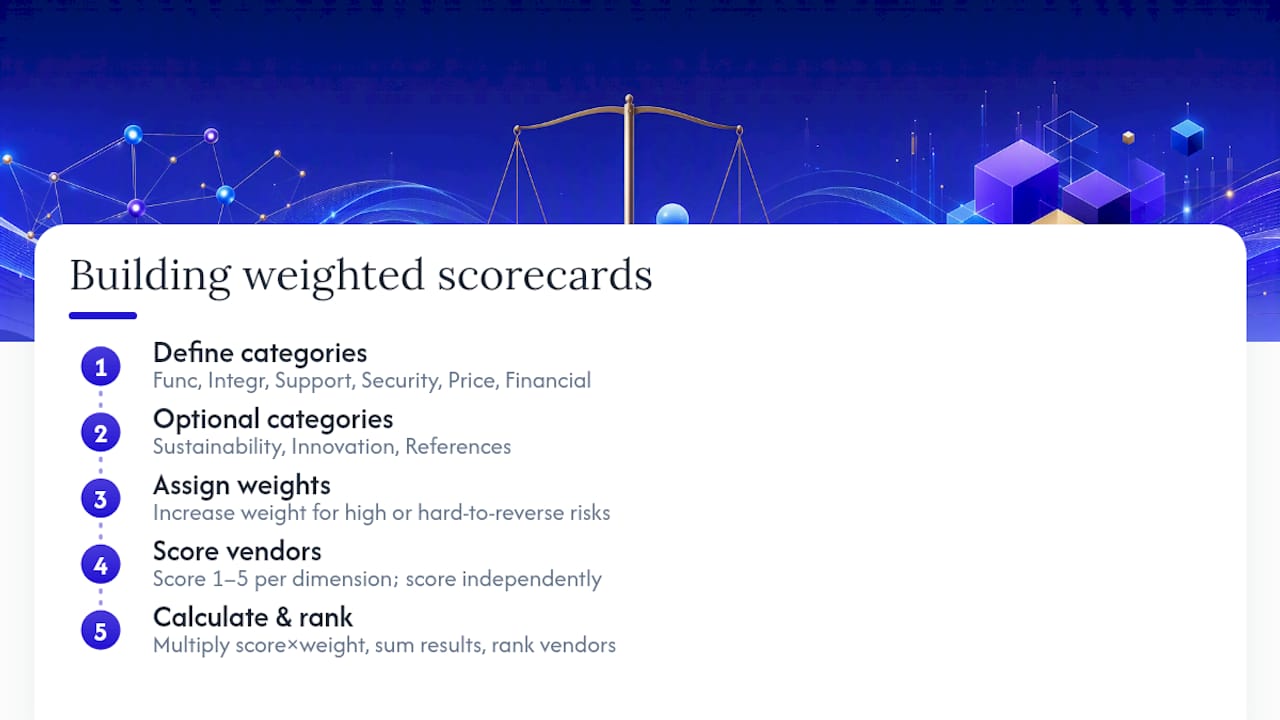
Increase a dimension's weight when the risk of failure there is high or hard to reverse. Security deserves more weight when a vendor touches customer data. Integration complexity deserves more weight when the tool must connect to a legacy system with limited API documentation. A commodity purchase with low switching costs can weight price more heavily than a platform decision that locks you in for five years.
Here is a sample scorecard using generic vendor labels and a 1 to 5 scoring scale per dimension:
To calculate a weighted total, multiply each score by its weight and sum the results. Run the same math for Vendor B and Vendor C and rank the totals.
Pro Tip: Score independently before any group discussion, then calibrate as a team. Averaging scores blindly hides disagreements that often point to a real risk one evaluator spotted and others missed.
This prevents a strong price or feature set from masking a serious gap elsewhere.
Which Data Collection Methods Work Best for Vendor Assessment?
Matching the right instrument to the right stage keeps your evidence comparable across vendors instead of a pile of mismatched documents.
RFI, RFP, or RFQ. An RFI gathers general capability information early in the sourcing phase, useful when your shortlist is still long. An RFP requests a detailed proposal against specific requirements once you've narrowed the field, and it should map every question directly to a scorecard dimension. An RFQ is narrower still, appropriate when the product is standardized and price is the deciding factor.
Build your supplier questionnaire around the scorecard, not around generic templates:
- Security certifications (SOC 2, ISO 27001, data residency policy).
- API documentation and integration architecture.
- Support model, including response time commitments and escalation paths.
- Implementation approach, timeline, and named project resources.
- Financial stability indicators and years in business.
For tools, the right choice depends on your evaluation volume and complexity:
- Spreadsheets work fine for a single evaluation with a handful of vendors and no ongoing monitoring need.
- E-procurement platforms add workflow and approval routing when multiple stakeholders need visibility.
- Supplier relationship management (SRM) systems support ongoing scorecards across a large vendor base.
- Vendor risk platforms automate financial and cybersecurity screening, which matters most for high-risk categories.
Design scenario-based demos using your own sample data, not the vendor's rehearsed script. That single change surfaces more real gaps than any number of reference calls.
What KPIs Should You Track After Selecting a Vendor?
Selection is not the finish line. The scorecard that got a vendor through the door needs a successor built from operational metrics that catch drift before it becomes a crisis.
Push uptime and on-time delivery to a weekly operational dashboard reviewed by the working team. Reserve cost variance, adoption, and SLA compliance for a monthly executive review, since those metrics matter more for strategic decisions than day-to-day fixes. Tie escalation thresholds directly to contractual remedies: two consecutive months below 95% SLA compliance, for example, should trigger a formal remediation clause rather than an informal conversation.
What Risk and Compliance Checks Belong in Vendor Screening?
Skipping risk screening is how a vendor that looked great on the scorecard turns into a liability six months into the contract. Before onboarding, request:
- Audited financial statements or, for smaller vendors, bank references and D&B reports.
- Sanctions and watchlist screening results.
- Certificates of insurance covering general liability and cyber liability.
- SOC 2 Type II or ISO 27001 certification, or an equivalent security audit.
- Data residency and subcontractor disclosure documentation.
Any one of these should pause the process until resolved, not get waved through because the demo went well.
Pro Tip: Fold risk findings directly into your weighted scorecard as a dedicated dimension rather than treating them as a separate gate. A vendor with a strong feature score but a thin financial profile should see its overall total drop, not just get flagged in a footnote.
Where residual risk remains acceptable but real, cover it in the contract with audit rights, data portability guarantees, and termination for cause tied specifically to the risk you identified.
How Should You Structure Vendor Onboarding and Development?
The evaluation earns its value only if onboarding executes on what the scorecard promised. Build a checklist with named owners and dates:
- Data migration plan, owned by IT, with a validated test migration before go-live.
- System integrations, owned by IT/architecture, tested against real transaction volume.
- User training, owned by operations, scheduled before the go-live date, not after.
- Go/no-go milestone review, owned jointly by procurement and operations, with documented sign-off criteria.
Your contract should lock in SLA and KPI elements before signature, including uptime guarantees, support response time tiers, data portability terms in case of termination, and payment milestones tied to delivery rather than a flat upfront fee.
Once live, run a supplier development plan on a fixed cadence:
- Quarterly business reviews covering KPI performance against contract terms.
- Roadmap alignment sessions to confirm the vendor's product direction still matches your needs.
- A staged ramp timeline that increases usage or volume only after each milestone clears review.
How Do You Design a Pilot to Reach a Final Decision?
A pilot only earns its keep if it produces a clear yes or no, not an open-ended trial that quietly becomes the permanent arrangement. Structure it around a fixed boundary and predefined KPIs, not a rolling extension.
- Bound the pilot to 60 to 90 days, as tkxel recommends, and set that end date in writing before it starts.
- Define KPIs across three categories: technical performance (uptime, integration stability), business adoption (user engagement, workflow completion), and vendor behavior (responsiveness, issue resolution).
- Assign independent measurement, meaning someone outside the vendor relationship reports the results.
A near-miss on one KPI can justify a short, defined remediation window rather than an outright rejection, but any exception to the rule needs a documented executive sign-off explaining why.
Pro Tip: Tie a portion of the contract payment to pilot milestones instead of releasing full payment at signature. It keeps the vendor invested in hitting the numbers they promised during the sales process.

Where Can You Find Reusable Scorecard and RFP Templates?
Building these artifacts from scratch each time wastes the discipline you just put into the process. Here's a compact scorecard you can copy directly:
For your RFP, map every question back to a scorecard row:
- Functionality: "Describe how your platform handles [your top three use cases]."
- Integration: "Provide API documentation and list of existing integrations with [your core systems]."
- Security: "Attach current SOC 2 or ISO 27001 certification."
- Support: "State guaranteed response time by severity tier."
- Pricing: "Break down implementation, licensing, and support costs separately."
- Vendor health: "Provide years in business and top three client references."
Common cost drivers that inflate the timeline and budget include integration complexity with legacy systems, custom configuration beyond the vendor's standard offering, data migration volume, and vendor travel or on-site support requirements. Flag these during scoring so they show up in the TCO line, not as a surprise change order after signing.
How AutoROIQ Applies This Framework in Practice
A regional dealership group recently needed to evaluate a new digital advertising analytics vendor after years of relying on self-reported vendor metrics.
Three finalists reached the scorecard stage after an initial screen of eight candidates. A 75-day pilot measured campaign attribution accuracy against an independent benchmark, CRM sync reliability, and support ticket resolution time. All three KPIs passed within the agreed window, and the contract moved forward with milestone-based payments tied to a 90-day and 180-day performance checkpoint.
The gap between what a vendor claims in a pitch deck and what an independent scorecard confirms is usually where the real decision gets made, not in the sales presentation itself.
AutoROIQ builds its own marketing performance analysis around this same discipline: vendor-agnostic scorecards, independent measurement, and executive-level recommendations that dealerships can defend to their own leadership. Applied frameworks like the GA4 vs Adobe Analytics comparison and the ad creative testing playbook show the same scoring logic applied to specific marketing technology decisions.
Get a Second Opinion on Your Vendor Scorecard
Building a defensible scorecard is straightforward on paper and harder in practice, especially when internal politics or a persuasive sales team push against the numbers. Dealership leaders who want an independent check on vendor performance data, rather than relying on the vendor's own self-reported metrics, can bring in AutoROIQ's marketing intelligence and advisory services for a vendor-agnostic review. AutoROIQ doesn't sell advertising and doesn't have a stake in which vendor wins, which is precisely the position you want when the scorecard results are close and the stakes are high.
The Overlooked Discipline in Vendor Evaluation
Most vendor evaluation advice focuses on what to ask vendors. The bigger failure point is what procurement teams ask themselves, or rather, fail to ask, before the first demo ever happens. Locking weights after seeing a polished presentation is the single most common mistake in this process, and it's rarely named as such. Teams call it "keeping an open mind," but an unlocked rubric just means the best salesperson wins instead of the best fit.
The conventional advice to "compare several vendors" also undersells how much the finalist count matters. Evaluating ten vendors with shallow scrutiny produces worse decisions than evaluating three with real rigor. Depth beats breadth every time in this process.
If you take one thing from this framework, make it the pilot boundary. Open-ended trials are where accountability goes to die, because nobody wants to be the one who calls a six-month "trial" a failure. A fixed window with predefined KPIs forces the conversation to happen on schedule, whether the news is good or not.
Frequently Asked Questions
What is new vendor evaluation?
New vendor evaluation is the structured process of assessing a prospective supplier against documented criteria, typically covering functionality, cost, risk, and capability, before signing a contract. It differs from a casual vendor comparison because it produces a weighted, auditable score rather than a subjective impression.
How long should a new vendor evaluation take?
Mid-complexity purchases typically run on a six-week cadence from requirements definition through pilot launch. More complex technology or multi-site vendor decisions often extend to ten or twelve weeks, largely due to pilot duration and legal review time.
What is the difference between an RFI, RFP, and RFQ in vendor selection?
An RFI gathers general capability information early when your shortlist is still long. An RFP requests a detailed, criteria-mapped proposal from a narrowed field. An RFQ focuses narrowly on price for standardized products where the specification is already settled.
How do you evaluate a marketing agency using the same framework?
Score agencies on business fit, strategic judgment, capability depth, and delivery model with a weighted scorecard rather than relying on polished pitch decks. The same pilot logic applies: a bounded trial campaign with predefined KPIs beats an open-ended engagement for testing real performance.
What should disqualify a vendor regardless of overall score?
A vendor that fails a critical dimension should be eliminated even with a strong overall weighted total.
How do you handle disputes with a newly onboarded vendor?
Reference the SLA and remediation clauses built into the contract during onboarding. Escalate through the documented threshold, such as two consecutive months of missed SLA compliance, and require a formal remediation plan with a deadline before considering termination.
Sources
- Supplier Evaluation - How to Evaluate Suppliers
- Vendor Evaluation Framework Guide | tkxel
- Vendor Evaluation Template: Free Download — Fairview
- Software Vendor Evaluation: A Framework That Works | 137Foundry