
Yes, modern TV advertising attribution can link TV exposure to measurable dealer outcomes, but only when the setup combines household-level matching, CRM integration, and daily re-scoring. Skip any of the three and you get a vendor report that looks confident but can't survive an audit. The priority for dealership marketing leaders is simple: before trusting any lift number, validate the vendor's match methodology.
TL;DR:
- Valid TV attribution requires household-level matching, CRM integration, and daily re-scoring; skipping any of these compromises accuracy.
- Deterministic matching is preferred for deduplicating linear and streaming exposures, while probabilistic is a fallback used in limited coverage areas.
- Using multiple attribution models and testing creative rotations improve reliability, especially given the long purchase cycle in automotive sales.
- Offline signals like test drives and showroom visits should be integrated with exposures to accurately link TV ads to sales results.
- Vendor audits should focus on match methodology, re-scoring frequency, and baseline construction to prevent conflicting reports and ensure trustworthy data.
Table of Contents
- What Does TV Advertising Attribution Actually Mean for Dealers?
- Is Your Dealership Ready to Measure TV Attribution?
- How Do TV Attribution Models Actually Work?
- Deterministic vs. Probabilistic Matching: What's the Real Difference?
- How Do You Implement TV Attribution at Your Dealership?
- What KPIs Should You Track, and How Often?
- What Pitfalls Should You Watch for When Auditing a TV Vendor?
- How Do Frequency and Creative Rotation Affect Attribution Accuracy?
- Why Is Dealership Attribution Harder Than Attribution in Other Industries?
- How Do You Fold in Test Drives and Showroom Visits, Not Just CRM Leads?
- How Are Privacy Rules Like CCPA Changing TV Attribution?
- Can Machine Learning Actually Improve Attribution Precision?
- How Do You Know If Your Attribution Results Are Actually Good?
- What Do We Think Dealerships Get Wrong About TV Attribution?
- How Can AutoROIQ Help You Validate Your TV Attribution?
- Sources
What Does TV Advertising Attribution Actually Mean for Dealers?
TV advertising attribution connects a specific TV airing, whether it ran on linear broadcast or Connected TV (CTV), to a measurable action a shopper takes afterward: a website visit, a vehicle detail page (VDP) view, a trade-in form submission, a call to the sales floor, or a showroom visit. Done well, it turns a media buy into a traceable chain of events instead of a monthly invoice you hope is working.
The industry has moved past the old model of waiting weeks for a post-campaign PDF. Modern attribution methods can surface consumer response within days of an ad airing, a shift that matters enormously for a dealership trying to decide whether to keep running a monthly spot buy costing tens of thousands of dollars or shift dollars to a better-performing daypart. That speed only counts if the underlying matching is deterministic and the reporting gets refreshed daily rather than dumped at the end of a flight.
Here's the checklist that tells you whether your dealership is ready to run a real pilot or whether you need a vendor audit first.
Is Your Dealership Ready to Measure TV Attribution?
Before committing budget to a pilot, confirm these four conditions hold:
- Your CRM captures lead and appointment events in a format a measurement vendor can actually ingest.
- Your TV vendor offers deterministic household matching or a documented, validated lift methodology, not a black box.
- The vendor states its attribution window and explains how it deduplicates overlapping linear and CTV exposures.
- The vendor re-scores daily or near-real-time, rather than delivering one static report after the flight ends.
If you can't check all four, fix those gaps before spending on a pilot. A measurement plan built on unverified inputs just produces a more precise-looking wrong answer.
How Do TV Attribution Models Actually Work?
Vendors typically lean on one of three model families, and each answers a different question.
View-through attribution credits a conversion to anyone who was exposed to an ad and then converted within a set window, commonly within a few days for high-intent categories like automotive. It's the simplest model to build and the easiest to inflate, since it doesn't require proving the ad caused the visit rather than merely preceding it.
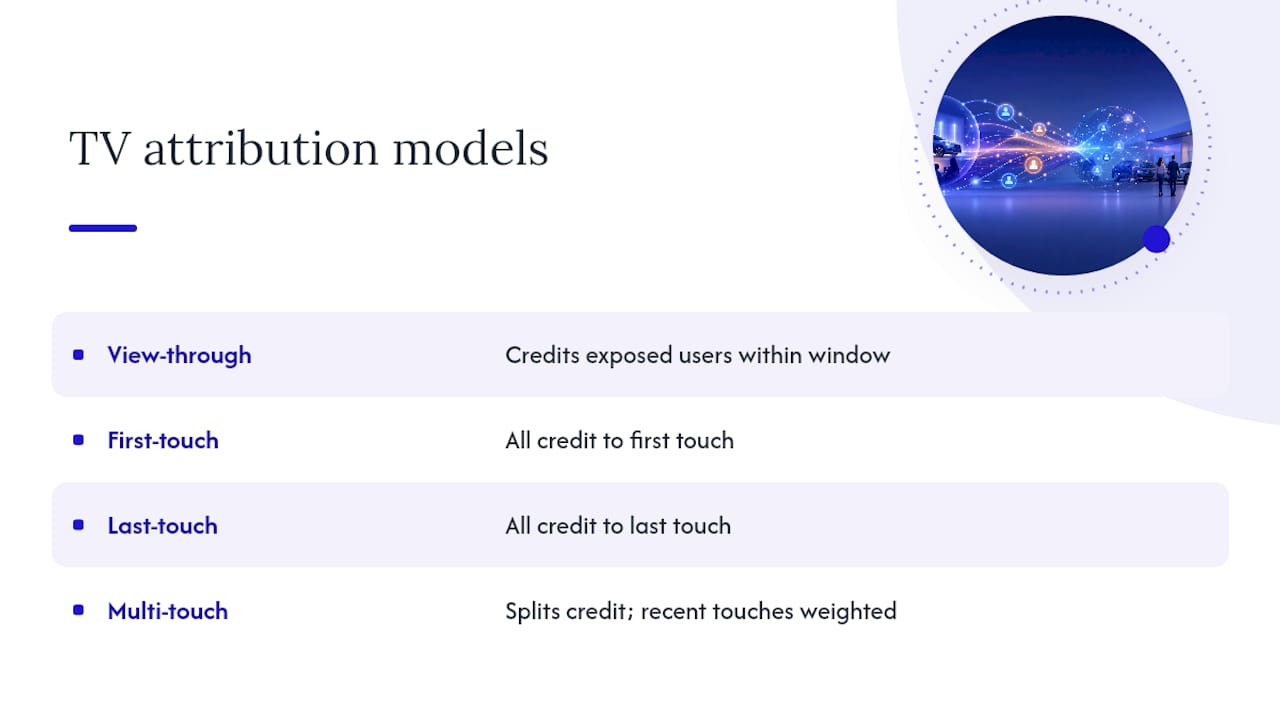
First-touch and last-touch models assign 100% of the credit to either the first or the last marketing touch a shopper had before converting. For a dealership running TV alongside paid search and retargeting, last-touch attribution almost always shortchanges TV, because TV drives the initial search intent that a branded search ad later "catches." First-touch does the opposite, overcrediting the earliest channel.
Linear and time-decay multi-touch models spread credit across every touchpoint a shopper had, weighting more recent touches more heavily. This gets closer to reality for longer automotive purchase funnels, where a shopper might see a TV spot, research for two weeks, then visit three competing dealership sites before calling.
Single-touch models are acceptable for short-funnel promotions like a Friday-Saturday-Sunday clearance event, where the buying window is compressed enough that view-through data is directionally useful. For anything longer, triangulating multiple models against an exposed-versus-control comparison produces far stronger evidence than trusting a single number. When a vendor's model disagrees sharply with a second model run on the same data, that gap itself is diagnostic. It usually means the attribution window or the deduplication logic is off, not that the campaign underperformed.
Deterministic vs. Probabilistic Matching: What's the Real Difference?
Deterministic matching links a specific household to a specific ad exposure using verified identifiers, like a set-top box ID or ACR (automatic content recognition) signal tied to a household, matched against site or CRM data through hashed identifiers. Platforms with large proprietary viewership datasets report high match rates when deterministic signals are available, and that precision is exactly why deterministic matching is the preferred method for deduplicating exposures across linear and streaming. Without it, a household exposed to the same creative on both broadcast and a streaming app gets counted twice, quietly inflating reach and reported lift.
Probabilistic matching estimates household-level connections using statistical modeling rather than verified identifiers. It's typically used when deterministic signal coverage is thin, in smaller media markets or with older set-top infrastructure, and it's a reasonable fallback, but it should be labeled as such in any report you receive.
Privacy constraints shape both approaches. Vendors should be able to describe how they generate aggregated, non-personally-identifiable reports rather than exposing raw household-level data to your dealership, and they should be able to explain their hashing workflow in plain language. Ask for a written match-methodology summary and a description of how identifiers get hashed before they ever touch your CRM. A vendor that can't produce this in a straightforward one-page document is a vendor you should be skeptical of, regardless of how polished the dashboard looks.
How Do You Implement TV Attribution at Your Dealership?
Building a working attribution setup is a sequencing problem more than a technology problem. Follow this order:
- Confirm your exposure feed. Get airing logs from your TV vendor or an ad-intelligence source; detection APIs that continuously track ad occurrences and airing metadata give engineering teams a clean, structured feed to work from instead of manually reconciling traffic logs.
- Standardize UTM tagging across every campaign and creative variant so your analytics platform can isolate traffic by spot, network, and daypart.
- Connect offline events to your CRM, including call tracking so phone leads generated by a spot get credited the same way a web form does.
- Feed vendor exposure data into your analytics or BI layer and join it against CRM records, deduplicating overlapping linear and CTV exposures at this stage, not after reporting.
- Set explicit attribution windows, schedule daily re-scoring, and run a real exposed-versus-control validation before trusting the topline lift number.
- Start with one market or one campaign. Validate the lift is real, then scale to additional stores or dayparts.
Pro Tip: Run your first pilot in your smallest or most self-contained market. A single-store, single-market test isolates variables you can't control in a five-rooftop group, and it gives you a clean baseline before you scale spend based on the results.
What KPIs Should You Track, and How Often?
The KPIs that matter are the ones tied to incremental outcomes, not raw volume.
- Primary KPIs: incremental site visits, form leads, trackable phone calls, showroom visits, and sales attributed above your baseline.
- Derived KPIs: cost per incremental lead, cost per incremental sale, and total lift versus a modeled or control-group baseline.
- Reporting cadence: daily re-scoring for in-flight optimization decisions, a weekly summary for the marketing team, and a monthly rollup for GM-level review.
Vendor platforms commonly report traffic spikes and can measure mid- and lower-funnel outcomes tied directly to airings, but the number that belongs in front of your general manager is incremental lift, not gross exposed volume. A report that shows "12,000 site visits from exposed households" without a control comparison tells you almost nothing about whether the campaign caused those visits.
What Pitfalls Should You Watch for When Auditing a TV Vendor?
Three pitfalls show up constantly in vendor reporting: siloed dashboards that never get reconciled against your CRM, attribution windows that quietly shift between reporting periods, and failure to deduplicate a household exposed on both linear and CTV. Relying solely on a post-campaign report compounds all three, since by the time you catch the mismatch, the budget's already spent.
Run every vendor through this five-question audit before signing or renewing:
- What is your match method, deterministic or probabilistic, and what's your typical match rate?
- How often does your model re-score, and can I see a mid-flight report, not just a final one?
- How is your baseline constructed, and what does the exposed group get compared against?
- Can you provide exposed-versus-control evidence, and what was the sample size?
- Can I export raw matched counts, or only your summarized dashboard view?
An independent audit of vendor match methodology and re-scoring cadence is the single most reliable way to prevent conflicting vendor reports from misallocating your next quarter's budget. The clearest red flag is a vendor who can describe their results in detail but goes vague the moment you ask how those results were calculated.
How Do Frequency and Creative Rotation Affect Attribution Accuracy?
Attribution accuracy degrades when the same household sees the same creative too many times inside one attribution window, because view-through models can't easily separate "this ad caused a new visit" from "this household was already going to visit and happened to see the ad again." High-frequency, low-rotation campaigns, the kind where one 30-second spot airs a dozen times a week on the same network, tend to produce inflated view-through numbers relative to what an exposed-versus-control test shows.
Rotating creative on a defined cadence, say every two to three weeks, gives you a cleaner read because you can compare lift by creative version, not just by campaign. It also solves a measurement problem dealerships underestimate: if your incentive offer changes mid-flight but your creative doesn't, your attribution data can't tell you whether a lift spike came from the ad or from the new offer showing up on your website. Testing creative variants deliberately rather than letting one spot run unchanged for months gives your attribution model something concrete to isolate. Dealerships that run the same 15-second spot for a full quarter typically see their attribution confidence intervals widen over time, not narrow, simply because saturation makes it harder to tell an incremental viewer from a habitual one.
Why Is Dealership Attribution Harder Than Attribution in Other Industries?
Automotive attribution carries a structural problem most retail categories don't face: an unusually long consideration window paired with an unusually high-value, infrequent purchase. A shopper might see a TV spot in March and not buy until July, researching across a dozen third-party sites in between, which stretches any fixed attribution window past its useful limit.
Dealerships also run multi-rooftop, multi-market campaigns where the same regional TV buy covers several stores with separate CRMs, separate inventory, and separate local promotions. A vendor's household-level match might correctly identify that a home saw the ad, but if that household's eventual visit gets logged under the wrong rooftop's CRM, your per-store ROI numbers come out wrong even though the aggregate number is fine.
Compare that to a quick-service restaurant chain, where the purchase cycle is measured in days and the CRM is a single centralized system. Dealership attribution has to solve for both a longer funnel and a fragmented data structure at the same time, which is exactly why CRM integration and rooftop-level tagging deserve more engineering attention in automotive than the standard vendor playbook usually assumes.
How Do You Fold in Test Drives and Showroom Visits, Not Just CRM Leads?
CRM data captures a shopper the moment they fill out a form or call, but it misses the shopper who saw a TV spot, drove to the lot on a Saturday, took a test drive, and left without submitting any digital record. That gap matters more in automotive than almost any other retail category, because the test drive is frequently the highest-intent action in the entire funnel.
Closing that gap requires pulling in offline signals that live outside a standard CRM: license-plate or geofenced visit detection tied to your lot's location, DMS (dealer management system) records of test-drive sign-ins, and point-of-sale data from the F&I office once a deal closes. Joining these offline events back to the original exposure data closes the loop between the ad and the sale rather than stopping at the lead.

The practical hurdle is timing. A test drive logged in your DMS on a Tuesday afternoon needs a timestamp precise enough to join against the TV exposure window from the prior week, and most dealership DMS platforms weren't built with attribution joins in mind. Getting IT and the sales floor to log showroom visits consistently, even something as basic as a "how did you hear about us" field tied to a timestamp, does more for attribution accuracy than any additional ad tech layer.
How Are Privacy Rules Like CCPA Changing TV Attribution?
Privacy regulation is pushing TV attribution toward aggregated, non-personally-identifiable reporting rather than household-level data changing hands directly with advertisers. Under frameworks like the California Consumer Privacy Act (CCPA) and the EU's General Data Protection Regulation (GDPR), vendors increasingly perform matching on their own side of a hashed data wall, sending dealerships summarized lift and reach numbers rather than raw household identifiers.
For dealerships, this shift is mostly good news operationally, since it removes the compliance burden of handling sensitive matched data directly. The tradeoff is that you have less visibility into the raw matched counts unless you specifically ask for them in an aggregated, privacy-safe export. This is exactly why the vendor audit checklist above includes asking whether a vendor can export raw matched counts at all, since some can only surface a dashboard summary with no underlying detail.
Regulatory pressure has also accelerated the industry's move away from third-party cookies and toward household-level deterministic identifiers and clean-room style data collaborations, where two parties can query matched data without either side seeing the other's raw records. That's a meaningful shift from the pre-regulation era when attribution vendors sometimes moved raw PII (personally identifiable information) between systems with minimal oversight. Ask any new vendor directly how they handle consent and data minimization under whichever framework applies to your state, since the answer varies more between vendors than most dealerships assume.
Can Machine Learning Actually Improve Attribution Precision?
Machine learning earns its place in TV attribution primarily in baseline modeling, the process of estimating what site traffic or lead volume would have looked like without the ad running at all. A simple week-over-week comparison can't account for seasonality, a competitor's promotion, or an unrelated news event driving traffic, but a model trained on years of historical traffic patterns can isolate those variables and produce a cleaner counterfactual.
AI-driven planning tools that re-score daily also allow program-level and daypart-level optimization that would be impractical to calculate manually across dozens of networks and time slots. Instead of waiting for a monthly report to learn that late-night airings on one network are outperforming prime-time spots on another, a daily-scoring model can surface that signal within a week, early enough to actually shift the media buy before the flight ends.
The caveat dealership marketers should hold onto: machine learning improves the quality of the baseline and the speed of the read, but it doesn't replace the need for an exposed-versus-control test. A model can be precisely wrong if it's trained on flawed deduplication or an inconsistent CRM feed underneath it. Treat ML-driven scoring as a way to sharpen a fundamentally sound measurement setup, not a substitute for fixing bad data at the source.
How Do You Know If Your Attribution Results Are Actually Good?
Benchmarking TV attribution is harder than benchmarking digital channels because there's no universal published standard the way there is for, say, average email open rates. What functions as a benchmark in practice is your own dealership's baseline, measured consistently over multiple flights, plus directional comparisons against similar-sized stores in comparable markets.
A useful internal benchmark tracks three numbers over time: your incremental lift percentage versus modeled baseline, your cost per incremental lead, and your match rate consistency from one vendor report to the next. If your match rate swings by double digits between reporting periods with no change in your campaign structure, that's a signal about vendor reporting stability, not your creative performance. Running a documented pilot with an exposed-versus-control structure before scaling gives you a defensible internal benchmark you can hold every future campaign against, which matters more for decision-making than any industry-wide average would.
What Do We Think Dealerships Get Wrong About TV Attribution?
The biggest mistake we see isn't picking the wrong attribution model. It's trusting a single vendor's number without ever asking how that number was built. Dealership marketing directors will happily interrogate a $50 cost-per-lead figure from a digital vendor line by line, then accept a TV vendor's reported lift at face value because the report looks polished and comes with a logo on it.
AutoROIQ exists because those two situations shouldn't be treated differently. As independent, vendor-agnostic marketing intelligence for automotive dealerships, we evaluate vendor performance and marketing channels using the same proprietary methodology whether the media in question is TV, digital, or direct mail, and we don't sell any of it ourselves. That's the structural difference that matters: a vendor grading its own homework has an incentive problem baked in, no matter how sophisticated its dashboard looks. Our guides on multi-touch attribution and closed-loop measurement exist because the underlying discipline, insisting on deterministic matching, transparent windows, and daily re-scoring, applies across every channel a dealership funds, not just TV.
The uncomfortable truth is that most conflicting vendor reports aren't lies. They're the predictable result of different attribution windows, different deduplication logic, and different baseline assumptions producing different numbers from the same campaign. Independent verification doesn't just catch fraud. It catches honest methodology mismatches that would otherwise send budget to the wrong channel for a full fiscal year.
— AutoROIQ
How Can AutoROIQ Help You Validate Your TV Attribution?
If you're staring at three vendor reports claiming three different lift numbers for the same TV flight, that's not a data problem you can solve with another dashboard. It's a validation problem, and it's exactly what AutoROIQ was built to fix.

AutoROIQ runs independent, vendor-agnostic reviews of your TV attribution setup, checking match methodology, attribution windows, re-scoring cadence, and CRM integration against the standards outlined above, then delivers executive-level recommendations your GM can actually act on. Because AutoROIQ doesn't sell media or run campaigns, there's no incentive to inflate a lift number or protect a vendor relationship. The recommendations point wherever the data actually leads, including toward cutting a channel that isn't working. If your dealership is planning a TV attribution pilot or auditing an existing vendor contract, request an independent marketing intelligence review and get a clear, defensible read on what your TV spend is actually producing before you commit another quarter of budget to it.
Sources
- Everything You Need to Know About TV Attribution — Veritone
- Outcomes Plus — Comcast Advertising
- Linear TV Advertising Platform - Simulmedia's TV+
- The Guide to TV Advertising Attribution — TEGNA
- Ad intelligence API — TVEyes