
Cost per vehicle sold equals total marketing cost divided by attributed vehicles sold, and it should function as the single governing metric for evaluating marketing spend. Tracking it aligns every advertising dollar with actual gross profit rather than vanity traffic or lead counts. Executives who compare their number to a blended benchmark and flag any vendor running above target gain immediate leverage in budget and vendor accountability conversations.
TL;DR:
- Focusing on source-level attribution reveals true cost per vehicle sold and prevents overestimating channel performance based on lead data alone.
- A good benchmark for cost per vehicle sold generally falls between $500 and $750, with high-efficiency dealerships achieving $250 to $350.
- Accurate attribution requires closing lead-to-sale loops, standardizing tagging, and conducting holdout tests to measure incremental sales reliably.
- Evaluating channel value by gross profit per sale helps identify high-margin contributors, with a 3x to 5x ROI indicating strong performance.
- Regular vendor-agnostic diagnostics improve budget allocation by standardizing measurement and ensuring marketing spend aligns with sales and profitability goals.
Table of Contents
- What Is the Formula for Cost Per Vehicle Sold?
- What Is a Good Cost Per Vehicle Sold Benchmark?
- How Do You Get Accurate Attribution Data?
- How Do You Judge Channel Value Against Gross Profit?
- What Steps Lower Cost Per Vehicle Sold?
- How Have Dealers Actually Reduced Cost Per Vehicle Sold?
- AutoROIQ's Take on Vendor-Agnostic Measurement
- How AutoROIQ Turns This Into a Vendor Review
- Sources
- FAQ
What Is the Formula for Cost Per Vehicle Sold?
The blended calculation is straightforward: total marketing spend divided by total units sold in the same period. If a dealership spends $180,000 in a month and sells 240 vehicles, the blended cost per sale is $750. That single number tells you almost nothing about which channel earned its keep, though.
Source-level cost per sale fixes that blind spot. Divide each vendor's or channel's cost by the vehicles actually attributed to it, not the leads it generated. This distinction matters because cost-per-lead and cost-per-sale routinely diverge. A Rework analysis of cost-per-sale calculations shows why: a channel spending $10,000 that converts 30 sales costs roughly $333 per sale, while another channel spending the same $10,000 but converting only 3 sales runs closer to $3,333 per sale, even if its cost-per-lead looked cheaper on paper.
- Blended formula: Total marketing spend ÷ total vehicles sold
- Source-level formula: Channel spend ÷ vehicles attributed to that channel
- Include everything: Agency fees, creative production, martech subscriptions, and internal marketing salaries belong in the numerator, or your PVR understates true cost
Skipping that third step is common, and it can understate real cost per sale by 20 to 35 percent, which makes a struggling channel look far healthier than it is.
What Is a Good Cost Per Vehicle Sold Benchmark?
Context determines whether $600 per vehicle is a win or a warning sign. Store size, new versus used mix, and market competitiveness all shift what "good" looks like.
- Average dealership marketing cost per vehicle sold typically falls in the $500 to $750 range
- High-efficiency dealers push that down to $250 to $350 per vehicle, usually by leaning harder on organic and retention channels rather than simply slashing ad budgets
- NADA guidance suggests allocating roughly 6 to 7 percent of gross profit to marketing, a sharper lens than measuring against revenue alone
By the numbers: The average dealership spent $586,246 on advertising, working out to $739 per new vehicle sold with an ad-to-sales ratio of 0.77 percent, according to NADA data.
Luxury stores often tolerate a higher cost per vehicle sold because gross profit per unit absorbs it comfortably. Volume used-car operations can't afford that luxury; their margins demand tighter numbers. A dealership in growth mode chasing market share will also run a different target than one in maintenance mode protecting an established customer base, and both are legitimate strategies as long as the target is chosen deliberately rather than inherited from last year's budget.
How Do You Get Accurate Attribution Data?
A cost per vehicle sold figure is only as trustworthy as the attribution behind it. Loose tagging and mismatched CRM records produce numbers that flatter the wrong vendors.
- Close the loop between leads and sales. Connect every lead record in your CRM or DMS to its outcome, then reconcile monthly so a sale never goes unattributed or gets double counted.
- Standardize tagging and windows. Apply consistent UTM parameters across every campaign and agree on a single attribution window across all vendors, since a 7-day window versus a 30-day window from two different vendors makes comparison meaningless.
- Account for multi-touch reality. Most buyers touch three or four channels before purchase, so treat last-click attribution as directional, not definitive.
- Run holdout tests. Pause or reduce a channel in one market or one week and measure the sales difference against a control group. This is the only reliable way to confirm a channel is driving incremental sales rather than capturing credit for demand that existed anyway.
Closed-loop attribution practices built on UTM discipline, CRM/DMS reconciliation, and periodic incrementality testing turn a rough PVR estimate into a figure you can defend in a vendor meeting.
Pro Tip: Before you cut a vendor's budget based on a high cost per sale, run a two-week holdout first. Vendors dispute attribution far less often when the data comes from a controlled test rather than a monthly report.
How Do You Judge Channel Value Against Gross Profit?
Cost per sale alone can mislead you if you ignore what each sale actually earns. A channel with a high PVR can still be your best performer if it sells higher-margin units, and a cheap channel can be a hidden loss if it only moves thin-margin inventory.
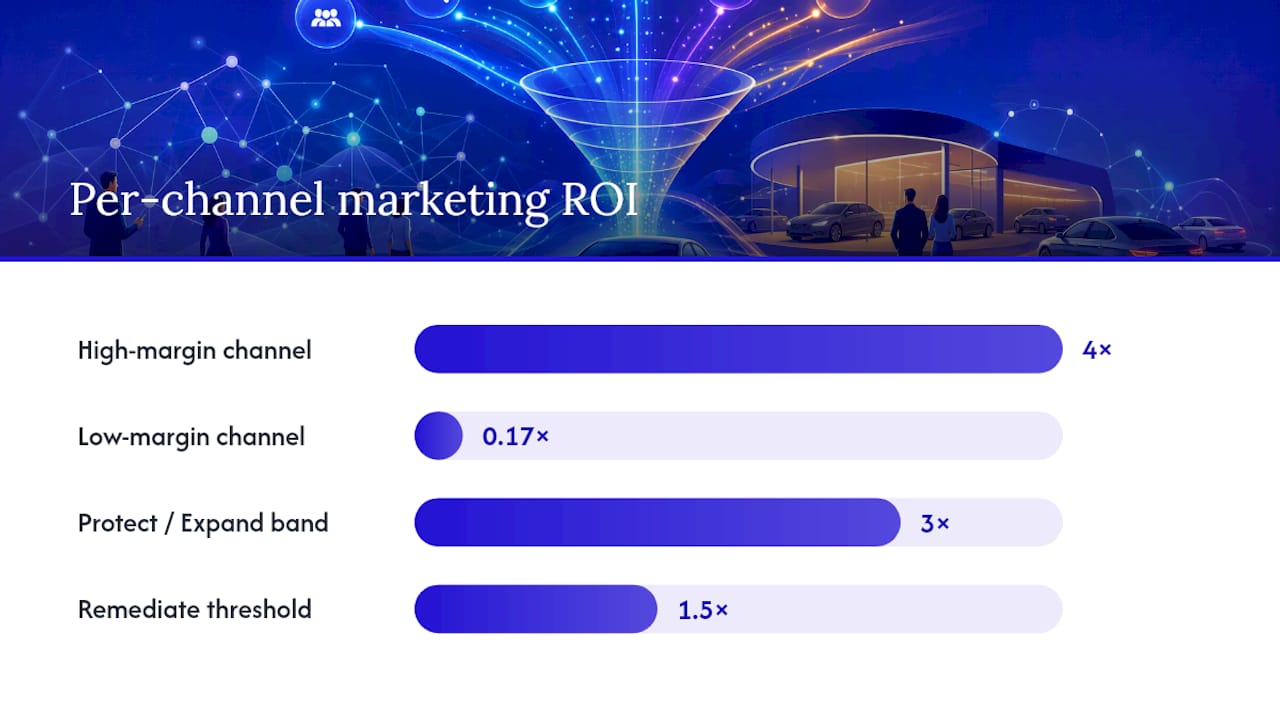
Calculate per-channel marketing ROI with this formula: (gross profit per sale minus cost per sale) ÷ cost per sale.
- A channel generating $2,500 gross profit per sale at a $500 cost per sale returns 4x, solidly in winner territory
- A channel converting at only $300 cost per sale but generating just $350 gross profit returns under 0.2x, a channel that looks cheap and performs poorly
- Set decision bands: 3x to 5x signals a channel worth protecting or expanding, while anything under 1.5x should be flagged for remediation or reallocation
This is the calculation that resolves the recurring cost per lead versus cost per sale debate in vendor meetings: profit contribution, not lead volume, decides who keeps budget.
What Steps Lower Cost Per Vehicle Sold?
Executives don't need a new dashboard to start improving PVR. They need governance discipline applied consistently across every vendor.
- Set one measurable PVR target per store and write it into vendor scorecards
- Require closed-loop reporting on a single, agreed attribution window from every vendor
- Fold all marketing costs, including agency fees and internal salaries, into the calculation
- Run a short holdout test before any major budget reallocation
- Shift spend toward channels in the 3x to 5x ROI band and away from anything under 1.5x
- Review vendor performance monthly, with documentation standards every vendor must meet
Anchoring the budget to a defined cost per sold vehicle target, rather than an arbitrary media plan, is the practice that aligns spend with inventory and sales objectives instead of just filling a calendar with impressions.
Pro Tip: Put the monthly PVR review on the same calendar cadence as your floor plan review. Vendors treat a recurring, dated meeting differently than an ad hoc call.
How Have Dealers Actually Reduced Cost Per Vehicle Sold?
The dealers who move their PVR number meaningfully rarely do it by cutting the ad budget across the board. They do it by reallocating toward what the attribution data proves is working and walking away from what isn't.
One common pattern: a store discovers through incremental testing that a legacy directory listing service, running for years on autopilot, produces almost no attributable sales once holdout data isolates its actual lift.
Video advertising has produced similarly sharp swings when dealers validate it properly rather than assuming it works because it looks good. One documented case tied structured testing of video advertising to a 47 percent sales lift once the store isolated incremental impact instead of crediting video for sales that other channels had already influenced.
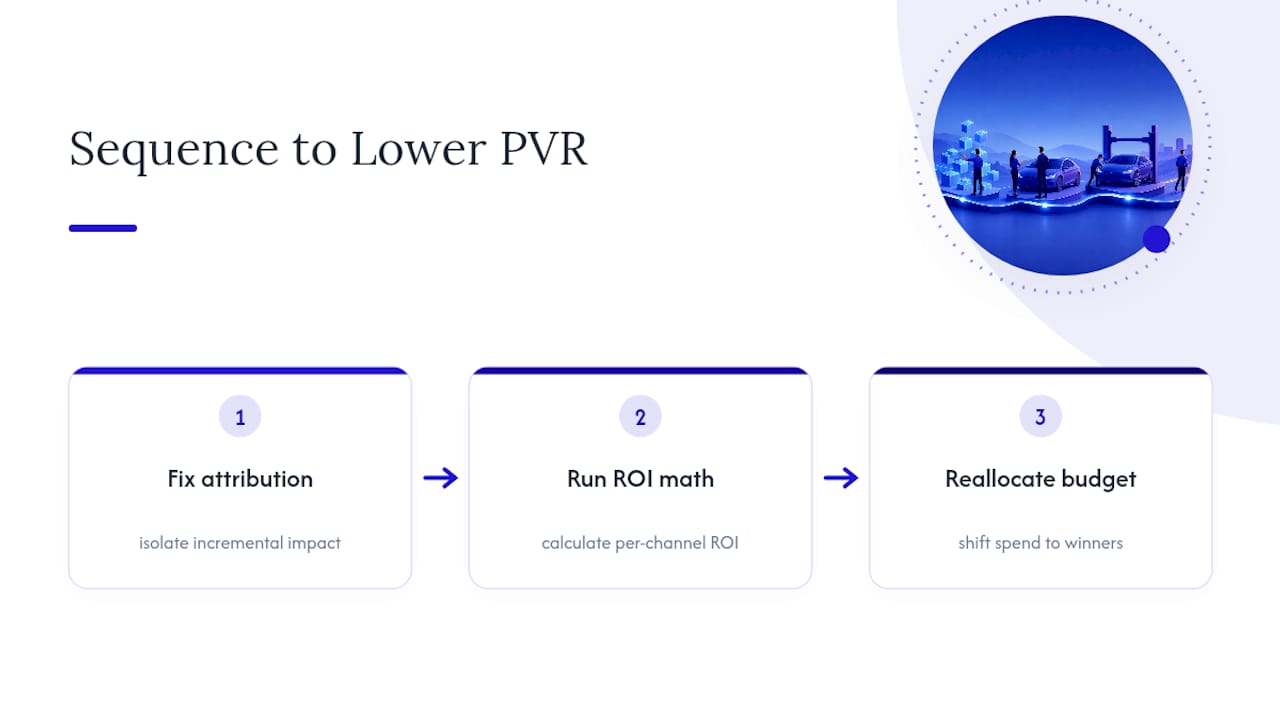
The common thread across every real reduction case is sequencing: fix attribution first, then run the ROI math per channel, then reallocate. Dealers who reallocate before they trust their attribution usually end up right back where they started, just with a different vendor to blame. A documented plan to lift marketing ROI by up to 40 percent follows exactly that order, and it's the order that separates a durable PVR improvement from a one-month blip that reverses itself.
AutoROIQ's Take on Vendor-Agnostic Measurement
Every vendor walks into a budget meeting with a report proving their channel worked. That's the structural problem with letting vendors grade their own performance: incentives and measurement sit with the same party. AutoROIQ exists because dealership executives need a scorecard nobody selling media had a hand in building.
A vendor-agnostic review standardizes attribution windows and cost inputs across every channel at once, so a $400 cost per sale from one vendor and a $650 cost per sale from another are actually comparable instead of built on different assumptions. That standardization is usually where the real disputes end. Once every vendor is measured the same way, the conversation shifts from "whose report is right" to "where does the next dollar go."
— AutoROIQ
How AutoROIQ Turns This Into a Vendor Review
Running this math internally, month after month, across every vendor and every attribution window, is where most marketing directors run out of hours before they run out of vendors to check. That's the gap AutoROIQ closes.

A service that delivers an independent diagnostic of your marketing spend: a scorecard that standardizes attribution, calculates blended and source-level cost per vehicle sold, and ranks every channel against relevant ROI bands. Because the service does not sell advertising, the recommendations that come out of a diagnostic have no incentive attached to steering budget toward any particular vendor. Clients typically walk away with clearer vendor accountability, a lower blended PVR within a couple of reporting cycles, and a prioritized list of where the next marketing dollar should go. If your last vendor review left you with three conflicting reports and no clear answer, request a diagnostic at AutoROIQ and get a number every vendor has to answer to.
Sources
- Insideradio
- Automotive Industry Marketing Benchmarks 2026
- Cost-per-sale analysis — Rework resources
- How to Set a Dealership Marketing Budget | Auto Ad Academy
FAQ
What Is a Good Cost Per Vehicle Sold?
Industry averages run $500 to $750 per vehicle, while high-efficiency dealers achieve $250 to $350 per vehicle through tighter attribution and channel selection rather than blanket budget cuts.
How Do You Calculate Cost Per Vehicle Sold?
Divide total marketing spend, including agency fees and creative production, by the number of vehicles sold in the same period; source-level calculations divide individual channel spend by vehicles attributed to that specific channel.
Why Does Cost Per Lead Differ From Cost Per Sale?
Conversion rates vary sharply by channel, so a cheaper cost per lead can still produce a more expensive cost per sale if that channel closes at a lower rate than a pricier lead source.
How Much Should a Dealership Spend on Marketing?
NADA guidance points to roughly 6 to 7 percent of gross profit, a more reliable anchor than a flat revenue percentage since it ties spend directly to profitability.
Can AutoROIQ Help Lower My Cost Per Vehicle Sold?
Yes. Independent diagnostics can standardize attribution across every channel and vendor, producing a defensible PVR scorecard executives can use to reallocate budget toward proven performers.