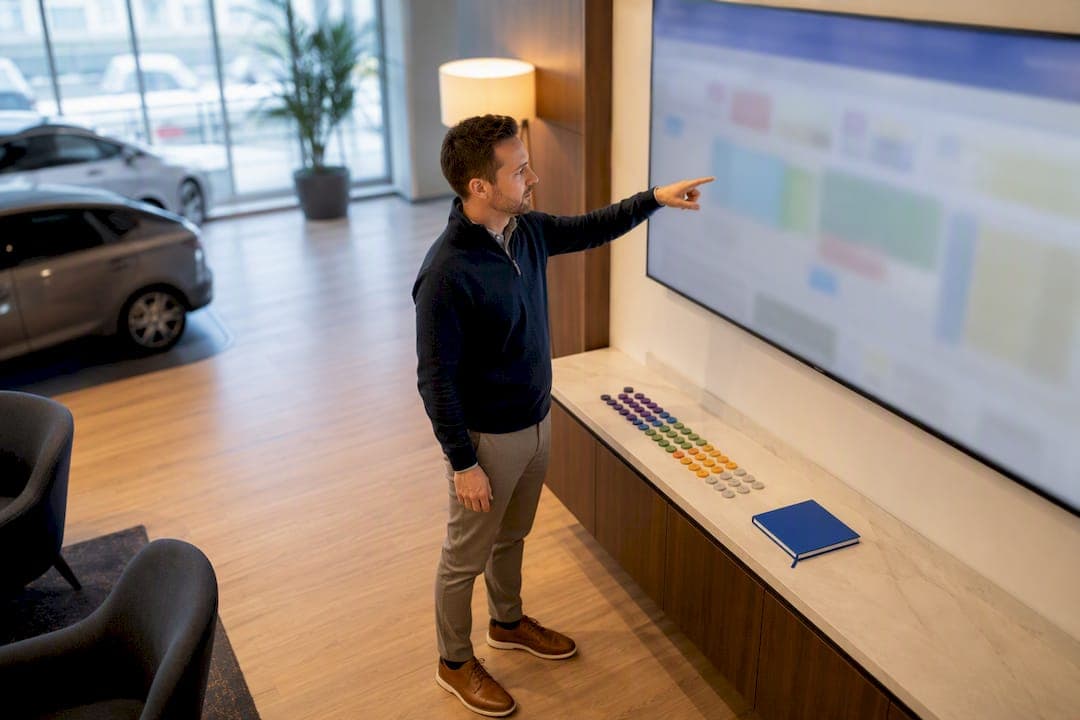
Start with a position-based multi-touch model, weight first and last touches, and track offline events like phone calls and test drives back to your CRM. Reconcile those numbers against your DMS every month, and before you shift significant budget on the strength of the model, validate it with a marketing mix model or a controlled incrementality test.
TL;DR:
- Position-based attribution models are the most reliable starting point, but advanced data-driven models require significant infrastructure and expertise.
- Last-click attribution overestimates lower-funnel channels and underestimates upper-funnel demand-generating channels, skewing budget allocation.
- Essential conversion events include phone calls, test drives, showroom visits, service bookings, and VIN-level sales, all tracked with persistent CRM IDs.
- Most credible attribution improvements appear within 30 to 60 days, with outcome metrics like sales shifting within three to six months after proper instrumentation.
- Independent audits and vendor scorecards are key to reconciling discrepancies between platform reports and actual CRM or DMS data, preventing wasted marketing spend.
Table of Contents
- What Is the Best Dealership Attribution Modeling Approach?
- Why Does Last-Click Attribution Mislead Dealerships?
- Which Conversion Events Should You Actually Track?
- What Does a 90-Day Attribution Rollout Look Like?
- How Do You Validate an Attribution Model Before Trusting It?
- What KPIs Should Vendors Be Held to?
- How Does AutoROIQ Validate Attribution for Dealerships?
- What Dealers Consistently Get Wrong About Attribution
- Ready to Fix Your Dealership's Attribution Blind Spots?
- Sources
What Is the Best Dealership Attribution Modeling Approach?
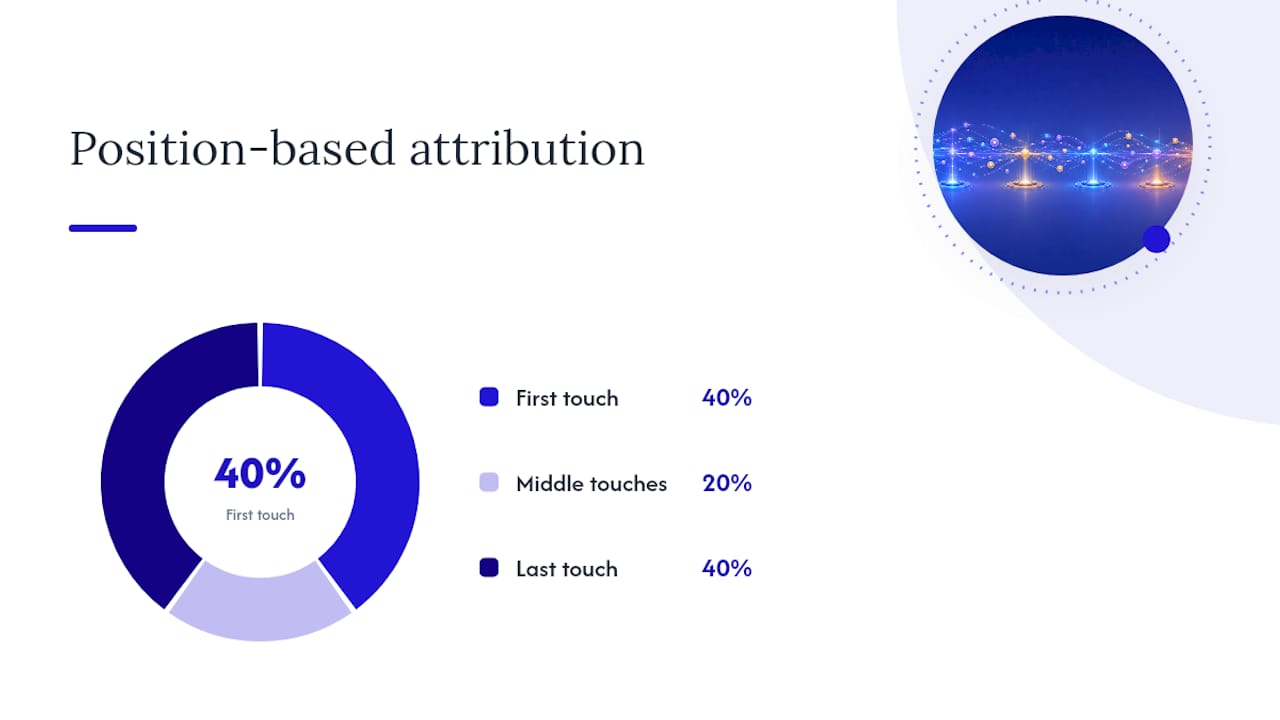
A position-based, or U-shaped, model is the most defensible starting point for dealership attribution modeling. This model typically assigns 40% of credit to the first touch, 40% to the last touch, and splits the remaining 20% across whatever happened in between. That split matches how car buyers actually shop: they discover a dealership through one channel, disappear for weeks of research, then come back through a different channel to book a test drive.
Data-driven, algorithmic attribution is the eventual goal for most stores, but it demands a lot: enough monthly conversion volume to train a model, clean identity resolution across devices, and mature server-side tagging. Advanced approaches like SVAR models or Markov chains can capture carryover effects and channel interactions with real precision, but they require significant data infrastructure and specialist statistical skills that most single-point dealerships simply don't have in-house yet.
Time-decay or last-click models still have a place, but only in narrow situations:
- Short sales cycles, like used-car clearance deals or inventory-driven promotions with a hard deadline.
- Service department campaigns where the path from ad to appointment is genuinely short.
- Situations where you're testing one channel in isolation, not evaluating the full budget mix.
The smarter move, regardless of your primary model, is running position-based, first-touch, and last-touch models in parallel for a full sales cycle. Channels that perform well across all three deserve more budget. Channels that only shine in last-click deserve a hard look.
Why Does Last-Click Attribution Mislead Dealerships?
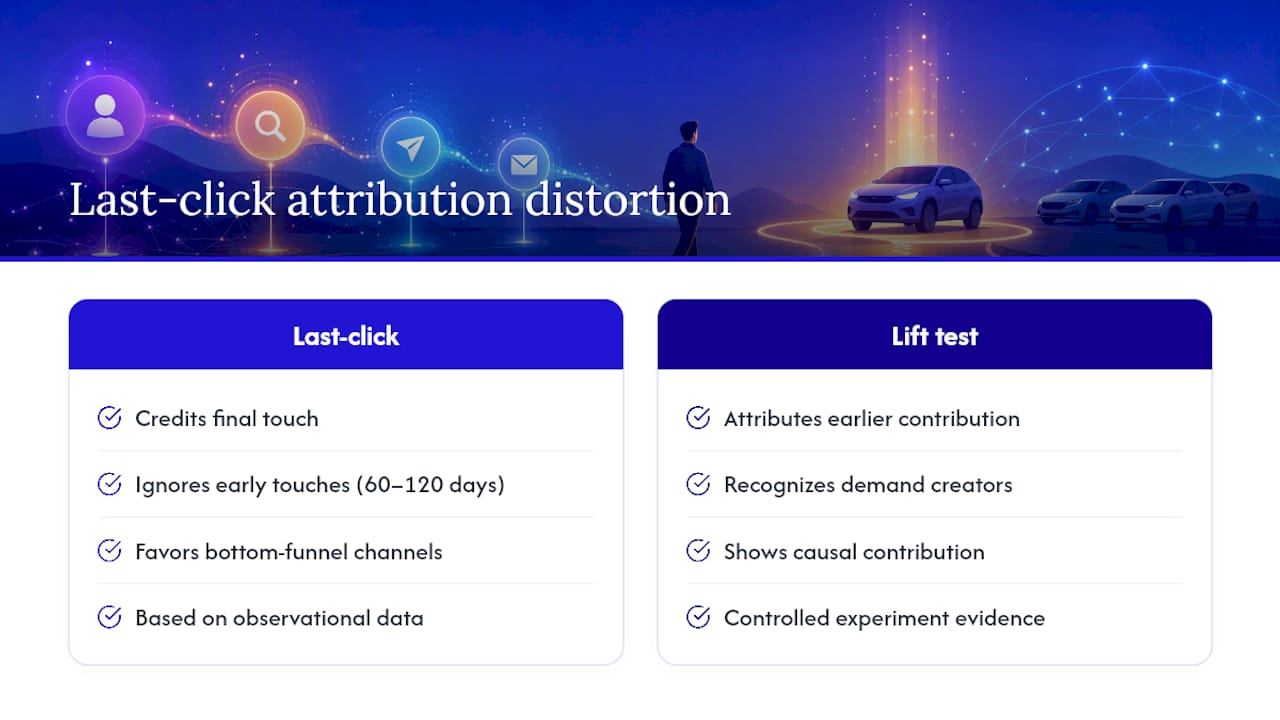
Last-click attribution rewards whichever channel happened to be there at the finish line, and for automotive, that's a serious distortion. Car buyers typically research for 60 to 120 days and touch a dealership's marketing dozens of times before they ever sit in a finance office. A branded search click on day 90 gets full credit, while the display ad that first put the dealership on the shopping list three months earlier gets none.
This creates a structural bias toward bottom-funnel, high-intent channels, mainly paid search and retargeting, simply because they tend to occur closer to the sale. Meanwhile, upper-funnel channels that actually generate demand get starved of budget because their contribution never shows up in the last-click report.
Statistic Callout: Attribution models are built on observational data, not controlled experiments, which means they can systematically diverge from what a randomized lift test would show). A channel that looks dominant in your last-click report may be capturing credit for demand another channel actually created.
Which Conversion Events Should You Actually Track?
Attribution is only as good as the outcomes it measures, and web form fills are a small fraction of how dealership deals close. A credible automotive attribution setup treats phone calls, test drives, showroom visits, and service bookings as first-class conversions, on equal footing with any online lead.
Five events deserve dedicated tracking:
- Phone calls with Dynamic Number Insertion (DNI) so every inbound call is tied to the specific ad, keyword, or page that generated it
- Test-drive bookings and completions, tracked as two separate events since booked and completed drives have very different conversion value
- Showroom walk-ins, captured through appointment tokens or check-in kiosks tied to a lead source
- Service department bookings, which often trace back to the same campaigns that drove the original sale
- VIN-level sales, matched back to the original lead source through your CRM, not self-reported by an ad platform
Pro Tip: Map every one of these events to a persistent CRM customer ID the moment it happens, not after the fact. Deterministic matching on a real ID is what lets you reconcile a phone call from March with a signed deal in June.
Roughly six in ten dealership conversions begin online but finish as a phone call or walk-in, which is exactly why DNI belongs at the top of your instrumentation list, not as an afterthought bolted on later.
What Does a 90-Day Attribution Rollout Look Like?
You don't need a year-long project to get usable signal. Most credible programs see leading indicators move within 30 to 60 days and real outcome metrics, like sold units, shift within 90 to 180 days once the instrumentation is in place.
Weeks 1 to 2: Get the general manager, marketing manager, and vendors aligned on which outcomes count, what attribution window you'll use (30, 60, or 90 days), and who owns weekly reporting.
Weeks 3 to 6: Roll out DNI across every campaign, enforce strict UTM discipline on all paid and organic links, map basic CRM fields to campaign sources, and move critical tags to server-side where your platform supports it.
Weeks 7 to 12: Build identity stitching or a lightweight customer data layer, sync VIN-level sales data from your DMS through closed-loop reporting, and stand up a multi-touch dashboard that pulls from CRM, not just ad platforms.
Month 3 and beyond: Run your first validation cycle. That means:
- Testing a subset of markets or budget against a holdout group
- Comparing model output against a lightweight marketing mix model
- Revisiting attribution windows based on what the first quarter of data actually shows
Dealerships that follow this sequence tend to see the attribution-driven optimization pay off in the form of measurably higher attributable traffic within the first two quarters, not the first two weeks.
How Do You Validate an Attribution Model Before Trusting It?
No attribution model, however well built, should dictate a six-figure budget swing on its own. Attribution models run on observational data, and that data can diverge meaningfully from what a real experiment would show. Validation is what separates a model you can defend to ownership from one you're just hoping is right.
Two methods do the heavy lifting:
- Marketing mix modeling (MMM), run quarterly, which validates channel-level spend impact using aggregate data and holds up even as privacy restrictions limit user-level tracking.
- Randomized incrementality or holdout tests, where you deliberately suppress spend in a comparable market or segment and measure the actual sales gap. This is the closest thing to causal proof you'll get, and broadcast-heavy campaigns have shown measurable lift when tested this way.
Pro Tip: When your platform dashboard and your CRM disagree on conversion counts, don't average the two and move on. Investigate the gap. Reconciling platform-reported conversions against system-of-record data on a monthly cadence, with a named owner responsible for chasing discrepancies, is what keeps a program honest.
What KPIs Should Vendors Be Held to?
Every vendor relationship should be governed by KPIs tied to dealership outcomes, not platform vanity metrics. Impressions and click-through rate tell you almost nothing about whether a channel sold a car.
Insist on KPIs built around test-drive bookings, sold units, and gross profit per unit attributable to the channel, not cost per click or cost per lead in isolation. Require raw event-level exports and API access rather than accepting a static PDF report, and enforce standardized UTM tagging across every vendor so cross-channel comparison is even possible.
Set a monthly reporting cadence with an agreed attribution window, written down, so nobody quietly redefines "conversion" mid-quarter. A few red flags deserve immediate escalation:
- A vendor's self-reported conversions consistently exceed your CRM's matched totals by a wide margin
- Reporting windows shift without notice, usually right before a renewal conversation
- A vendor refuses raw data access and offers only summary dashboards
How Does AutoROIQ Validate Attribution for Dealerships?
AutoROIQ's methodology exists specifically to reconcile the gap between what vendor dashboards claim and what a dealership's own CRM and DMS actually show. That gap is where most wasted marketing spend hides, and it rarely surfaces in a self-reported vendor summary.
A typical engagement follows a clear arc:
- A 30-day independent audit of current attribution setup, vendor reporting, and CRM/DMS data quality
- A prioritized roadmap that sequences instrumentation fixes, model selection, and validation steps
- A governance handoff that defines KPIs, reporting cadence, and named owners going forward
Because AutoROIQ doesn't sell advertising or represent any vendor, the scorecards and channel evaluations it produces carry no incentive to protect any one platform's numbers. That independence is the entire point of bringing in outside measurement in the first place.
What Dealers Consistently Get Wrong About Attribution
Most dealerships that struggle with attribution aren't lacking sophistication. They're lacking discipline on the fundamentals. DNI rollout, UTM consistency, and clean CRM customer IDs sound boring next to a data-driven model, but skipping them is the single biggest reason attribution programs stall out.
The mistake we see most often is treating attribution as a one-time setup instead of an operating rhythm. A dashboard built in January and never revisited by June is worse than no dashboard, because leadership starts making decisions on stale assumptions. Attribution needs a named owner checking reconciliation monthly, not a project that ships and goes dormant.
Bring in outside measurement help once your instrumentation is solid but you're still getting conflicting stories from different vendors. That's the exact point where an independent, vendor-agnostic read on the data earns its cost many times over.
— AutoROIQ
Ready to Fix Your Dealership's Attribution Blind Spots?
Vendor dashboards all claim credit for the same sale, and sorting out which channel actually earned it takes an outside, vendor-agnostic read on your data. That's the gap this kind of service is built to close: independent audits, vendor scorecards, and attribution implementation with no advertising to sell and no platform to protect.
A typical engagement starts with a 30-day audit of your current attribution setup, CRM/DMS data quality, and vendor reporting, then produces a prioritized roadmap you can hand to your marketing team or agency partners. The service also helps set up the governance, reporting cadence, and KPIs covered above, so the next vendor conversation happens with real numbers on the table instead of competing dashboards. If your last three vendor reports disagreed on what drove your last ten sales, visit AutoROIQ and get a scorecard started this month.
Sources
- Mastering marketing attribution: 6 essential models (Impact)
- Multi-Touch Attribution Models for the Auto Buyer Journey (Relevant Dealer)
- Automotive attribution: Dealership measurement (Attriqs)
- Academic study applying SVAR/advanced models to automotive channel effectiveness (Springer)