
Lead quality measurement means tracking how well leads fit your ideal customer profile, show real buying intent, and are ready to talk to sales, then confirming those early signals against actual pipeline outcomes. The single operational rule that makes this work: never judge a lead cohort before it has had time to mature, and never let marketing and sales grade leads on different definitions. Track qualified rate, sales acceptance rate, lead-to-opportunity rate, cost per qualified lead, and median days to qualify, all inside a CRM that logs status changes and disqualification reasons.
TL;DR:
- Accurate lead quality measurement requires tracking fit, intent, and readiness signals separately and avoiding premature judgments before cohort maturity.
- Key metrics such as qualified rate, sales acceptance rate, and cost per qualified lead should be reviewed monthly, while early signals like ICP fit and unknown rate need weekly monitoring.
- Defining consistent MQL and SQL criteria through team alignment, clear documentation, and timely status updates is essential for reliable data and effective decision-making.
- Cohorting leads by creation date or campaign, then waiting for the median days to qualify, prevents false low-performance judgments based on early-stage data.
- External assessments like AutoROIQ provide unbiased validation of lead data and vendor performance, helping dealerships identify true marketing ROI and fix targeting issues.
Table of Contents
- What Does Lead Quality Actually Mean?
- Which Metrics Actually Measure Lead Quality?
- How Do You Define MQL and SQL Criteria?
- How Do You Build a Working Measurement System?
- Why Are Your Leads Underperforming? A Diagnostic Framework
- What Fixes Actually Improve Lead Quality?
- How Does AutoROIQ Validate These Numbers For Dealerships?
- Why Outcome Data Beats Engagement Data Every Time
- Get an Independent Read on Your Lead Quality Data
- Sources
- FAQ
What Does Lead Quality Actually Mean?
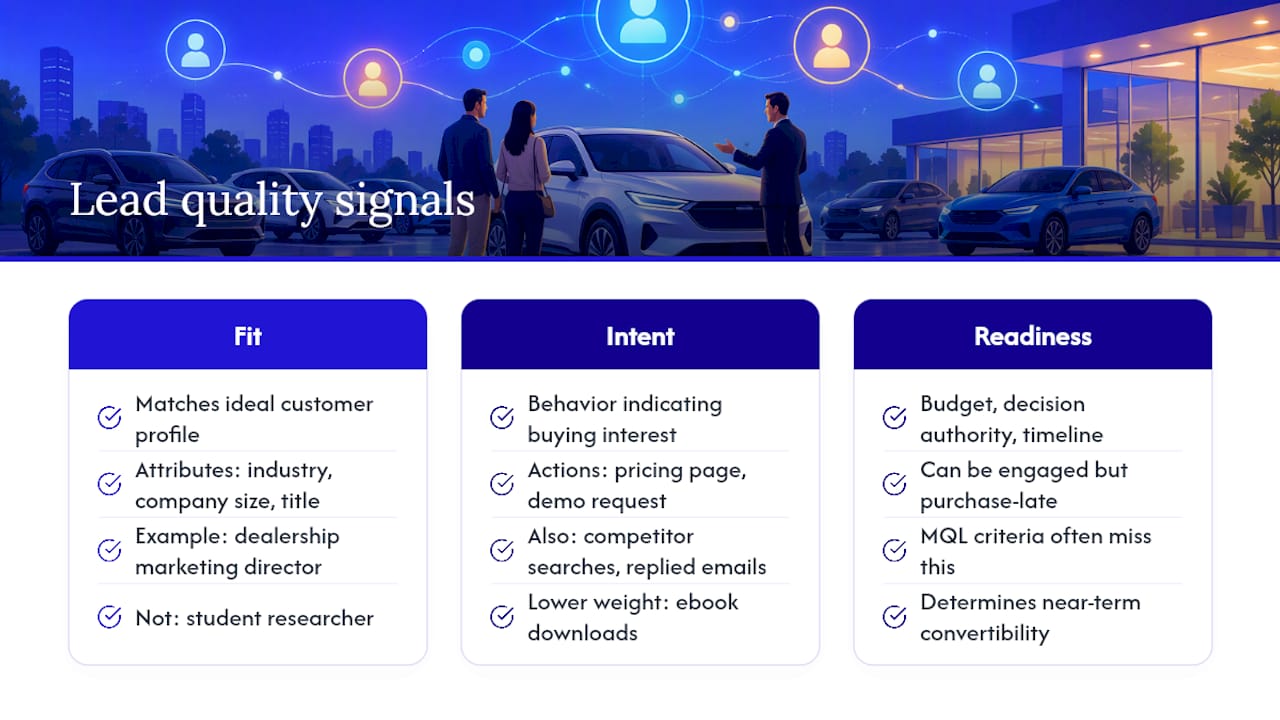
A lead's quality comes down to three separate signals, and conflating them is where most measurement breaks down.
Fit describes whether the lead matches your ideal customer profile. That means concrete attributes: industry, company size, job title, revenue band, and sometimes tech stack. A dealership marketing director evaluating vendor accountability problems is a fit; a student researching marketing careers is not, no matter how many pages they view.
Intent describes behavior that suggests active buying interest, not passive curiosity. Pricing page visits, demo requests, competitor comparison searches, and replied emails all carry more weight than a downloaded ebook. Fit, intent, and readiness together form the three evidence types that separate a real prospect from a curious visitor, and behavioral engagement alone can't prove someone is ready to buy.
Readiness captures whether the lead has budget, decision authority, and a timeline. This is where marketing qualified lead (MQL) criteria typically break, because a lead can be engaged and even a perfect fit while still being a year away from any purchase decision.
The trap most teams fall into: treating email opens, content downloads, and webinar attendance as quality indicators. These measure curiosity, not commitment. A lead who opens five emails but never asks a pricing question is not more qualified than one who visits your pricing page once and replies to a follow-up.
Which Metrics Actually Measure Lead Quality?
Ten metrics cover the full arc from raw lead to closed revenue. Each one answers a different question, and mixing them up is the fastest way to draw the wrong conclusion from your data.
| Metric | Formula | What it tells you |
|---|---|---|
| Valid contact rate | Valid contacts ÷ total leads | Whether your data collection is clean |
| ICP fit rate | ICP-matched leads ÷ total leads | Whether targeting is hitting the right accounts |
| Qualified rate | Qualified leads ÷ total leads | Overall lead quality at the top of the funnel |
| Sales acceptance rate | Accepted leads ÷ leads sent to sales | Whether marketing and sales agree on "qualified" |
| MQL to SQL rate | SQLs ÷ MQLs | How much readiness the lead actually has |
| Lead to opportunity rate | Opportunities ÷ total leads | End to end funnel efficiency |
| Cost per qualified lead | Marketing spend ÷ qualified leads | True cost of usable pipeline, not just volume |
| Cost per opportunity | Marketing spend ÷ opportunities created | Cost efficiency at a revenue relevant stage |
| Median days to qualify | Median time from creation to qualified status | How long a cohort needs before you can judge it |
| Unknown rate | Leads with no status after SLA ÷ total leads | Whether your process, not your leads, is the problem |
A high unknown rate means your qualified rate is measuring how fast sales updates records, not how good the leads are.*
Valid contact rate, ICP fit rate, and unknown rate are early signals. Check them weekly, since they respond fast to targeting and process changes. Sales acceptance rate, lead-to-opportunity rate, and cost per qualified lead are downstream validators. A practical B2B measurement approach tracks both early signals like ICP fit and buyer intent, and downstream outcomes like opportunity conversion and revenue, reviewed monthly at minimum, because they need a full sales cycle to mean anything.
The most common misread: pulling a raw conversion rate on a cohort that's only two weeks old. If your median days to qualify is 34, a two-week-old cohort hasn't had time to convert. Its numbers will look artificially low, and if a campaign manager reacts by cutting budget, the cut is based on noise.
How Do You Define MQL and SQL Criteria?
Marketing and sales arguing over what counts as a "good lead" is the single most common reason lead quality data goes unused. Gartner defines an MQL as marketing's determination that a lead is ready to be pursued by sales, and defines an SQL as a lead sales has accepted as an opportunity, but those labels only work if both teams apply the same criteria to them. The label matters far less than the discipline behind it.
Here's a replicable process to get there:
- Schedule a facilitated alignment session. A two-hour structured exercise is enough for most teams to agree on MQL and SQL definitions, ownership, and handoff rules, using a framework like the AMA's qualified-lead definition toolkit as a starting point.
- Write down the agreed criteria in plain language. Not "engaged prospect," but "director-level or above, 50 to 500 employees, has viewed pricing or requested a demo."
- Build the required CRM fields before you build any dashboard. At minimum: lead source, campaign, created date, status, status date, disqualification reason, and a sales-assigned flag.
- Set an SLA for status updates. 48 hours is a common standard. Every lead needs a status change within that window, qualified, disqualified, or working, with no exceptions.
- Create a feedback loop for disqualification reasons. Wrong customer type, duplicate, no budget, no authority, no timing, and vendor or agency inquiry are the standard categories worth tracking separately in your CRM setup.
Skip step one and every metric downstream becomes an argument instead of a decision. Sales will say the leads are bad; marketing will say sales isn't following up. Both might be right, and you'll never know which without agreed criteria and a paper trail.
How Do You Build a Working Measurement System?
Cohorting is the piece almost every team skips, and it's the reason most lead quality dashboards get ignored by leadership within six months. Group leads by the month they were created or by campaign, then wait for that cohort's maturity window, roughly its median days to qualify, before drawing any conclusion about performance.

Judging a fresh cohort before it has matured is one of the most common measurement mistakes, since time to qualify, sales cycle length, and pipeline velocity all need a defined window before the numbers mean anything. A campaign that looks weak at day 10 can look strong at day 45, and reallocating budget on day 10 data is a common and expensive mistake.
A minimal weekly scorecard by campaign and channel should include:
- Unknown rate (process health check)
- Valid contact rate (data quality check)
- ICP fit rate (targeting check)
- Qualified rate (overall quality check)
- Cost per qualified lead (efficiency check)
- Qualified-to-opportunity rate (sales conversion check)
You don't need a CRM overhaul to start. A spreadsheet tracking lead ID, created date, source platform, campaign, status, status date, and disqualification reason is enough to calculate every core metric while you build out a more permanent system.
On attribution: resist the urge to credit a single touchpoint for every closed deal. Multi-touch and experimental attribution approaches outperform simple first or last touch models when several channels influence a buyer over weeks or months, and building a closed-loop attribution process matters more than picking the perfect model on day one. When budget decisions are high stakes, a holdout test, running a channel dark for a defined period, beats attribution modeling every time.
Why Are Your Leads Underperforming? A Diagnostic Framework
Metrics only matter if they point you toward a fix. Match the symptom to the likely cause before changing anything.
- High lead volume with low ICP fit rate: targeting is off. Your ads, keywords, or lookalike audiences are pulling in the wrong accounts.
- High MQL count but low MQL-to-SQL conversion: your qualification criteria are too loose. Marketing is passing leads sales doesn't want.
- High unknown rate: this is a process ownership problem, not a lead quality problem. Nobody is updating status within the SLA window.
- Low qualified rate but strong disqualification data showing "no budget" repeatedly: your messaging or offer is attracting the wrong stage of buyer.
- Strong qualified rate but weak lead-to-opportunity rate: the handoff itself is broken, slow follow-up, poor routing, or a sales team that doesn't trust marketing's leads.
Disqualification reasons are your most underused diagnostic tool. If "wrong customer type" dominates, fix targeting. If "no timing" dominates, your nurture sequence needs a longer runway before handoff.
Before reallocating any budget based on a diagnosis, validate it. Run the fix against a fresh cohort, or hold out a control group, rather than assuming the first plausible explanation is correct. A fix that looks obvious in a symptom-to-cause table can still be wrong in practice.
What Fixes Actually Improve Lead Quality?
Run these in order of speed to impact, not order of ambition.
- Tighten ICP targeting first. Narrow ad audiences and landing page copy to speak directly to the fit criteria you defined earlier, and separate fit questions from intent triggers on your forms so you're not conflating "who are you" with "how ready are you."
- Cut speed to first contact. Research on online sales leads has consistently found that most companies respond too slowly, and response speed has a measurable effect on conversion. Test a rapid response window specifically on high-intent leads, such as demo requests, and measure the change in qualified-to-opportunity rate.
- Automate routing so high-fit, high-intent leads reach a rep immediately instead of sitting in a queue.
- Adjust scoring weights using historical cohort data, not guesses. If leads scoring 80+ convert at the same rate as leads scoring 50, your weights are miscalibrated.
- Clean your data. Dedupe records, validate contact fields, and strip out vendor and agency inquiries that inflate volume without adding pipeline.
Pro Tip: Test one variable at a time. If you change scoring weights and follow-up speed in the same week, you'll have a better funnel and no idea which change caused it.
How Does AutoROIQ Validate These Numbers For Dealerships?
Everything above assumes your team can measure objectively, but marketing vendors have their own incentive to report favorable numbers. AutoROIQ provides independent, vendor-agnostic marketing intelligence built specifically to help automotive dealerships cut through that noise and see where budgets actually perform.
The approach applies the same discipline covered in this guide, at dealership scale:
- A proprietary methodology evaluates vendor performance and marketing channels side by side, without any advertising sales interest influencing the read.
- Reports connect lead source accuracy to what actually closes, comparing cost per lead against cost per sale rather than stopping at raw lead counts.
- A 90 day vendor-agnostic sales match analysis ties leads to closed deals over a full maturity window, the same cohorting principle this article recommends applying internally.
- Recommendations arrive at the executive level, built to be defensible in a budget conversation, not just informative.
The value isn't a second opinion for its own sake. It's a check against the exact bias every vendor report carries by default.
Why Outcome Data Beats Engagement Data Every Time
Engagement metrics feel productive because they move fast and look good in a slide deck. Open rates climb, downloads pile up, and everyone nods. None of that tells you whether a single one of those leads will ever generate revenue. Automated nurturing programs can raise engagement substantially without moving the needle on closed deals in longer B2B sales cycles, which is exactly why we push clients toward meetings booked, cycle speed, and revenue instead.
The fix is organizational before it's technical: agree on definitions, cohort before judging, and track disqualification reasons like they're diagnostic data, because they are. Teams that get this right stop arguing about lead quality and start fixing it. If your internal numbers still feel unreliable after doing this work, that's usually a sign you need outside eyes on the data.
— AutoROIQ
Get an Independent Read on Your Lead Quality Data
If your marketing and sales teams still can't agree on whether your leads are actually good, an outside review settles the argument with data neither side can dispute. A Marketing Intelligence Review applies the same fit, intent, and outcome framework covered here directly to your dealership's vendor mix, without selling you advertising or taking commissions from any platform. That's the core difference: every recommendation comes from an analysis with no stake in which vendor you keep spending with.
The review compares your current vendors and channels against actual cost per qualified lead and cost per sale, then delivers executive-level recommendations you can act on immediately. It's built for dealership general managers and marketing directors who need a defensible answer to "where is our marketing budget actually working," not another vendor pitch dressed up as analysis. Ongoing strategic advisory is also available for dealerships that want that discipline maintained quarter over quarter. Visit the AutoROIQ FAQ page to see how the review process works and what to expect from your first engagement.
Sources
- Does automated lead nurturing really work? A new study challenges the hype
- The short life of online sales leads
- Marketing-Qualified Lead (MQL) — Gartner Sales Glossary
FAQ
What Are MQL and SQL Leads?
An MQL, or marketing qualified lead, is a lead marketing has judged ready to hand to sales based on agreed criteria. An SQL, or sales qualified lead, is one sales has accepted as a real opportunity. Gartner frames both as internal labels that only work when both teams define and apply them consistently.
How Do You Identify Quality Leads?
Quality leads show three things at once: they fit your ideal customer profile, they display genuine buying intent, and they have the budget and authority to move forward. Fit, intent, and readiness together separate real prospects from casual browsers, and no single engagement metric substitutes for checking all three.
What Is the 5-Minute Rule for Leads?
The 5-minute rule holds that contacting a lead within five minutes of an inquiry dramatically improves your odds of a meaningful conversation compared to waiting hours. Research on online sales leads has found response speed has a measurable effect on conversion, which is why testing a fast response window on high-intent leads is one of the higher-impact fixes covered above.
What Is the Difference Between a Qualified and Unqualified Lead?
A qualified lead meets your agreed fit and readiness criteria and has been confirmed through a real interaction, not just a form fill. An unqualified lead fails one or more of those criteria and gets logged with a specific disqualification reason, like wrong customer type, no budget, or no timing, so the data can be used to fix targeting later.
Can an Outside Review Confirm My Lead Quality Data Is Accurate?
Yes. AutoROIQ's Marketing Intelligence Review applies vendor-agnostic analysis to compare your lead sources against actual sales outcomes, removing the bias any single vendor's self-reported numbers carry. Current pricing and engagement details are available on the AutoROIQ site.