
Sales match analysis links every sold vehicle back to the marketing vendor, channel, and campaign that actually influenced the buyer. Done right, it replaces vendor-supplied lead counts with defensible, dealership-owned proof of what marketing spend produced which sale. For franchise executives juggling conflicting vendor reports, that shift from "trust the dashboard" to "verify the outcome" is the primary benefit, and it's exactly the kind of vendor-agnostic review firms like AutoROIQ build.
TL;DR:
- Most dealership sales are untraceable through CRM alone because the customer journey spans over 95 days and involves roughly 62 touchpoints.
- Last-touch attribution typically overstates the value of near-sale interactions and underfunds early-stage channels like listings and organic search.
- Position-based attribution provides a balanced and transparent starting point, focusing on both the first and last touches to improve revenue accuracy.
- Reliable sales match analysis requires shared deal IDs, consistent UTM tagging, dynamic call tracking, and designated ownership of data reconciliation.
- External independent reviews offer unbiased insights and are necessary when vendor claims conflict or internal data ownership breaks down.
Table of Contents
- What Is Sales Match Analysis in a Dealership Context?
- Why Last-Touch and Lead-Based Attribution Miss Most Dealer Sales
- Core Attribution Models and the Metrics That Actually Matter
- The Data Plumbing You Need Before Any of This Works
- A 90-Day Plan to Get Real Attribution Signals
- How to Validate Vendor Claims and Run Accountability Reviews
- What Success Looks Like and How Long It Takes
- When to Hire an Independent Reviewer vs. Build It Internally
- AutoROIQ's Marketing Intelligence Review
- Sources
- FAQ
What Is Sales Match Analysis in a Dealership Context?
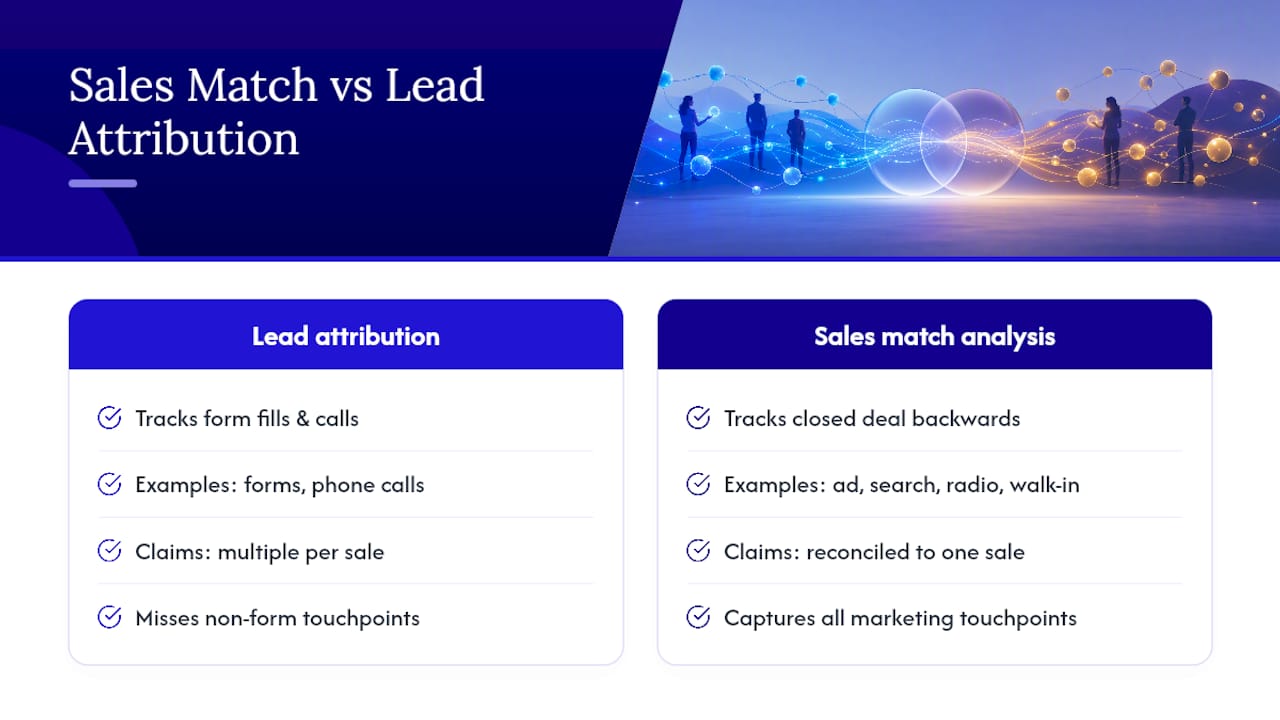
Sales match analysis is the practice of tying a closed deal in the DMS back to the marketing activity that generated it, rather than relying on whatever lead source a CRM field happens to list. Most dealerships confuse this with lead attribution, but the two are not the same thing. Lead attribution tracks form fills and phone calls. Sales match analysis tracks the vehicle out the door and works backward through every marketing touchpoint that led there, including the ones no lead form ever captured.
The distinction matters because a customer who called after seeing a marketplace listing, then Googled the dealer three weeks later, then walked in off a radio ad, generates one sale and three separate attribution claims. Without a match process that reconciles those claims against actual sales data, every vendor involved can plausibly take credit for the same unit.
Why Last-Touch and Lead-Based Attribution Miss Most Dealer Sales
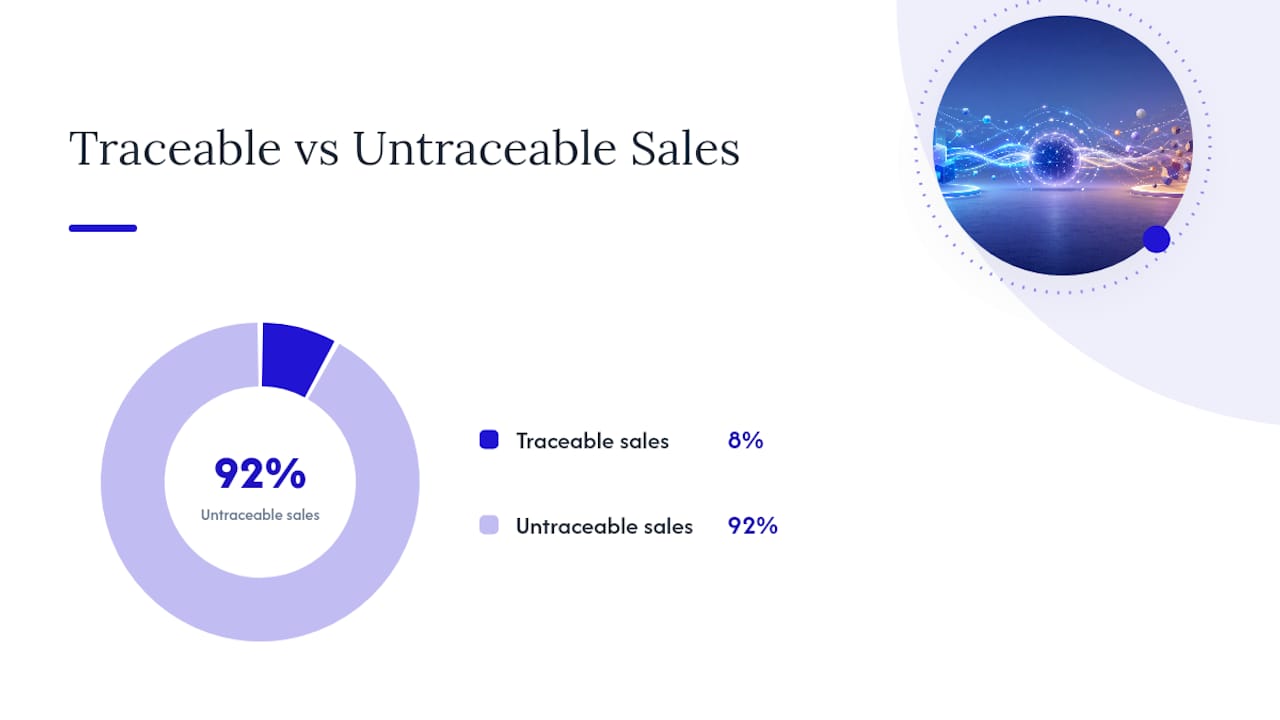
Last-touch attribution assumes the final click or call before a sale tells the whole story. It doesn't, and the scale of the miss is larger than most marketing directors assume. An Autotrader analysis of 875,000 automotive sales found that 92% of vehicle sales were untraceable in CRM, meaning only 8% of closed deals had a clean, traceable line back to a marketing source.
Part of the reason is how long and winding the buyer journey actually is. Clarivoy and Autotrader data show the average car buyer spends 95 days in market and interacts with roughly 62 touchpoints across multiple channels before buying. A CRM built around last-touch rules simply cannot hold that many data points, so it defaults to whichever touch happened closest to the sale.
The budget consequences compound from there:
- Channels that influence early-stage research, like marketplace listings and organic search, get systematically underfunded.
- Vendors whose activity happens to sit closest to the sale get credit they didn't fully earn.
- Executives approve renewals based on inflated claims because no internal system challenges them.
Sales attributed accurately: 8%. That's the ceiling most dealerships are working from before any attribution fix.
Core Attribution Models and the Metrics That Actually Matter
Not every attribution model deserves equal weight, and running the wrong one produces confident, wrong answers faster than running none at all. Five models dominate the field:
- First-touch credits whatever channel started the journey, useful for measuring awareness spend but blind to everything after.
- Last-touch credits the final interaction, the default in most CRMs and the least reliable given a 62-touchpoint journey.
- Linear splits credit evenly across every touchpoint, simple but ignores that some touches matter more than others.
- Position-based (U-shaped) weights the first and last touch heavily while still crediting the middle, and it tends to balance discovery and conversion well for dealerships.
- ML-assisted models learn weighting from historical conversion data, powerful once volume is high enough to train on.
For most franchise stores, position-based attribution is the right starting point. It's transparent enough for executives to interrogate and sophisticated enough to stop rewarding last-touch vendors by default. Two metrics should anchor every report built on it: campaign-attributed revenue, the actual sold-unit revenue tied to a specific campaign, and cost per sale, total campaign spend divided by matched sales rather than raw leads. Running two or three models side by side and watching for which channels stay strong across all of them is the fastest way to separate real performers from artifacts of whichever model you picked.
The Data Plumbing You Need Before Any of This Works
Attribution models are only as good as the data feeding them, and most dealership tech stacks weren't built to feed them well. Connected data linking the DMS, CRM, and analytics platforms is the foundational requirement for credible campaign-attributed revenue; without that link, any revenue figure a vendor hands you is effectively unverifiable.
Four things need to be true before a match analysis produces trustworthy output:
- DMS and CRM must share a common deal ID. Otherwise a closed unit in the DMS has no reliable path back to the lead record that started it.
- Every campaign needs consistent UTM tagging, applied the same way across every vendor, every time a link goes live.
- Dynamic number insertion (DNI) needs to sit on every paid channel so phone calls, still the highest-intent touchpoint at most stores, get tracked with the same rigor as web clicks.
- Someone specific has to own reconciliation. Usually the marketing director, sometimes a dedicated analyst, but never "whoever has time this week."
Pro Tip: Run a 90-day reconciliation cadence, not a quarterly one. Marketing spend moves faster than a quarter, and by the time a quarterly report flags a problem, you've already paid for three more months of it.
A 90-Day Plan to Get Real Attribution Signals
Executives don't need a perfect measurement system on day one. They need a mandate that produces verifiable signals fast, and 30 to 60 days is a realistic window for basic instrumentation to start generating usable data.
- Days 1 to 30: Audit current tracking, set baseline KPIs, deploy UTM tagging and DNI, and fix the quick, obvious gaps in DMS/CRM linkage.
- Days 31 to 60: Connect the systems fully, run two or three attribution models in parallel, and manually reconcile a sample of recent sales against vendor claims.
- Days 61 to 90: Publish the first campaign-attributed revenue report, hold vendor accountability reviews with the numbers in hand, and reallocate spend based on what actually held up.
Pro Tip: Don't wait for a perfect data set to hold the first vendor review. A partial reconciliation that catches one inflated claim pays for the entire 90-day effort.
How to Validate Vendor Claims and Run Accountability Reviews
Dealerships run an average of 8 to 12 marketing vendors at once, and each one has an incentive to report the numbers that make renewal easy. Independent reconciliation is the only real check on that.
Ask every vendor for three things: campaign-attributed revenue, not leads or impressions; cost per sale, not cost per click; and a quality-adjusted lead-to-sale rate that separates real buyers from junk leads. Then reconcile: pull a sample of transactions, compare the vendor's dashboard against your own CRM and DMS records, and request the raw data export rather than the summarized report.
- A vendor that resists sharing raw exports is a red flag on its own.
- Numbers that shift meaningfully between the vendor dashboard and your DMS deserve escalation, not a follow-up email.
Pro Tip: If two vendors both claim credit for the same closed unit, don't split the difference. Match analysis exists specifically to resolve that conflict with data instead of negotiation.
What Success Looks Like and How Long It Takes
The first real signal is consistency, not certainty. By day 30 to 60, watch for channels that keep performing well across every model you run and for a reconciliation rate that climbs each cycle instead of staying flat. That consistency is what tells you a channel's performance is real rather than a quirk of one attribution method.
Outcome-level change takes longer. Measurable movement in sold-unit revenue and actual budget reallocation typically shows up within 90 to 180 days of instrumenting the system properly, once enough sales have flowed through the matched process to trust the pattern. The payoff isn't a report. It's the budget conversation that follows it, where dollars move toward channels with matched sales behind them and away from ones with only vendor-supplied claims.
When to Hire an Independent Reviewer vs. Build It Internally
Build internally when you have the staff to own reconciliation and vendor reports mostly agree with each other. Bring in an independent review the moment those two conditions break down, which is more common than most executives expect. Vendor dashboards are built to optimize for vendor-friendly metrics, not dealership truth, so conflicting reports, high spend with thin proof, or simply no one internally owning measurement are all signs it's time to scope an outside review. A good one delivers a defensible scorecard, vendor-agnostic recommendations, and reporting an executive team can act on without translation.
AutoROIQ's Marketing Intelligence Review
Independent marketing intelligence firms run sales match analysis most dealerships never get from their own vendors, providing vendor-agnostic reviews without selling advertising, managing campaigns, or taking commissions. That's the entire point: a vendor-agnostic review that has no financial reason to protect any single vendor's numbers.
A marketing intelligence review connects DMS, CRM, and vendor data into one reconciled picture, then provides leadership teams with executive-ready scorecards showing which channels produced matched sales and which ones showed inflated claims. Ongoing strategic advisory can help keep that picture current as spend shifts and vendors change their pitch. Full details on both engagements, including how the review is scoped, are on the AutoROIQ FAQ page. If your vendor reports have stopped adding up, that's the place to start the conversation.
— AutoROIQ
FAQ
What Is Sales Match Analysis?
It's the process of linking a closed vehicle sale back to the specific marketing vendor, channel, and campaign that influenced it, using DMS, CRM, and campaign data reconciled against each other rather than a single last-touch field.
Why Do So Many Dealer Sales Go Untraceable?
Most CRMs rely on last-touch attribution, which can't account for a buyer journey averaging 95 days and 62 touchpoints, so the system defaults to whichever channel happened closest to the sale and drops the rest.
Which Attribution Model Should Dealerships Start With?
Position-based (U-shaped) attribution is a practical starting point because it credits both the first touch that sparked interest and the last touch that closed the deal, without ignoring the middle of the journey.
How Long Does It Take to See Results From an Attribution Fix?
Basic instrumentation like UTM tagging and dynamic number insertion can produce usable signals in 30 to 60 days, while measurable sold-unit and ROI impact typically appears within 90 to 180 days.
Does AutoROIQ Sell Advertising or Take Vendor Commissions?
No. Autoroiq does not sell advertising, manage campaigns, or accept vendor commissions, which is what allows its Marketing Intelligence Review to stay vendor-agnostic when evaluating dealership marketing performance.