
A dealership data warehouse is a dealer-owned, governed, queryable store that unifies DMS, CRM, inventory, service, and marketing records into one trusted source for reporting and AI. It replaces conflicting vendor reports with a single version of the truth for cross-rooftop decisions. Before choosing a platform, run a data audit. Most dealership data problems start upstream, not in the warehouse itself.
TL;DR:
- Building a dealership data warehouse typically takes 60 to 120 days with managed solutions but 12 to 24 months if custom-built on general-purpose cloud platforms.
- Data quality issues like duplicates, missing fields, and outdated contact info can lead to confidently wrong reports if not addressed before warehouse construction.
- Key questions for vendors include data ownership rights, export capabilities, connector availability, SLA details, and access to audit logs to ensure control and continuity.
- Early wins such as cross-rooftop KPI dashboards, inventory analytics, and service retention campaigns help justify the investment and build credibility before developing advanced models.
- Independent, vendor-neutral audits like AutoROIQ’s review help verify data setup and vendor claims, reducing risks of conflicting reports and making informed decisions.
Table of Contents
- What Is a Dealership Data Warehouse, and How Does It Differ From a DMS or CDP?
- How Is a Dealership Data Warehouse Built? The Core Architecture Layers
- Why Data Quality Determines Whether Your Warehouse Actually Works
- How Long Does It Take to Build a Dealership Data Warehouse?
- What Questions Should You Ask Data Warehouse Vendors?
- What Are the Best Early Use Cases for a Dealership Data Warehouse?
- AutoROIQ's Advisory View: A 90-Day Program for Getting This Right
- Balancing Control, Speed, and Long-Term Optionality
- How AutoROIQ Helps You Plan a Data Warehouse Strategy That Actually Pays Off
- Sources
- FAQ
What Is a Dealership Data Warehouse, and How Does It Differ From a DMS or CDP?
A dealership data warehouse is a governed, historical repository built specifically to answer analytical questions across every rooftop, every department, and every time period a dealer group cares about. It pulls data out of your operating systems, standardizes it, and stores it in a structure built for queries, not transactions.
That distinction matters because a Dealer Management System (DMS) was never designed for this job. Your DMS runs the deal desk, the parts counter, and the service drive in real time. It's optimized for writing a repair order fast, not for answering "what's our average gross per unit across five stores over the last 18 months?" Ask a DMS that question and you'll either wait a long time for a report or get an answer that doesn't match what your controller pulled last week.
A Customer Data Platform (CDP) solves a different problem entirely. It's built to unify customer profiles for activation, meaning it triggers a service reminder text or feeds a retargeting audience. A CDP is forward-looking and action-oriented. A warehouse is backward-looking and analysis-oriented, holding years of history so you can spot trends a CDP was never built to store.
Here's where the lines get confused in most dealership tech pitches. A warehouse can answer questions like these, and a DMS or CDP typically cannot:
- How does customer pay labor gross per RO compare across all stores over the trailing 12 months?
- Which marketing channel actually drove the vehicles that turned into F&I profit, not just leads?
- What's the real lifetime value of a customer who bought from us in 2022 versus one from 2024?
- Which VINs sat on the lot longest before selling, and what did that cost in floorplan interest?
A CDP alone is sufficient if your only goal is real-time personalization, service reminders, or basic segmentation for email and SMS. But the moment leadership wants trended, cross-rooftop, historical analysis that blends sales, service, and marketing data, only a warehouse delivers it. A single source of truth for dealership data resolves this confusion at the executive level, and it's usually the first concept that needs clarifying before any vendor conversation starts.
How Is a Dealership Data Warehouse Built? The Core Architecture Layers
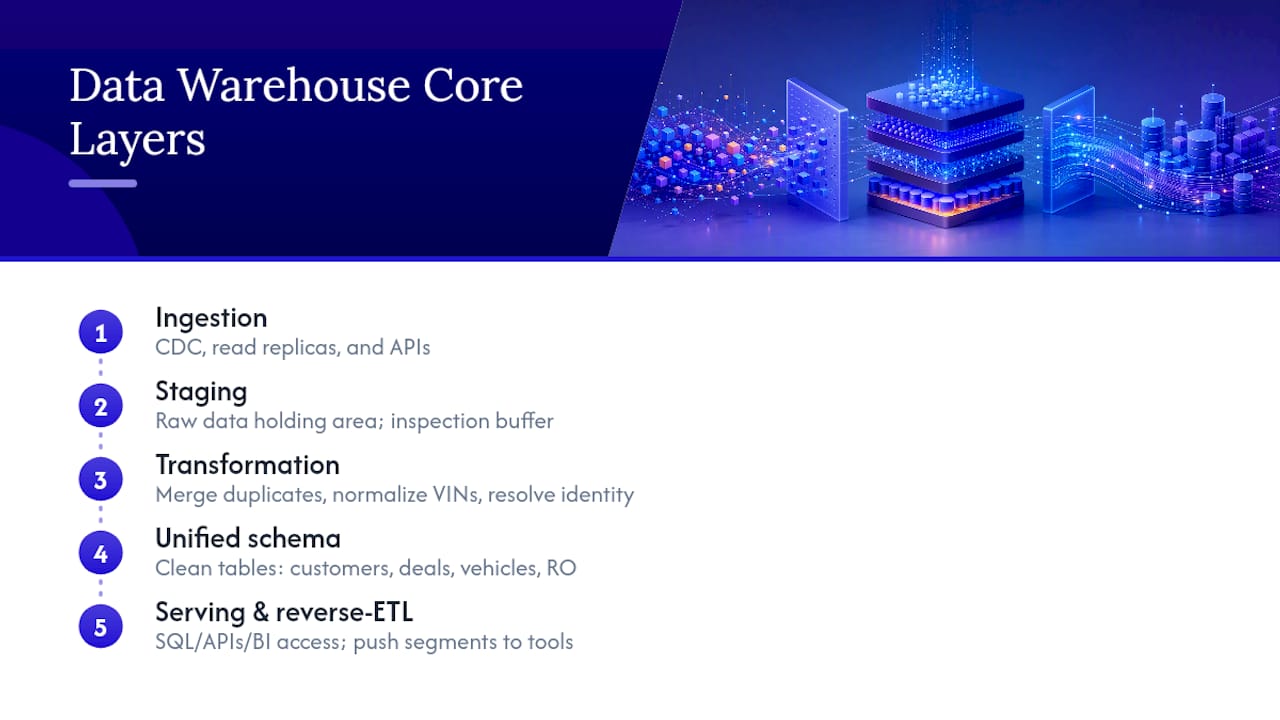
Every functional data warehouse, dealership or otherwise, runs through five layers. Understanding them is the difference between asking a vendor smart questions and nodding along to a slide deck full of buzzwords.
Ingestion is where raw data enters the pipeline. For dealerships, this typically happens through three methods: change data capture (CDC), which streams updates the moment a record changes in your DMS; read replicas, which copy your database on a schedule without touching production performance; and APIs, which pull structured data from CRM, marketing, and inventory platforms. CDC works best for high-volume transactional systems like your DMS, where you need near real-time visibility into deal status. APIs make more sense for marketing platforms and CRM tools that expose clean, documented endpoints.
Staging is a holding area where raw, unprocessed data lands before anything happens to it. This layer exists so a bad ingestion run doesn't corrupt your finished tables. Think of it as a loading dock: nothing gets shelved until it's inspected.
Transformation is where the real work happens, and it's the layer academic research on dealership data warehouse design identifies as the most demanding part of the build. This is where duplicate customer records get merged, VINs get normalized to a standard format, and identity resolution runs across systems that don't naturally agree on who's who. A customer named "Bob Smith" in your DMS and "Robert Smith" in your CRM needs to become one person here, not two.
Unified schema is the finished product: clean, standardized tables organized around business entities like customers, deals, vehicles, and repair orders. This is what your analysts and BI tools actually query.
Serving and reverse-ETL is the delivery layer. Reverse-ETL pushes warehouse data back into operational tools like your CRM or ad platforms, so a segment built from warehouse-level insight (say, "customers with high service spend who haven't visited in 90 days") can trigger a real campaign. Serving also includes SQL access for analysts, API access for custom apps, and direct BI connectors for dashboarding.
Platforms built for large-scale automotive data, including modular vehicle-data systems like IAV Merida, show how separating storage, processing, and analysis into distinct layers keeps performance predictable even as data volume grows. That same separation principle applies whether you're processing telemetry data or five years of RO history.
Why Data Quality Determines Whether Your Warehouse Actually Works
A warehouse built on dirty data doesn't just produce mediocre reports. It produces confidently wrong answers that look authoritative because they're sitting in a polished dashboard. Duplicate customer records inflate your database size and skew retention math. Stale contact information means your marketing ROI numbers include people who can't be reached. Missing fields, like a repair order with no technician ID or a lead with no source attribution, create silent gaps that analysts often don't notice until a board member asks a question the data can't answer.
This is why hygiene work has to happen before or alongside warehouse construction, not after. The essential controls include:
- Deduplication rules that merge records based on matched keys, with every merge logged for reversal if needed.
- Reachability checks that flag phone numbers and emails that consistently bounce or go unanswered.
- Field normalization applied consistently at ingestion, not fixed later in ad hoc spreadsheets.
- An enrichment audit trail showing what data was added, changed, or merged, and when.
A CDP or a managed cleansing service typically sits upstream of the warehouse, acting as the quality gate before records ever reach the analytical layer. AutoROIQ's own 90-day CRM data hygiene playbook treats this sequencing as the difference between a fast, credible dashboard rollout and a stalled project that burns budget on rework.
Pro Tip: Track three numbers before you sign any warehouse contract: your CRM duplicate rate, the percentage of contacts that are actually reachable, and the percentage of records with all required fields populated. If you don't know these numbers today, that's your real starting point, not vendor selection.
How Long Does It Take to Build a Dealership Data Warehouse?
Timeline and cost depend almost entirely on one decision: build a custom warehouse from scratch, or buy a managed solution built specifically for dealership data.
A custom build on a general-purpose cloud platform typically runs 12 to 24 months from kickoff to a stable production system. That timeline reflects the reality that dealership-specific schema design and ETL mapping is not a plug-and-play exercise. Every DMS has its own quirks, and connectors have to be built or heavily customized for each one. Dealer-focused managed platforms, by contrast, often deploy in 60 to 120 days because the connectors, schema, and common transformations already exist and just need configuration for your store count and systems.
Cost drivers follow a predictable pattern regardless of path. Connector development eats the largest share of engineering time, especially for older or less common DMS platforms. Cloud compute and storage costs scale with data volume and query frequency, generally staying modest for a single rooftop but climbing for multi-store groups running frequent dashboard refreshes. Ongoing data operations, meaning the people watching for broken integrations and drifting schema, are a recurring line item many dealers underbudget.
Staffing looks different depending on the path chosen. A custom build usually requires a dedicated data engineer, at minimum, plus analyst time for validation. A managed deployment shifts most engineering work to the vendor but still needs an internal data owner accountable for governance, access decisions, and vendor communication.
Decide between build and buy based on three factors: how many rooftops you operate, whether you already have in-house data engineering talent, and how mature the vendor's dealership-specific connector library actually is. A single-store dealer with no data team almost always comes out ahead buying a managed solution. A ten-rooftop group with an existing analytics function may find a custom build pays off over a longer horizon.
What Questions Should You Ask Data Warehouse Vendors?
Procurement conversations for dealership business intelligence infrastructure tend to go smoothly right up until the contract stage, where vague language around data ownership creates problems years later. Ask these questions before signing anything:
- Who owns the data once it's in your system? The answer should be "you," in writing, with no ambiguity.
- Can we export the full schema and underlying data on demand, in a usable format? If the answer involves extra fees or a lengthy request process, that's a warning sign.
- What's your native connector list for DMS and CRM platforms? Ask for the exact list, not a general claim of "broad compatibility."
- What SLA governs uptime and integration monitoring? Get specifics on response time when a connector breaks.
- What audit logs are available for access and changes? You need visibility into who touched what data and when.
Contract language should explicitly guarantee export rights, provide access to audit logs, and include a continuity or export artifact clause. This means if the relationship ends, you receive a complete, usable copy of your schema and data, not a hollowed-out shell.
Pro Tip: During a demo, ask the vendor to show you a live export of a full customer or deal table, not a sample screenshot. If they hesitate or say that requires a separate conversation, that hesitation tells you more than the pitch deck does.
Red flags in proposals include vague language around "data portability," pricing that changes materially with rooftop count in ways that aren't explained upfront, and reluctance to name specific DMS or CRM connectors they've built before. A simple scoring matrix, rating each vendor on ownership terms, connector maturity, time-to-first-dashboard, and governance transparency, keeps procurement meetings focused on substance instead of sales polish.
What Are the Best Early Use Cases for a Dealership Data Warehouse?
The fastest way to justify a warehouse investment to a skeptical board is showing value before the full build is finished. Three use cases consistently deliver early, visible wins.
Cross-rooftop KPI dashboards built in tools like Looker Studio or Power BI give group executives a single view of gross profit, F&I penetration, and CSI scores across every store, refreshed daily instead of reconstructed manually each month. Inventory turn and pricing analytics flag aging units before they become a floorplan drag, using VIN-level data on days in stock and price adjustment history. Service retention campaigns pull warehouse-level insight, like customers overdue for a visit based on mileage and time patterns, and push those segments into marketing platforms for targeted outreach, which pairs naturally with reputation and retention work covered in Repvive's auto shop reputation management guidance.
Once those quick wins build credibility, medium-term projects become easier to fund: predictive models for customer lifetime value, churn scoring that flags at-risk service customers before they defect to an independent shop, and marketing spend optimization based on which channels actually produce profitable deals rather than just cheap leads.
Track value with KPIs leadership already understands: revenue per repair order, marketing ROI by channel, and days-to-turn on inventory. The phasing that works best in practice is dashboards first, prediction second. Executives fund what they can see working, and a clean dashboard proves the underlying data pipeline before anyone asks for a churn model.
AutoROIQ's Advisory View: A 90-Day Program for Getting This Right
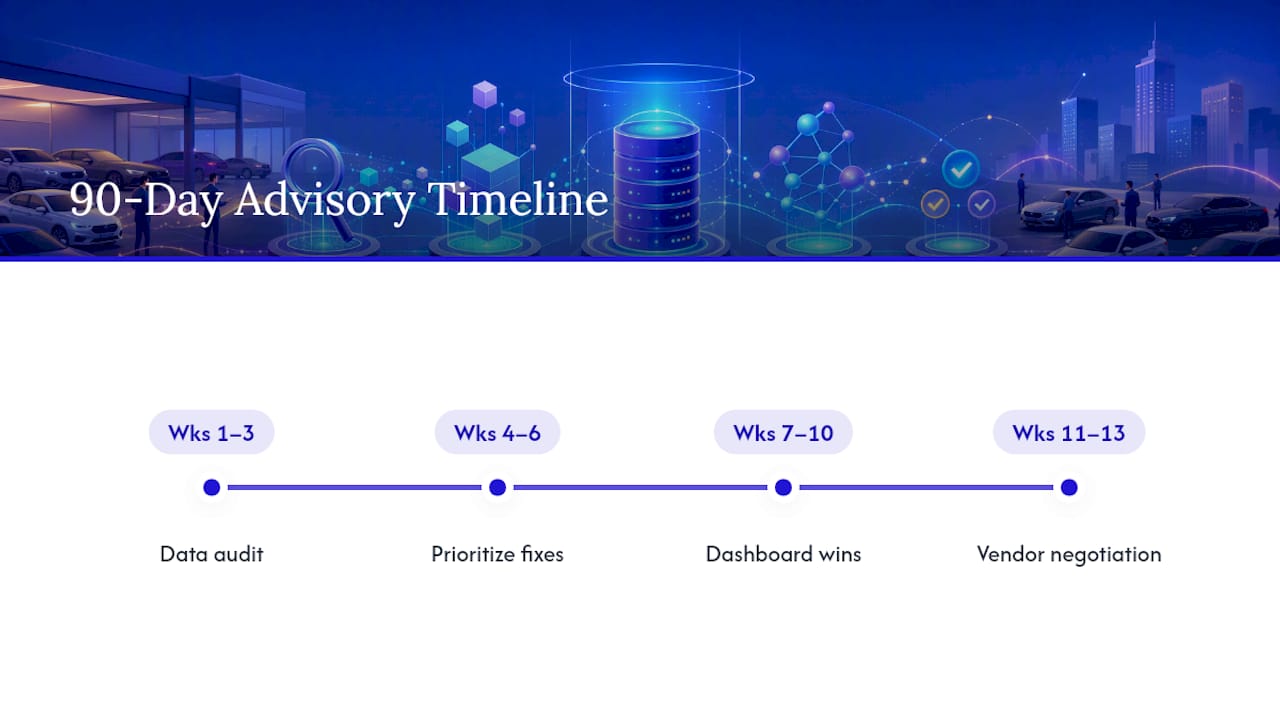
Most dealership groups don't need more technology recommendations. They need a sequence. A recommended advisory approach for dealer groups includes a 90-day structure: weeks one through three cover a full data audit across DMS, CRM, and marketing platforms; weeks four through six prioritize fixes based on what's actually broken; weeks seven through ten deliver quick dashboard wins to build internal confidence; and the final stretch focuses on vendor negotiation informed by real findings instead of sales pitches.
Governance can't be an afterthought bolted on later. Every warehouse needs a named data owner, a documented access control policy, clear rules for what vendors can and cannot touch, and a change management process for schema updates. A vendor-agnostic scoring methodology evaluates vendor performance and marketing ROI to address dealer frustration with conflicting reports from the vendors selling them the media.
Balancing Control, Speed, and Long-Term Optionality
The conventional pitch in this category oversells speed and undersells exit terms. A managed deployment that gets you a working warehouse in 90 days is genuinely valuable, but only if the contract guarantees full exportability the day you sign it, not a promise made verbally in the sales process.
Dealer-owned, vendor-neutral data layers preserve negotiating leverage in a way that's easy to underestimate until you're three years into a relationship with a vendor who knows switching costs you dearly. Prioritizing hygiene and governance before architecture selection isn't the exciting part of this project, and it's the part almost every failed implementation skipped.
— AutoROIQ
How AutoROIQ Helps You Plan a Data Warehouse Strategy That Actually Pays Off
Building a dealership data warehouse means choosing between vendor sales pitches with no way to verify who's telling the truth about your actual marketing performance. AutoROIQ takes a different approach: independent, vendor-agnostic advisory that audits your current data setup before you spend a dollar on new infrastructure.

An engagement typically includes an independent data and vendor audit, a vendor accountability scorecard that shows where marketing spend is and isn't working, and a prioritized roadmap that sequences hygiene fixes, dashboard quick wins, and vendor negotiations in the right order. You get a clear audit report, an action list your team can actually execute, and measurable KPIs to track progress, not another vendor relationship to manage. If you're weighing a warehouse investment or trying to make sense of conflicting vendor reports right now, start with an independent marketing intelligence review from AutoROIQ and get a clear-eyed view before you sign anything.
Sources
For technical teams designing schema and ETL processes from scratch, the academic research on dealership DMS data warehousing walks through the iterative design process in detail. Platforms like AVL Data Analytics and Aeris Mobility Suite offer useful patterns for normalization and cloud-first analytics at scale. For dealership-specific hygiene and BI tool selection, AutoROIQ's CRM data hygiene playbook and Power BI versus Tableau comparison offer practical next steps.
FAQ
What CRM Do Most Dealerships Use?
Dealerships commonly run platforms like DealerSocket, VinSolutions, and Elead, though the right choice depends on integration depth with your DMS. AutoROIQ's dealership CRM guide breaks down what executives should weigh before switching.
What Are the Top Data Warehouse Platforms?
Cloud platforms like Snowflake, Google BigQuery, and Amazon Redshift dominate general enterprise use, but dealership groups increasingly favor managed, dealer-specific solutions with pre-built DMS and CRM connectors over generic platforms requiring custom engineering.
Is Snowflake an Enterprise Data Warehouse (EDW)?
Yes, Snowflake functions as a cloud-based enterprise data warehouse, but it arrives as a blank platform. Dealerships still need custom schema design and DMS-specific ETL work before it becomes usable for automotive reporting.
What Software Do Most Car Dealerships Use?
Most dealerships run a DMS like CDK Global or Reynolds and Reynolds for transactions, paired with a separate CRM for sales and service follow-up. Neither system alone provides the cross-rooftop, historical analysis a dedicated data warehouse delivers.
How Long Does a Dealership Data Warehouse Implementation Take?
Managed, dealer-focused deployments typically take 60 to 120 days, while custom builds on general cloud platforms usually run 12 to 24 months due to the schema and connector work required.