
A marketing spend audit is a structured review of every dollar flowing through your marketing budget, scored against what each dollar was supposed to accomplish. Done well, it uncovers structurally wasted spend without penalizing the tests and brand work that need time to pay off. Expect audits to surface reallocation opportunities in the 20 to 40 percent range, guided by frameworks like the ADM² audit playbook. Start with a full cost inventory this week.
TL;DR:
- A marketing spend audit typically reveals 20 to 40 percent of wasteful expenses that can be reallocated efficiently.
- Disaggregated analysis at the placement, keyword, and audience level uncovers hidden waste, especially from placements or search terms with consecutive zero conversions.
- Verifying attribution data accuracy by reconciling platform reports with CRM and analytics prevents misguided cuts and ensures trustworthy results.
- External costs like agency fees and software subscriptions should be routinely reviewed for overlapping tools, unused licenses, and auto-renewal clauses.
- Conducting recurring audits at regular intervals helps identify and eliminate waste steadily while supporting strategic reallocation and vendor management.
Table of Contents
- What Is a Marketing Spend Audit and How Do You Start One?
- How Do You Build a Spend Taxonomy That Doesn't Punish Good Bets?
- Where Does a Disaggregated Analysis Find the Waste Dashboards Hide?
- How Do You Verify Your Attribution Data Is Trustworthy?
- How Do You Audit Agency Fees and Martech Contracts?
- How Do You Turn Audit Findings Into a Reallocation Plan?
- How Often Should You Repeat a Marketing Spend Audit?
- How Does AutoROIQ Structure an Independent Spend Audit?
- What Three Lessons Actually Change Audit Outcomes?
- Get an Independent Read on Where Your Dealership's Marketing Dollars Are Going
- Sources
What Is a Marketing Spend Audit and How Do You Start One?
A marketing spend audit inventories every cost tied to your marketing operation, then evaluates whether each cost is producing the outcome it was assigned. Harvard Business School's overview of the process frames it as an assessment of activities' effectiveness, relevance, and alignment with business goals, which is exactly the lens dealership leaders and marketing managers need before touching a single campaign setting. This isn't a performance report from your ad platform. It's an independent pass across everything, media, people, and tools alike, that either earns its place in next quarter's budget or gets cut.
The starting point is scope. Before pulling a single report, decide what falls inside the audit boundary and how far back you're looking.
Costs to inventory:
- Ad spend broken out by platform (search, social, display, programmatic, connected TV)
- Agency retainers and freelancer fees, including performance bonuses
- Martech and analytics subscriptions (CRM add ons, attribution tools, creative platforms)
- Sponsorships, event fees, and co op marketing dollars
- Creative production costs (photography, video, design contractors)
Present totals as monthly rolling figures so seasonal spikes don't distort the picture, and split each line into fixed versus variable. A $3,000 monthly software subscription behaves differently than a $40,000 paid search budget that flexes with inventory. Most teams get more signal from a rolling quarterly window since a single month can be skewed by a launch or a slow week, but pair that with monthly checks so nothing drifts unnoticed for 90 days.
Before you pull any data, fix your hygiene problems. Audit results built on broken UTMs or inconsistent CRM source fields will mislead you into cutting the wrong things. Confirm campaign owners are assigned in your project tracker, verify UTM parameters are consistent across platforms, and check that your CRM captures lead source at the record level, not just at the campaign summary level. Skipping this step is the single most common reason audits produce findings nobody trusts.
How Do You Build a Spend Taxonomy That Doesn't Punish Good Bets?
Grading every campaign against one universal ROI target is the fastest way to kill useful experimentation and brand investment that hasn't matured yet. A spend taxonomy fixes that by sorting spend into a small number of categories, each judged against its own job.
Stick to four or five categories, no more. More than that and the scoring system becomes too granular to act on quickly.
- Performance and direct response. Search, retargeting, and shopping campaigns judged on cost per lead, cost per acquisition, and conversion rate.
- Awareness and brand. Video, display, and social reach campaigns judged on reach, frequency, and brand lift or assisted conversions over a longer window.
- Retention. Email, loyalty, and remarketing to existing customers judged on repeat purchase rate and lifetime value contribution.
- Experimentation. New channels or formats given a fixed test budget and a defined learning objective rather than an ROI target.
Set benchmarks within each category using your own trailing 12-month average as the baseline, then adjust for known seasonality. A research-backed rationale for this approach holds that spend evaluated against its intended job produces clearer remediation recommendations than a blanket standard applied across every channel.
Score each item into one of three buckets: performing (leave alone), recoverable (needs optimization with a deadline), or structurally wasted (cut or reallocate). A display campaign that's spent $18,000 over three months with zero attributed leads and no brand lift data to justify it falls into structurally wasted. A search campaign converting at half your category benchmark, but trending upward after a landing page fix, falls into recoverable.

Pro Tip: Tag every experimentation-bucket campaign with an end date and a learning question before it launches. Without a defined finish line, tests quietly become permanent line items nobody remembers approving.
Where Does a Disaggregated Analysis Find the Waste Dashboards Hide?
Summary dashboards are built to reassure, not to expose problems. They average performance across placements, devices, and audiences, which means a handful of catastrophic placements can hide inside an otherwise decent-looking campaign average. Disaggregated data at the placement, keyword, and audience level reveals waste that summary reporting simply can't, and this is where the real audit work happens.
Reports to pull, by channel:
- Search term reports for every paid search campaign, filtered for spend with zero conversions
- Placement reports for programmatic and display, sorted by spend descending
- Audience and placement splits for social, broken out by creative and interest segment
- Device and time-of-day breakdowns layered across all of the above
The dimensions that matter most are placement or site, individual search terms, creative ID, audience segment, device, and time-of-day. A campaign converting well on desktop during business hours can be quietly bleeding budget on mobile placements at 2 a.m., and you won't see it until you slice the data that way. This isn't a hypothetical: practitioner audits of dashboard reporting consistently find that the metrics leadership sees hide the exact problems an audit is meant to catch.
Statistic Callout: Placements or search terms with zero conversions across two or more consecutive reporting periods, at meaningful spend for your account size, should be treated as structurally wasted rather than underperforming. That distinction matters for how you act on it. Underperforming spend gets optimized. Structurally wasted spend gets cut immediately, no test extension required.
Prioritize kills over tests when the pattern is consistent and the spend concentration is high relative to the rest of the campaign. Reserve test extensions for placements with some conversion signal, just below benchmark, where a creative swap or bid adjustment has a reasonable shot at recovery. If a placement has burned through 15 percent of a campaign's monthly budget with no attributed outcome for two straight cycles, that's a kill, not a test.
How Do You Verify Your Attribution Data Is Trustworthy?
An audit built on broken measurement will send you cutting the wrong campaigns. Before you finalize any reallocation decision, sanity check the numbers that led you there.
Common tracking failures to check for first:
- Inconsistent UTM parameters across platforms, especially after agency handoffs or platform migrations
- CRM records missing a lead source field, or defaulting to "unknown" or "website"
- Auto-tagging mismatches between ad platforms and your analytics tool, which inflate or deflate channel credit
Reconcile platform-reported numbers against your central analytics tool or CRM, and expect some variance. A gap under 10 percent between platform and central reporting is normal and reflects differences in attribution windows. A gap beyond that signals a tracking problem that needs fixing before you trust any conclusion drawn from the data. Where multi-touch attribution is unavailable or unreliable, use a sensitivity range instead of a single number, showing what the reallocation decision looks like under both a conservative and a generous attribution model.
When attribution is genuinely uncertain, default to the conservative assumption before cutting a channel entirely. A campaign with ambiguous credit but a plausible assist role is a candidate for a reduced test budget, not an immediate kill. For search specifically, reconciling platform and analytics data before drawing conclusions prevents the single most common audit mistake: cutting a channel that was quietly supporting conversions credited elsewhere.
How Do You Audit Agency Fees and Martech Contracts?
External costs, agencies, freelancers, and software subscriptions, tend to accumulate quietly because nobody revisits them once they're signed. This is often the fastest place to find savings, because the fixes don't require new campaigns or creative, just contract review.
- Inventory every vendor cost and match it against actual usage. Pull login activity or usage reports for every martech subscription; a tool nobody has logged into in 60 days is a candidate for cancellation regardless of its original justification.
- Ask pointed questions of every agency and vendor relationship. Does the fee model scale with ad spend regardless of performance? Are there overlapping tools doing the same job under two different contracts? Is the contract on an auto-renewal clause you'd miss if you weren't looking? Auto-renewal clauses and overlapping subscriptions are a recurring source of avoidable waste that audits routinely catch.
- Decide: renegotiate, bring in-house, or terminate. A vendor delivering results but on a misaligned fee structure gets renegotiated toward outcome-based terms. A capability you're paying a premium for but could staff internally gets evaluated for in-house transition. A tool with no measurable usage or a vendor with no defensible performance gets terminated.
Fee structures tied to spend, where the agency earns more as your budget grows regardless of results, create a perverse incentive worth fixing directly, often through renegotiated SLAs tied to outcomes rather than budget size. To keep this from recurring, put a calendar reminder 60 days ahead of every contract renewal date and require a usage check before any auto-renewal goes through. If you're currently evaluating whether your agency relationship itself needs a harder look, a structured approach to agency selection is worth reviewing before your next renewal.
How Do You Turn Audit Findings Into a Reallocation Plan?
Findings without a decision rule just sit in a spreadsheet. Every scoring bucket from your taxonomy needs a corresponding action, a timeline, and a named owner.
- Cut immediately. Anything scored structurally wasted gets its budget pulled within the current billing cycle, no exceptions, and the freed dollars move into a holding account rather than getting spent immediately elsewhere.
- Optimize on a deadline. Recoverable items get a specific fix (new creative, bid adjustment, landing page change) with a 30 to 45 day window and one named owner accountable for the result.
- Maintain. Performing campaigns get left alone, with a note in the audit record explaining why, so nobody re-litigates a working campaign next quarter out of habit.
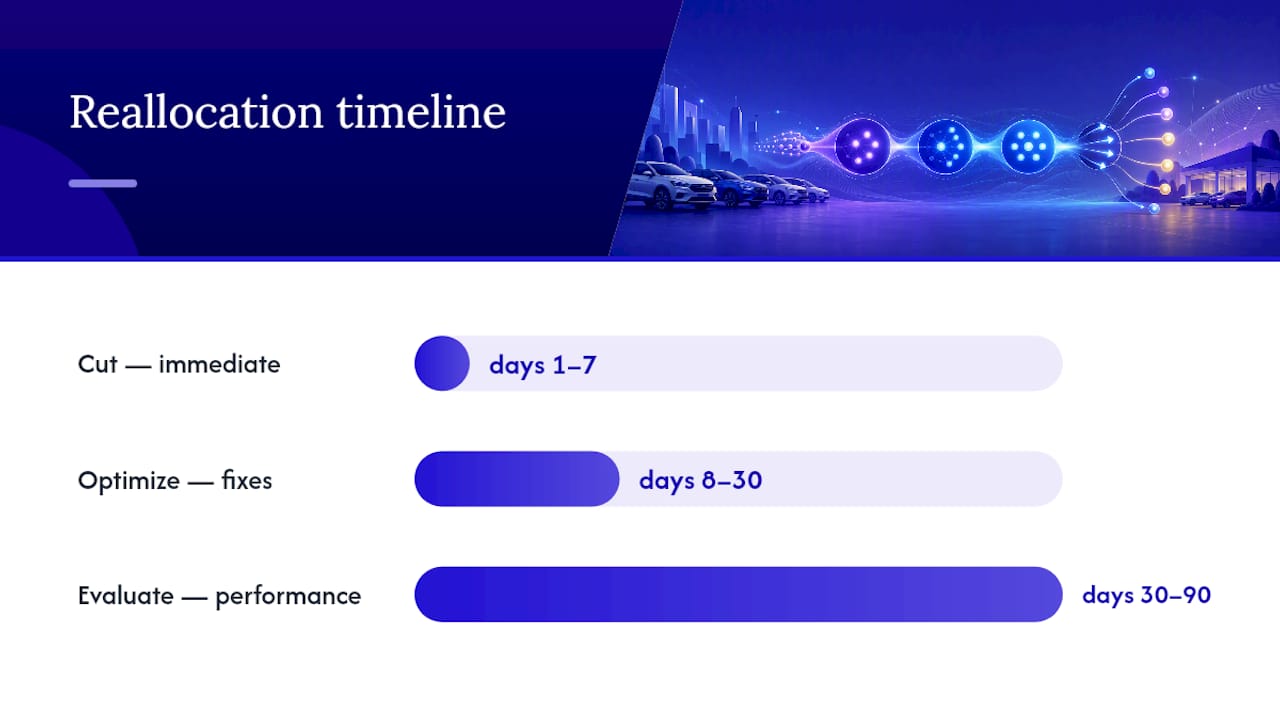
A realistic timeline runs like this: days 1 through 7 for the cut decisions and immediate reallocation, days 8 through 30 for optimization fixes to show early movement, and days 30 through 90 to evaluate whether the reallocated budget is outperforming where it used to sit. Statistic Callout: Businesses that complete this process typically reallocate 20 to 40 percent of total spend, with the bulk of that recovered from redundant tools, underperforming placements, and contracts that had outlived their usefulness.
When you present this to finance or ownership, skip the platform jargon and show two numbers side by side: cost per lead or cost per sale before the audit, and the same figure projected after reallocation, with the dollar amount moved and where it's going. Leadership doesn't need to understand placement-level waste. They need to see the before and after number and the date the change takes effect.
How Often Should You Repeat a Marketing Spend Audit?
A one-time audit fixes a problem. A recurring audit prevents the next one from forming. Set a rhythm and stick to it.
- Monthly light checks. A 30-minute review of spend by category against budget, flagging anything trending toward zero conversions before it becomes a quarter-long problem.
- Quarterly deep audits. The full disaggregated pull, taxonomy scoring, and vendor review described above.
- Annual strategic review. A step back to ask whether the taxonomy categories themselves still match business priorities.
Assign three roles to every audit cycle: an owner who runs the analysis, an implementer who executes the cuts and optimizations, and an executive approver who signs off on reallocations above a set dollar threshold. Each completed audit should leave behind a record containing the scope window, the taxonomy scores by campaign, the decisions made, and the dollar impact, so the next audit starts from history instead of from zero. Teams running this cadence consistently reduce the accumulation of hidden waste over time, since each audit catches problems before they compound into the next one. For a broader diagnostic checklist you can adapt to your own cadence, these dealership-specific waste indicators are a useful reference point between full audit cycles.
How Does AutoROIQ Structure an Independent Spend Audit?
AutoROIQ's methodology maps directly onto the taxonomy and scoring approach above, applied specifically to dealership marketing budgets rather than generic categories. Because AutoROIQ doesn't sell advertising and takes no vendor commissions, the scoring isn't influenced by which platform or agency benefits from a "performing" label.
What the review typically inventories and evaluates:
- Every vendor invoice, platform spend line, and martech subscription tied to the dealership's marketing budget
- Attribution consistency between vendor-reported numbers and the dealership's CRM and sales data
- Agency fee structures, checked for spend-linked incentives that misalign with dealership profitability
Dealerships commonly find waste concentrated in overlapping lead-generation tools, display and social placements running with no attributed sales, and agency fees that scale with budget regardless of closed deals. A dedicated audit checklist built for dealership GMs covers the specific line items that recur most often across franchise stores, if you want a starting point before an outside review.
Pro Tip: Ask any vendor presenting audit results one question: "Do you sell any of the media or tools you're evaluating?" If the answer is yes, treat the findings as a sales pitch, not an audit.
What Three Lessons Actually Change Audit Outcomes?
Fix tracking before you touch budget. A cut made on broken attribution data gets reversed within a quarter, and that reversal costs more credibility than the original waste did. Second, favor standing reallocation rules over one-off cuts. Rules survive staff turnover; individual decisions don't. Third, document every decision, including the ones to leave a campaign alone. When you present findings upward, lead with dollars moved and the date the change takes effect, not platform terminology nobody outside marketing recognizes.
— AutoROIQ
Get an Independent Read on Where Your Dealership's Marketing Dollars Are Going
Autoroiq is the alternative to relying on the same vendors who sold you the media grading their own performance. The diagnostic delivers a full cost inventory, a scored taxonomy of every campaign and vendor, a reallocation plan with timelines, and an executive memo written for decision-makers, not marketers.

Because Autoroiq takes no advertising commissions and sells no media, the scorecard reflects what's actually working, not what's most profitable for the agency presenting it. Engagements typically start with the inventory and scoring pass described above, then move into vendor conversations and a 90-day reallocation window with clear ownership at each step. Dealership leaders walk away with defensible numbers they can bring straight to ownership meetings. If your budget review keeps coming from the same people selling you the media, request an independent diagnostic from Autoroiq and get a scorecard nobody involved in your current spend had a hand in writing.