
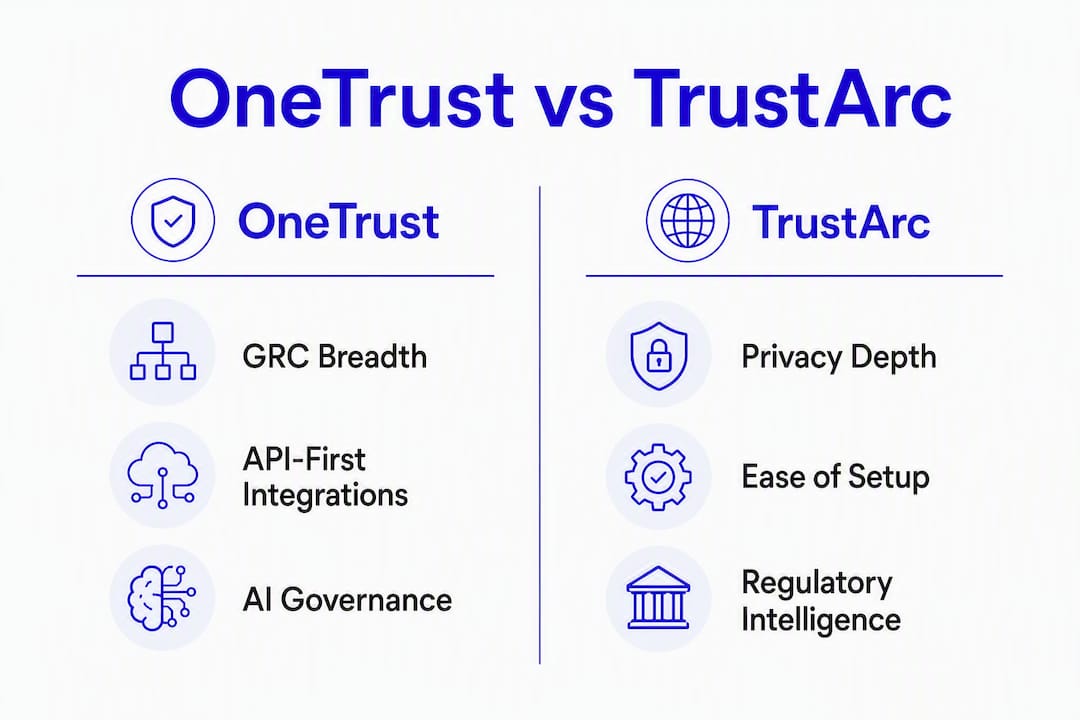
Pick OneTrust if your organization needs a consolidated GRC platform spanning privacy, security, ESG, ethics, and AI governance in one system. Pick TrustArc if your program is privacy-first and your team values embedded regulatory intelligence, managed consulting, and the TRUSTe certification for consumer-facing properties. The core trade-off is breadth versus depth: OneTrust bundles more disciplines, TrustArc goes deeper on privacy operations and regulatory content.
- OneTrust ideal buyer: Large enterprise with an existing GRC program, a dedicated technical team, and a need to unify privacy, security, and ESG reporting under one vendor contract.
- TrustArc ideal buyer: Legal or privacy-led team at a consumer-facing organization that needs regulatory guidance, TRUSTe assurance, and managed service support without heavy internal IT lift.
- Budget note: Both platforms carry a reported minimum annual cost of $10,000/year for entry-level enterprise packages, with mid-market and enterprise deals typically at a significantly higher level. Smaller organizations should evaluate purpose-built alternatives before committing to either.
Verdict: For a consolidated GRC program, OneTrust is the stronger fit. For a privacy-specialist program with regulatory depth and managed services, TrustArc is the better choice. Before signing either contract, run a structured RFP with at least 15 vendor-specific questions covering APIs, renewal terms, and implementation milestones.
Table of Contents
- How do OneTrust and TrustArc compare side by side?
- What are the real feature differences between these platforms?
- What should you budget for OneTrust or TrustArc?
- What do deployment and integrations look like in practice?
- How do support models and managed services differ?
- Which vendor fits your organization's size and program maturity?
- What are the 15 RFP questions every buyer should ask?
- What do reviewer data and independent research show?
- Key Takeaways
- The case for picking a lane, not a platform
- Autoroiq's independent vendor evaluation approach
- Sources and further reading for the procurement file
How do OneTrust and TrustArc compare side by side?
| Dimension | OneTrust | TrustArc (Arc) |
|---|---|---|
| Best for / ideal buyer | Large enterprise consolidating GRC, ESG, and AI governance | Privacy-led teams and consumer-facing orgs needing regulatory depth |
| Pricing & licensing | $10,000/year minimum; enterprise deals commonly $40,000–$100,000+; renewal uplifts reported at 22–80% | $10,000/year minimum; enterprise ranges similar; renewal behavior reported as more predictable |
| Core modules | Consent, DSAR, data mapping, vendor risk, ESG, ethics, AI governance | Consent, DSAR, data mapping, vendor risk, TRUSTe certification, Arc Intelligence |
| Ease of setup / usability | Longer implementation; external consultants often required | Faster time-to-value for privacy-focused scope; managed services available |
| Support & managed services | TAM-based support; professional services available | Managed privacy consulting; human-in-the-loop regulatory expertise |
| Reporting & analytics | Broad GRC dashboards; multi-domain program reporting | Privacy-focused reporting; regulatory compliance tracking |
| Integrations & API | Strong API-driven integrations; broad enterprise connector library | API available; focused on privacy workflow integrations |
| Regulatory intelligence & certifications | Regulatory content included; no standalone certification program | Arc Intelligence + Nymity library; TRUSTe certification program |
| Scalability & enterprise features | High; built for multi-domain, multi-jurisdiction enterprise programs | High for privacy programs; GRC breadth is narrower by design |
The single biggest procurement trade-off: OneTrust gives you more modules across more disciplines, but that breadth comes with longer implementation cycles, higher configuration complexity, and renewal pricing that requires active negotiation. TrustArc trades module breadth for deeper privacy expertise and more predictable commercial terms.
Pro Tip: Neither vendor publishes list pricing. Always request a written quote that itemizes base subscription, modules, implementation fees, and renewal cap language before any demo commitment.
What are the real feature differences between these platforms?
Consent management
OneTrust's consent management platform (CMP) is one of the most widely deployed in the market, with web SDKs supporting hundreds of domain configurations, granular consent records, and integrations with major tag management systems. TrustArc's consent module is functionally competitive for most enterprise use cases and benefits from Arc Intelligence surfacing jurisdiction-specific consent requirements automatically. For organizations managing consent across dozens of domains in multiple jurisdictions, OneTrust's technical depth and connector library give it a practical edge. TrustArc's advantage is that the regulatory guidance is embedded in the workflow rather than requiring a separate research step.
DSAR and workflow automation
Both platforms automate data subject access request intake, routing, and response tracking. OneTrust's DSAR module integrates tightly with its data mapping layer, which means automated fulfillment can pull from a live data inventory. TrustArc pairs its DSAR tooling with managed consulting support, which matters for teams that lack the internal headcount to handle complex requests without guidance. If your team is small and privacy-focused, TrustArc's human-in-the-loop model reduces the risk of a misconfigured automated workflow producing a compliance gap.
Automated data mapping and discovery
OneTrust's API-driven data mapping is a genuine differentiator for enterprises with complex data environments spanning cloud, SaaS, and on-premise systems. It supports automated scanning and classification at a scale that TrustArc's platform does not match out of the box. TrustArc's data mapping is adequate for privacy-program-level inventories but relies more on structured questionnaires and manual input for discovery. If your data environment is technically complex, OneTrust's mapping capabilities justify the longer implementation cycle.
Vendor and third-party risk
OneTrust includes a dedicated vendor risk module that integrates with its broader GRC framework, allowing security and privacy teams to share vendor assessment data. TrustArc covers vendor risk within its privacy program scope but does not extend into security or ESG vendor assessments. For organizations that want a single vendor risk workflow across privacy and security, OneTrust is the more complete solution.
Reporting and analytics
OneTrust's reporting layer spans GRC disciplines, which is useful for CISOs and compliance officers who need a unified view across privacy, security, and ESG metrics. TrustArc's reporting is privacy-program-focused and tightly integrated with its regulatory intelligence layer, making it easier for privacy teams to track compliance posture against specific regulatory requirements without building custom reports.
Regulatory intelligence
TrustArc's Arc Intelligence and Nymity regulatory content library cover an extensive set of legal references and operational guidance templates across multiple jurisdictions, with a relaunch as part of the Arc platform in December 2025. This library surfaces relevant regulatory updates and maps them to operational tasks automatically. OneTrust includes regulatory content, but it is not the platform's primary differentiator. For legal and privacy teams that treat regulatory research as a core daily workflow, TrustArc's depth here is a meaningful operational advantage.
AI governance
OneTrust has invested in AI governance modules that allow organizations to inventory AI systems, assess risk, and document governance decisions alongside their privacy and security programs. TrustArc's Arc Intelligence applies AI to surface regulatory guidance but does not offer a standalone AI governance module comparable to OneTrust's. If AI governance is a current or near-term program requirement, OneTrust is the only one of the two that covers it.
| Core function | OneTrust edge | TrustArc edge |
|---|---|---|
| Consent management | Multi-domain scale, tag manager integrations | Embedded jurisdiction-specific guidance |
| DSAR automation | Integrated data inventory fulfillment | Managed consulting support for complex requests |
| Data mapping / discovery | API-driven automated scanning | Structured questionnaire-based for privacy programs |
| Vendor / third-party risk | Cross-GRC vendor assessment | Privacy-scoped vendor risk |
| Regulatory intelligence | Included; not primary differentiator | Arc Intelligence + Nymity library; primary differentiator |
| AI governance | Dedicated module | Not available as standalone |
Pro Tip: During procurement, identify the two or three modules your team will actually use in year one. Buying a full suite and activating 20% of it is the most common source of wasted spend on both platforms.
What should you budget for OneTrust or TrustArc?
Market signals point to a $10,000/year minimum contract floor for both vendors across most enterprise and mid-market packages, with typical enterprise implementations running well above $40,000/year once modules, implementation, and professional services are factored in. Neither vendor publishes list pricing, and actual contract values vary significantly based on organization size, number of jurisdictions, and module selection.
The components that drive total cost of ownership beyond the base subscription:
- Module licensing: Each additional module (vendor risk, ESG, AI governance, TRUSTe certification) typically carries incremental licensing fees.
- Implementation and professional services: OneTrust implementations commonly require external consultants, adding weeks to months of professional services cost. TrustArc's managed service model can absorb some of this, but managed consulting is priced separately.
- Integration development: Custom API integrations with existing enterprise systems (HRIS, CRM, cloud data platforms) add both vendor professional services hours and internal engineering time.
- Training and change management: Both platforms require structured onboarding for privacy, legal, and IT teams, which is rarely included in base subscription pricing.
- Renewal uplifts: OneTrust renewal uplifts are reported to sometimes involve substantial increases without active negotiation. TrustArc's renewal behavior is described by reviewers as more predictable. This single variable can materially change three-year TCO calculations.
Pricing callout: Renewal uplifts on base contracts may result in notable cost increases in subsequent years before any scope changes. Build renewal cap language into the initial contract, not the renewal conversation.
Procurement pricing checklist:
- Request itemized pricing for each module you plan to activate.
- Ask for a written renewal cap (e.g., CPI + fixed percentage) in the initial contract.
- Confirm whether implementation and professional services are included or quoted separately.
- Ask for a total three-year cost projection from the vendor, including assumed renewal rates.
- Clarify whether TRUSTe certification fees are bundled or billed separately from the platform subscription.
What do deployment and integrations look like in practice?
OneTrust's technical architecture is built around API-first integrations, which is a genuine advantage for enterprises with complex data environments. The platform supports web SDKs for consent management, REST APIs for data mapping and DSAR workflows, webhook support for event-driven automation, and SSO via SAML 2.0 and OIDC. The breadth of the integration library means most enterprise systems (Salesforce, ServiceNow, Workday, major cloud platforms) have documented connectors. The trade-off is implementation complexity: activating those integrations requires technical configuration that typically extends timelines.

OneTrust implementations commonly take weeks to months, with external consultants often required for complex multi-domain or multi-jurisdiction programs. TrustArc's focused privacy scope enables faster time-to-value for privacy teams, though complex setups still require technical effort. TrustArc's managed service model can absorb some of the implementation burden, which is a practical advantage for teams without a dedicated privacy engineer.
| Technical dimension | OneTrust | TrustArc (Arc) |
|---|---|---|
| API availability | REST API; broad endpoint coverage | API available; privacy-workflow focused |
| Web SDK / CMP | Multi-domain; tag manager integrations | Available; jurisdiction-aware |
| SSO support | SAML 2.0, OIDC | Available |
| Webhook / event automation | Supported | Limited |
| Typical implementation timeline | Weeks to months; external consultants common | Faster for privacy scope; managed services available |
| Data export formats | Multiple; audit-ready exports | Privacy-program exports |
| Automation vs. human-in-the-loop | High automation potential; requires configuration | Human-in-the-loop managed service option |
Integration checklist for vendor demos:
- Ask for a live demonstration of the API endpoint for DSAR intake and fulfillment.
- Confirm webhook support for real-time consent event logging.
- Request documentation on SSO configuration and user provisioning.
- Ask how the platform handles data residency requirements for EU/EEA data.
- Confirm data export formats and whether audit-ready exports are included in the base subscription.
- Ask for a sample implementation project plan with milestone dates and resource requirements.
The automation-versus-human-in-the-loop distinction matters for staffing. OneTrust's high automation potential requires a technically capable privacy engineer or external consultant to configure correctly. TrustArc's managed service model is better suited to teams where the privacy function is led by legal or compliance professionals who prefer guided workflows over self-configured automation.
How do support models and managed services differ?
G2 and third-party review summaries consistently rate TrustArc higher on ease of setup, implementation quality, and support responsiveness compared to OneTrust. This pattern shows up repeatedly in buyer feedback: OneTrust's scale means smaller accounts can feel deprioritized in support queues, while TrustArc's managed consulting model provides more direct access to privacy expertise.

OneTrust offers technical account manager (TAM) support at higher contract tiers, along with a professional services organization for implementation and customization. The quality of that support is contract-size-dependent, and reviewers note that mid-market accounts often experience slower response times than enterprise accounts with dedicated TAMs.
TrustArc's support model is structurally different. The platform pairs product functionality with managed privacy consulting, meaning clients can access human regulatory expertise as part of their service engagement rather than as a separate professional services purchase. This is the right model for organizations where the privacy team is small, legally oriented, and lacks the technical capacity for self-implementation.
Procurement contract clauses to request:
- Defined SLA response times by severity tier (P1, P2, P3) with financial remedies for breach.
- Named onboarding success manager and milestone schedule for the first 90 days.
- Escalation path to senior support with documented response time commitments.
- Quarterly business review (QBR) cadence written into the contract.
- Migration assistance clause specifying data export support if you exit the contract.
- Implementation milestone acceptance criteria before final payment.
Buyer profile for managed services: If your privacy team is two to four people, primarily legal or compliance-trained, and you are implementing a multi-jurisdictional program for the first time, budget for TrustArc's managed consulting from day one. Expecting self-implementation with that profile is the most common source of delayed go-live dates on either platform.
Which vendor fits your organization's size and program maturity?
The right choice depends less on feature lists and more on where your organization sits on three dimensions: team composition, regulatory footprint, and program maturity.
| Buyer profile | Recommended fit | Core reason |
|---|---|---|
| Startup or mid-market (<$40K/year budget) | Neither; evaluate alternatives | Both platforms over-provision for simpler use cases; purpose-built alternatives exist at lower price points |
| Large enterprise with GRC consolidation goal | OneTrust | Module breadth covers privacy, security, ESG, and AI governance in one contract |
| Consumer-facing org seeking TRUSTe certification | TrustArc | TRUSTe program and Arc Intelligence are the primary differentiators for this profile |
| Regulated global enterprise, privacy-first program | TrustArc | Regulatory depth, Nymity library, and managed consulting reduce compliance risk |
| Enterprise with complex technical data environment | OneTrust | API-driven data mapping and automation capabilities justify the implementation investment |
Migration drivers: Organizations commonly switch from OneTrust to TrustArc when renewal uplifts exceed budget tolerance or when the privacy team finds the platform over-engineered for their actual use case. The reverse migration, from TrustArc to OneTrust, typically happens when an organization expands its program scope beyond privacy into security, ESG, or AI governance and needs a single GRC platform. Both migrations require structured data export planning, and neither vendor makes it trivial to extract historical consent records or DSAR audit logs without professional services support.
What are the 15 RFP questions every buyer should ask?
A structured RFP is the single most effective way to expose pricing surprises, integration gaps, and support quality before you sign. Use these questions across vendor calls and demos.
Scope and modules
- Which modules are included in the base subscription, and which require separate licensing?
- Can we activate modules incrementally, or does the contract require full-suite commitment at signing?
- How does pricing scale with additional jurisdictions, domains, or data subjects?
Integrations and technical architecture
- Provide documentation for your REST API, including rate limits, authentication methods, and available endpoints for DSAR and consent workflows.
- Do you support webhooks for real-time consent event logging? What is the latency SLA?
- How does your platform handle data residency requirements for EU/EEA personal data?
- What SSO protocols do you support, and is user provisioning via SCIM available?
Implementation timeline and resources
- Provide a sample implementation project plan for an organization of our size and regulatory scope, including milestone dates and required internal resources.
- What percentage of your customers at our contract tier use external implementation consultants, and do you have preferred partners?
SLA and support
- What are your defined SLA response times by severity tier, and what are the financial remedies for breach?
- At our contract tier, will we have a named technical account manager or customer success manager?
Pricing and renewal terms
- What is the maximum annual renewal uplift written into the contract, and is it tied to CPI or a fixed percentage?
- Are implementation and professional services fees included in the quoted price, or are they billed separately?
Data portability and exit
- In what formats can we export our consent records, DSAR audit logs, and data inventory at contract end?
- Do you provide migration assistance if we exit the contract, and is that assistance included or separately priced?
Red flags and negotiation tactics:
- Opaque pricing with no itemization: Push for a written line-item quote. If the vendor refuses, treat it as a signal that renewal pricing will be equally opaque.
- No written renewal cap: Negotiate a cap (e.g., CPI + 3%) before signing. Verbal assurances about "reasonable" increases are not enforceable.
- No API documentation available pre-contract: A vendor that cannot share API documentation during evaluation is signaling either limited API capability or a sales process that discourages technical scrutiny.
- Vague implementation timelines: Require a milestone-based project plan with acceptance criteria before final payment is released.
- No data export commitment: If the vendor cannot specify export formats and timelines for contract exit, assume extraction will be difficult and expensive.
Score vendor responses on a 1–5 scale across these five areas: pricing transparency, API completeness, implementation clarity, SLA specificity, and data portability. A vendor scoring below 3 on pricing transparency or data portability warrants a pilot or proof-of-value before full contract commitment.
What do reviewer data and independent research show?
G2 review summaries show TrustArc outperforming OneTrust on ease of setup, implementation quality, and support responsiveness. This is a consistent signal across multiple review cycles, not a one-time data point. For procurement teams, it translates to a concrete risk difference: OneTrust implementations carry a higher probability of timeline overrun and support escalation, particularly for accounts below enterprise tier.
OneTrust's breadth is validated by its position in Gartner Peer Insights, where it appears as a leading option across IT risk management categories alongside ServiceNow, IBM, and MetricStream. That positioning reflects its GRC scope, not privacy-specialist depth.
TrustArc's December 2025 relaunch of Arc, centered on Arc Intelligence, represents a meaningful product investment in AI-assisted regulatory guidance. The Nymity regulatory library, now integrated into Arc, covers an extensive set of jurisdictions and legal references, which is the primary reason legal-led privacy teams choose TrustArc over OneTrust for day-to-day regulatory research workflows.
Analyst signal: TrustArc's TRUSTe certification program remains the deciding factor for consumer-facing organizations that need an independent privacy seal. No other platform in this comparison offers an equivalent assurance program.
The procurement implication: if your program requires TRUSTe certification, TrustArc is not one option among several. It is the only option. If your program requires GRC consolidation across privacy, security, and ESG, OneTrust is the more complete platform, but budget contingency for renewal uplifts and implementation overrun is not optional.
Key Takeaways
OneTrust is the right choice for GRC consolidation; TrustArc is the right choice for privacy-specialist programs that need regulatory depth, managed services, and TRUSTe certification.
| Point | Details |
|---|---|
| GRC breadth vs. privacy depth | OneTrust covers privacy, security, ESG, ethics, and AI governance; TrustArc goes deeper on regulatory intelligence and privacy operations. |
| Budget floor and renewal risk | Both platforms start at a $10,000/year minimum; OneTrust renewal uplifts can involve substantial increases without negotiated caps. |
| TRUSTe certification | Only TrustArc offers the TRUSTe assurance program; consumer-facing organizations that need an independent privacy seal have no equivalent alternative. |
| Implementation complexity | OneTrust commonly requires external consultants and weeks-to-months timelines; TrustArc's managed service model reduces internal lift for privacy-led teams. |
| Autoroiq advisory fit | Autoroiq's vendor-agnostic evaluation methodology applies the same RFP scoring and contract review discipline to privacy platform procurement as it does to any vendor category. |
The case for picking a lane, not a platform
The framing of OneTrust vs. TrustArc as a feature comparison misses the more important strategic question: what kind of privacy program are you actually building?
Organizations that treat privacy as one component of a broader GRC program, alongside security, ESG, and AI governance, will get more value from OneTrust's consolidation model. The implementation cost and renewal risk are real, but they are manageable with the right contract terms and internal technical resources. The alternative, running separate point solutions for each discipline, creates its own coordination overhead.
Organizations where privacy is the primary compliance discipline, where the team is legally trained rather than technically oriented, and where consumer trust signals like TRUSTe matter to the business, will consistently get better operational outcomes from TrustArc. The Arc Intelligence relaunch in December 2025 reinforces that TrustArc is investing in the regulatory intelligence layer, not in expanding into adjacent GRC disciplines.
The vendor lock-in risk is real for both platforms. Historical consent records, DSAR audit logs, and data inventories are not trivially portable. Negotiate data export terms before signing, not at renewal. And treat the regulatory content layer, whether Arc Intelligence or OneTrust's built-in content, as vendor-managed infrastructure that requires governance: verify update cadence, jurisdiction coverage, and how quickly the platform reflects new regulatory developments before you depend on it for operational compliance decisions.
For most organizations, the right answer is not "which platform is better" but "which platform fits the program we are actually running today, with the team we actually have."
Autoroiq's independent vendor evaluation approach
OneTrust and TrustArc are purpose-built privacy platforms, and both are legitimate choices for the right buyer profile. But the procurement process for either platform, negotiating renewal caps, scoping implementation milestones, and scoring vendor responses on APIs and data portability, follows the same discipline as any high-stakes vendor evaluation.
Autoroiq brings that same vendor-agnostic evaluation methodology to organizations that need an independent second opinion before committing to a multi-year platform contract. The approach is straightforward: assess what your program actually requires, score vendor responses against those requirements, and identify the contract terms that protect your organization from the most common sources of cost overrun and lock-in. No vendor relationships, no preferred platforms, no conflicting incentives.
If you are in the shortlisting phase for a privacy platform or any enterprise software category, Autoroiq's independent advisory gives you a structured evaluation framework and a defensible recommendation you can take to finance and procurement with confidence. Request an evaluation engagement before your next vendor demo.
Sources and further reading for the procurement file
| Source | What it covers | Procurement priority |
|---|---|---|
| G2: OneTrust vs TrustArc comparison | Peer review ratings, ease of setup, support quality scores | High: use for support SLA benchmarking |
| TrustArc vs OneTrust (TrustArc) | TrustArc product positioning, Arc Intelligence, TRUSTe certification details | High: vendor due diligence on TrustArc capabilities |
| Enzuzo: OneTrust vs TrustArc pricing and alternatives | Pricing floors, renewal uplift data, mid-market fit warnings | High: use for TCO modeling and renewal clause negotiation |
| IQWorks: OneTrust vs TrustArc | Feature-by-feature comparison, decision-maker guidance, implementation effort | High: use for RFP scoring and feature gap analysis |
| Gartner Peer Insights: OneTrust alternatives | Competitive landscape, GRC category positioning, peer reviews | Medium: use for competitive context and alternative vendor identification |
| FuturePicker: OneTrust alternatives | Mid-market alternatives, cost ranges for simpler use cases | Medium: use if budget is below $40K/year |
| Main Capital Partners: TrustArc acquisition | Ownership and financial backing of TrustArc | Medium: vendor stability due diligence |