
Service appointment attribution links a booked appointment to the repair order it produces, so a dealership can see which campaigns, channels, or vendors actually create profitable service revenue instead of just leads. The single most actionable KPI to start with is RO value by source, paired with appointment-set rate. Once those two numbers exist side by side, marketing spend stops being a guess and starts being a measurable input to fixed ops profit.
TL;DR:
- Accurate attribution relies on linking appointment data to repair orders using consistent identifiers like VIN and session IDs, especially for past records older than 90 days.
- The most common issues in dealership attribution setups include missing session persistence, incomplete call tracking, and mismatched DMS appointment fields, which reduce accuracy.
- Implementing position-based or time-decay attribution models balances accuracy and simplicity, with full data-driven models reserved for high-volume stores.
- Key metrics to monitor include appointment-set rate, no-show rate, RO value by source, upsell rate, and rebooking rate, all supported by technical signals like UTM and click IDs.
- Regular audits and controlled testing are essential to improve data quality, responsibly reallocate marketing budgets, and verify that reports accurately reflect revenue-generating appointments.
Table of Contents
- What Service Appointment Attribution Measures and Why It Matters
- Core Metrics That Make Attribution Auditable
- Data Stack and Integrations Required for Accurate Mapping
- Attribution Models and Practical Tradeoffs
- How to Implement Appointment Attribution Step by Step
- Common Gaps We Find in Dealership Attribution Setups
- Turning Attribution Reports Into Budget Decisions
- AutoROIQ's Marketing Intelligence Review for Fixed Ops
- Where to Learn More
- Sources
- FAQ
What Service Appointment Attribution Measures and Why It Matters
Three distinct outcomes get confused constantly in service marketing: leads, booked appointments, and realized repair orders. A lead is an inquiry. A booked appointment is a scheduled slot on the shop calendar. A repair order (RO) is money that actually landed, with a labor and parts total attached. Attribution only becomes useful once you can trace a dollar figure back through all three steps to the campaign, call, or channel that started it.
This matters because dealership fixed ops is not a small line item. Franchised dealers generate roughly $164 billion in annual service and parts sales across about 276 million repair orders, yet only a minority of buyers leave the lot with a first-service appointment already scheduled. That gap between vehicle sale and service capture is where most attribution value sits.
Attribution protects service share in two concrete ways:
- It shows which marketing sources produce appointments that actually show up and generate ROs, not just clicks or form fills.
- It exposes vendors whose reported "leads" never convert to scheduled work, which is exactly the kind of conflicting vendor report that erodes budget confidence.
- It ties every dollar of ad spend to a measurable RO value, so budget conversations shift from impressions to profit.
Core Metrics That Make Attribution Auditable
Attribution only holds up if the underlying metrics are consistent and checkable. Start with the booking funnel: appointment-set rate (leads that convert to scheduled appointments), booking conversion on the online scheduler, and no-show and cancellation rates. Industry benchmarks put online booking conversion in the 3% to 12% range, with no-show rates commonly under 10% once automated reminders are in place.
Beyond the booking stage, you need financial and retention metrics: RO value by source, service approval and upsell rates, and rebooking rate for the next service interval. A systematic review of appointment scheduling systems found that patient waiting time and no-show rate are among the most frequently used measures across scheduling systems generally, which is a useful cross-industry validation that these two metrics deserve priority in any service scheduling analysis.
None of this works without technical signals captured at the session level. That means UTM parameters, Google Click ID or Facebook Click ID, dynamic number insertion (DNI) phone session IDs, and scheduler session IDs that persist from ad click through to the DMS record.
| Metric category | Key signal | What it tells you |
|---|---|---|
| Booking funnel | Appointment-set rate | How well leads convert to scheduled visits |
| Booking funnel | No-show / cancellation rate | Reliability of the booked pipeline |
| Financial | RO value by source | Which channels drive profitable work |
| Financial | Approval / upsell rate | Advisor and channel quality combined |
| Retention | Rebooking rate | Whether appointments build repeat service |
| Technical | UTM / GCLID / DNI session ID | The raw data that makes attribution possible |
Data Stack and Integrations Required for Accurate Mapping
Reliable service appointment attribution depends on four connected systems: your DMS/CRM, call tracking, the online scheduler, and analytics. Skip one and the chain breaks somewhere between click and repair order.
DMS linkage to ROs is the backbone. Every appointment needs a canonical set of fields carried through to the DMS record: appointment ID, RO ID, VIN, and assigned advisor. Without VIN as a matching key, backfilling historical appointments against existing ROs becomes guesswork.
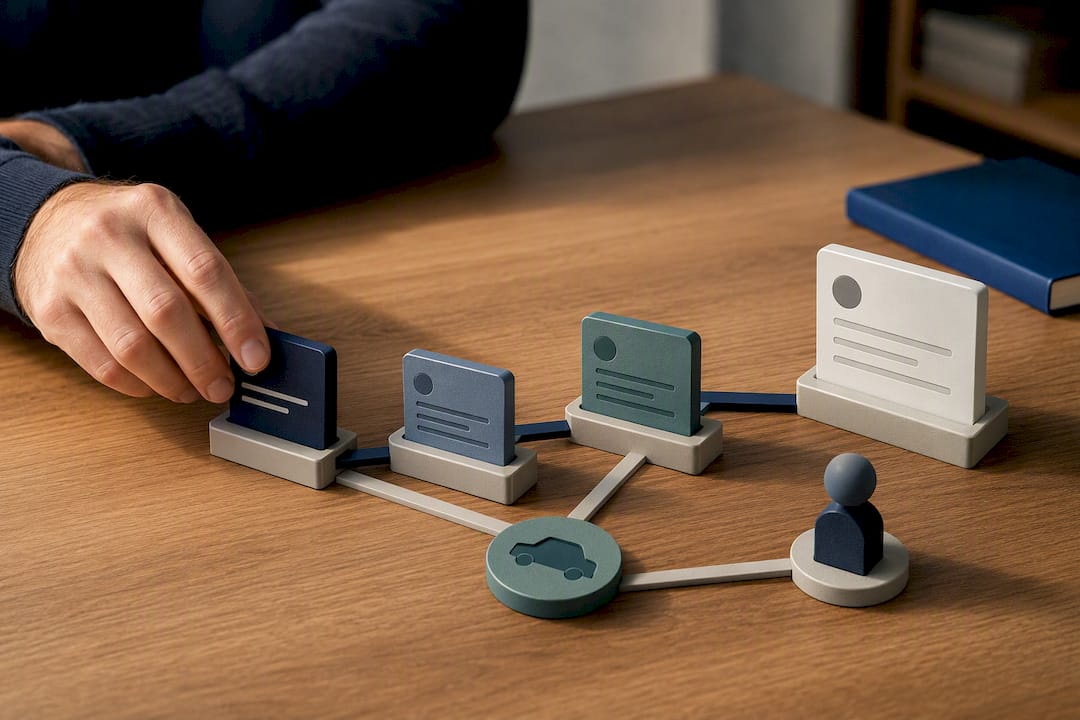
Call tracking with DNI captures phone session IDs and maps them to the scheduler session that generated the call, ensuring accurate ad verification: check placements from the city you targeted · Masklabs. Modern scheduling platforms can capture UTMs, referrer data, and click IDs and pass them into the CRM or DMS through hidden form fields or onclick event capture, which is the mechanism that keeps campaign data alive as a visitor moves from an ad to a phone call to a booked slot.
A few integration requirements deserve special attention:
- Hidden fields on the scheduler must carry UTM and click ID values without exposing them to the customer.
- Session and cookie lifetime need to span the realistic consideration window, not just a single visit.
- Export options into a BI tool or analytics platform should preserve source-level granularity, not just aggregate totals.
Pro Tip: Test your scheduler's session persistence by clicking a campaign link, closing the browser, and returning three days later to book. If the UTM data doesn't survive that gap, your attribution is silently dropping a meaningful share of real customers.
Attribution Models and Practical Tradeoffs
No single model gets service attribution perfectly right, and chasing perfection usually costs more than the accuracy it buys. Here's how the common models stack up for fixed ops reporting:
- Last-click credits whichever source touched the customer immediately before booking. It's the easiest to implement but systematically overvalues search and branded terms.
- First-touch credits the original discovery channel, which is useful for measuring awareness campaigns but ignores everything that closed the appointment.
- Position-based splits credit between first and last touch, with a smaller share to the middle. This tends to match how service journeys actually work.
- Time-decay weights recent touches more heavily, useful when service intervals are short and the booking decision happens quickly after a reminder.
- Data-driven / multi-touch models use statistical weighting across all touches, which is the most accurate approach but requires enough volume and clean data to be trustworthy.
Home-service research shows customers often interact with 7 to 12 touchpoints before booking, and last-click attribution can overvalue search by 40% to 60% in that context. Service journeys at a dealership tend to run shorter, but the same directional bias applies: a customer who called after seeing a service reminder email, then searched for the dealership by name, will show up as "organic search" under last-click even though the email started the visit.
For most dealerships, position-based or time-decay models offer the best balance of accuracy and simplicity. Save a full data-driven model for stores with enough monthly appointment volume to make the statistics reliable, and use our multi-touch attribution guide for the mechanics of setting weights.
How to Implement Appointment Attribution Step by Step
Getting from "we have some data" to "we trust this report" takes a specific sequence, not a big-bang rollout. Follow these steps in order:
- Map identifiers. Decide on canonical fields, appointment ID, VIN, phone session ID, and document exactly where each one is captured in your stack.
- Implement capture. Add hidden UTM and click ID fields to every booking form, preserve session IDs as visitors move between pages, and enable DNI on all tracked phone numbers.
- Build DMS mapping rules. Create linking rules that tie appointments to RO records automatically, then run an initial backfill on ROs from the past 90 days, since older records typically lack the session metadata needed for a clean match.
- Validate with reporting and QA. Pull a sample of matched records each month and manually check accuracy; reconcile any calls or appointments that failed to link.
- Test and iterate. Run small budget shifts or holdout tests on a limited segment before reallocating major spend, so you confirm the attribution signal actually predicts real RO outcomes.
Pro Tip: When backfilling historical appointments, match on VIN plus a date window first, then reconcile by advisor or appointment ID. Records older than 90 days rarely carry usable session data, so don't waste time forcing a match there.
For the DMS-to-marketing linkage specifically, our closed loop attribution guide walks through the reconciliation routines that keep this process from drifting out of sync month over month.
Common Gaps We Find in Dealership Attribution Setups
The most frequent breakdowns aren't exotic. Missing session persistence, call flows that skip DNI entirely, and DMS appointment fields that don't match across systems account for most of the attribution errors we encounter in dealership reviews.
The fastest fixes tend to be operational, not technical. Enforcing appointment capture at vehicle delivery, requiring UTM parameters on every campaign landing link, and manually validating a sample of call logs against DMS entries each month typically lift measurable accuracy within a single reporting cycle. A tightened call tracking setup alone often resolves a large share of misattributed appointments before any model changes are needed.
Turning Attribution Reports Into Budget Decisions
Use attribution to shift budget directionally toward higher-RO-value channels, not to chase precise single-digit percentage swings that the data can't reliably support. Set clear reallocation thresholds in advance, run controlled tests before major budget moves, and put a cross-functional owner, marketing and service together, on regular audits so the rules stay documented and consistent.
AutoROIQ's Marketing Intelligence Review for Fixed Ops
Reading this checklist and actually running it inside a live DMS, call tracking platform, and CRM stack are two different projects. Most service departments discover the gap when a vendor's reported appointment lift doesn't match what the shop floor actually booked. The audit is conducted independently, so there is no incentive to protect any single channel's numbers.
The Marketing Intelligence Review covers three things: a full audit of your current attribution data, an accuracy check on how appointments are actually being mapped to RO value, and a prioritized list of fixes ranked by impact. Dealerships that go through it typically improve vendor accountability and gain a reporting setup that ties spend to repair order revenue instead of lead counts. If your current reports raise more questions than they answer, visit AutoROIQ to see how an independent review works for your store.
— AutoROIQ
Where to Learn More
For implementation specifics beyond this guide, consult your DMS and scheduler vendor's own integration documentation, plus the call tracking guidance referenced above for DNI setup details.
Sources
- Evaluation metrics of appointment scheduling systems (systematic review)
- Auto service bay revenue attribution statistics
- Multi-Touch Attribution for Home Service Companies
- Track lead attribution and Scheduling Pro jobs (ServiceTitan doc)
FAQ
What Does "Service Appointment" Mean at a Dealership?
A service appointment is a scheduled visit to the dealership's service department for maintenance or repair work, booked either online, by phone, or in person. It becomes a repair order (RO) once the vehicle is checked in and work is authorized.
What Happens if I Miss a Scheduled Service Appointment?
Missing a service appointment typically means the slot is released back to the schedule and you'll need to rebook, though policies vary by dealership. From an attribution standpoint, a no-show still counts as a booked appointment but never converts to an RO, which is why tracking no-show rate separately from appointment-set rate matters; benchmarks suggest no-show rates should sit under 10% once automated reminders are used.
What Happens During a Car Service Appointment?
A car service appointment typically starts with vehicle check-in and a multi-point inspection, followed by the advisor reviewing recommended work and pricing before authorization. The visit closes with the repair order finalized, payment processed, and often a rebooking prompt for the next service interval.
What Are the Types of Service Appointments?
Dealership service appointments generally fall into a few categories: scheduled maintenance (oil changes, inspections), warranty repairs, recall work, and unscheduled or diagnostic visits for a specific problem. Each type carries a different average RO value, which is why attribution should track RO value by source rather than treating all appointments as equal.
How Does AutoROIQ Help With Appointment Attribution Specifically?
AutoROIQ's Marketing Intelligence Review audits your existing attribution setup across DMS, call tracking, and scheduler data to identify where appointments are getting lost or misattributed. Because AutoROIQ doesn't sell advertising or take vendor commissions, the findings reflect what the data actually shows rather than what a vendor wants reported.