Dealership geo targeting works when it combines three things at once: tight radius or polygon boundaries, an inventory feed that updates in real time, and attribution that traces a click back to a showroom visit. Run those together and you get measurable lift in conversions and vehicle detail page traffic. Skip any one of them and you get expensive impressions with no way to prove they mattered. Start with radius targeting, layer in conquest geofencing, then connect both to your live inventory feed before you scale spend.
TL;DR:
- Combining tight radius or polygon boundaries, real-time inventory feeds, and accurate attribution is essential for dealership geo-targeting to generate measurable sales lift.
- Radius targeting should be adjusted based on population density, with urban dealers using 3 to 5 miles, suburban dealers 8 to 12 miles, and rural dealers up to 25 miles.
- Polygon geofencing is preferable when targeting irregular locations like competitor lots or event venues, but boundaries must be precise to avoid wasted impressions.
- Syncing in-stock inventory data daily and linking ads directly to matching vehicle detail pages improves conversion rates significantly.
- An independent marketing intelligence review helps verify vendor claims, optimize campaign setup, and determine if geo spend is delivering true value.
Table of Contents
- Why Dealership Geo Targeting Actually Moves the Sales Needle
- How Wide Should Your Radius Targeting Go?
- When Should You Use Geofencing Instead of a Radius?
- Why Inventory-Level Geo Ads Outperform Generic Creative
- How Do You Run Conquest Campaigns Without Burning Trust?
- What Contextual Triggers Actually Change Campaign Results?
- How Should First-Party Data Refine Your Geo Audiences?
- What Metrics Prove Geo Targeting Is Actually Working?
- A Three-Week Pilot for Testing Dealership Geo Targeting
- What Should You Actually Ask Your Geo Vendor?
- When Is Scaling Geo Spend the Right Call?
- Get an Independent Read on Your Geo Targeting Spend
- Sources
- FAQ
Why Dealership Geo Targeting Actually Moves the Sales Needle
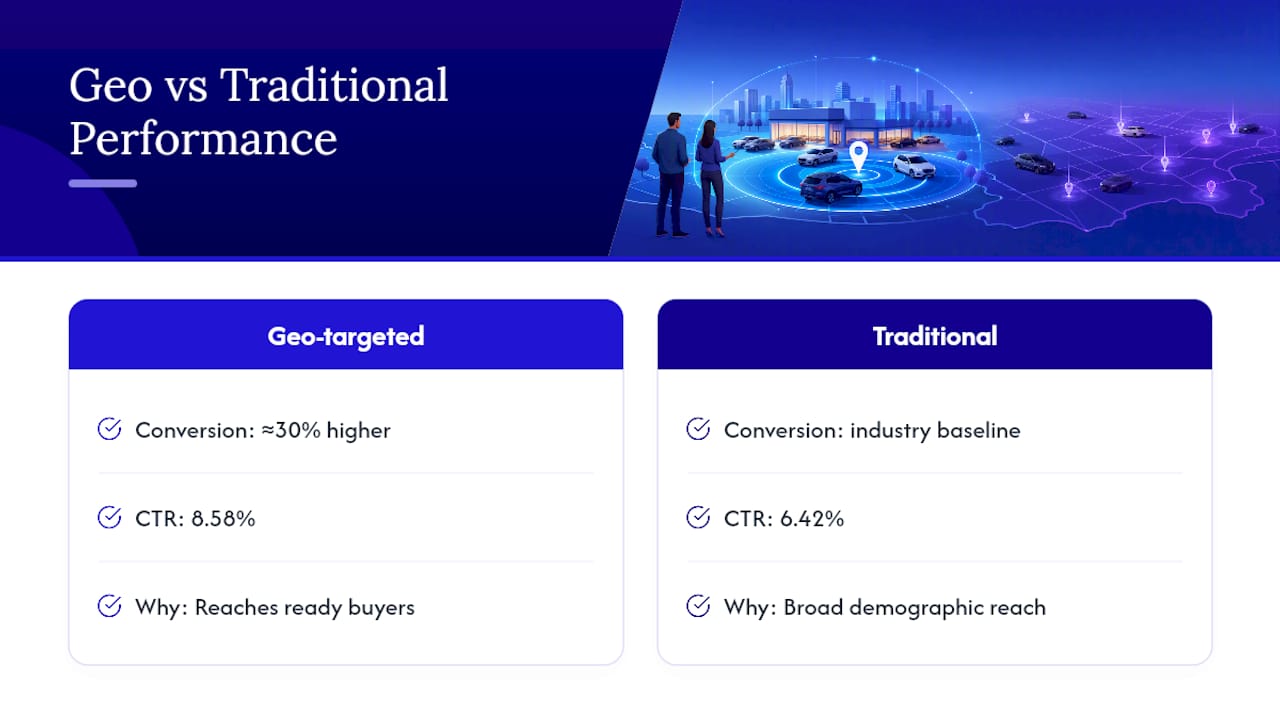
Geo-targeted automotive campaigns produce roughly 30% higher conversion rates than traditional advertising, with click-through rates that can run as high as 8.58% against an industry average closer to 6.42%. That gap exists because location-aware ads reach people who are already close to a purchase decision, not people who happen to fit a broad demographic bucket.
Mobile behavior explains most of the gap. Shoppers search "Toyota dealer near me" or ask a voice assistant for directions while sitting in a parking lot three miles from your lot, and the dealership that shows up first at that moment usually wins the visit. Every one of those signals should map to a KPI you already track: VDP views by ZIP code, cost per lead by radius tier, and showroom visits tied back to a specific campaign.
That difference compounds fast once you're spending five figures a month on digital.
How Wide Should Your Radius Targeting Go?
Radius size should follow population density, not habit. A dealer in a dense metro pulls from a much tighter area than one serving a rural county, and treating them the same wastes budget on either end.
- Urban dealers: 3 to 5 miles, since inventory competition and traffic density shrink the realistic drive radius.
- Suburban dealers: 8 to 12 miles, wide enough to cover neighboring towns without bleeding into a competitor's core market.
- Rural dealers: 15 to 25 miles, because shoppers already expect to drive farther for the right vehicle.
Layer drive-time data and household income bands on top of the raw radius before you launch. Then run two versions of the same offer at different radii for two weeks and compare cost per lead. The tighter radius almost always wins on efficiency; the wider one usually wins on volume. Which one matters more depends on whether your service drive or your sales floor needs the traffic more that month.
When Should You Use Geofencing Instead of a Radius?
Radius targeting draws a circle. Geofencing and polygon mapping draw an actual shape, which matters when the thing you're targeting isn't round, like a competitor's lot, a stadium parking structure, or a county fairground during an auto show weekend. Polygon mapping reduces wasted impressions compared to broad radius targeting because it follows the real footprint of the audience you want, not an approximation of it.
- Use polygons for irregular shapes: competitor dealership lots, event venues, or mall parking structures.
- Use radius targeting for general local awareness where no single physical location matters more than proximity.
- Set competitor-lot fences at 500 to 1,000 feet around lot entrances, tight enough to catch actual visitors and loose enough to avoid missing them at the edges.
- Write creative that acknowledges intent directly. Someone standing on a competitor's lot already wants a vehicle. A generic brand ad wastes the moment.
Pro Tip: The most common geofencing mistake is setting the polygon too wide and capturing the strip mall next door along with the dealership. Pull up satellite view before you publish any fence and trace the actual lot boundary, not a rough circle around an address pin.
Why Inventory-Level Geo Ads Outperform Generic Creative
Static geo ads promoting a model you sold last week burn budget and frustrate shoppers who click through to a sold-out VDP. Syncing your DMS or inventory feed directly to your geo campaigns means only in-stock vehicles get promoted within a defined zone, which keeps every impression relevant to what a shopper can actually buy today.
- Feed VIN-level data into your ad platform on a daily or same-day cadence, not weekly.
- Route every inventory ad to its matching VDP, never to a generic new-inventory landing page.
- Monitor for stale listings weekly. A feed that lags by even a few days starts showing sold units.
- Pair inventory sync with radius tiers so a rare trim promotes across a wider area than a common one.
Precision sells better than reach here. A shopper who clicks an ad for the exact truck sitting on your lot converts at a noticeably higher rate than one clicking a general "new inventory arriving" banner, because there's no friction between the ad and the vehicle behind it.
How Do You Run Conquest Campaigns Without Burning Trust?
Conquest targeting means advertising to people who recently visited a competitor's lot or attended a regional auto event, and it works best when the audience definition is tight and the exclusions are airtight.
- Target visitors captured within a 500 to 1,000 foot geofence around competitor lot entrances.
- Exclude your own existing customers and service visitors so you're not paying to re-target people already in your database.
- Cap frequency at two or three impressions per week per device to avoid feeling like surveillance.
- Lead creative with a comparison angle, trade-in value, or a specific incentive, not a jab at the other brand.
- Watch VDP visits and lead form fills from the conquest segment separately from your general local audience to see if the tactic is actually working.
Some conquest platforms, including capability marketed under Drivonic's MobileLync, promote engagement windows of 24 to 48 hours after a competitor-lot visit, on the logic that a shopper's decision is still fluid in that window. Whether that window holds for your market is worth testing rather than assuming.
What Contextual Triggers Actually Change Campaign Results?
Time of day, weather, and local events all change what a shopper wants to hear from you. Dayparting and weather-based adjustments let you match the message to the moment instead of running the same ad around the clock.
- Increase bids during peak shopping hours, typically weekday evenings and Saturday mornings, when in-market research spikes.
- Switch creative to service-focused offers during cold fronts or storm warnings, when tire and battery searches jump.
- Trigger click-to-call and directions-focused ad formats for mobile users within your radius, since voice and mobile searches skew heavily toward "near me" and immediate-action intent.
- Build a simple rule set: temperature drops below 32°F triggers battery-service creative; local event within 5 miles triggers a shuttle or loaner-vehicle message.
None of this requires a large media budget increase. It requires someone checking the trigger rules weekly and swapping creative before the moment passes, not after.
How Should First-Party Data Refine Your Geo Audiences?
CRM records, service history, and website VDP visitors are the highest-value audience sources you own, and none of them require paying a third party for reach.
- Prioritize purchase history and service records first. Someone whose lease matures in 60 days is a warmer local prospect than any lookalike audience.
- Build lookalike audiences from your best customers, then constrain them to your actual trade radius so the algorithm doesn't drift into markets you can't serve.
- Use hashed, privacy-safe matching when uploading customer lists to ad platforms rather than raw personal data.
- Confirm your vendor's data-handling practices meet applicable privacy requirements, including consumer rights frameworks like the CCPA for reader-facing consent and opt-out handling.
A service-department list matched against a radius-constrained lookalike model consistently outperforms a cold local audience, because you're really just finding more people who resemble customers who already trust you.
What Metrics Prove Geo Targeting Is Actually Working?
Attribution is the part most dealers skip, and it's the part that determines whether next quarter's budget conversation goes well or badly.
- Instrument every geo campaign with consistent UTM parameters and VDP tracking so you can isolate performance by ZIP code and radius tier.
- Track VDP views by ZIP, cost per lead by radius, cost per visit, and sales match-back against showroom traffic.
- Run short 2 to 4 week control versus variant windows, comparing VDP lift against adjacent control ZIPs that received no geo spend, to isolate incremental impact rather than assuming every visit came from the ad.
- Review agency performance metrics monthly so vendor-reported numbers get checked against your own CRM and DMS data.
Without this step, you're trusting a vendor's dashboard to grade its own homework. With it, you know exactly which radius, fence, or trigger earned the visit.
A Three-Week Pilot for Testing Dealership Geo Targeting
You don't need a full rooftop rollout to know if geo targeting will work for your store. A three-week pilot on one campaign type tells you almost everything.
- Week 0, prep: confirm your inventory feed connects cleanly to your ad platform, audit your Google Business Profile for completeness (a factor Google itself ties to visit and purchase likelihood), and define your baseline and test audiences.
- Week 1, launch: run a radius campaign against a no-geo control group with basic UTM and VDP tracking active from day one.
- Week 2, refine: layer in inventory sync, add one competitor geofence, apply a dayparting rule, and start logging sales match-back data.
- Decision gate: if cost per visit beats your baseline channel and VDP lift holds against the control ZIP, expand radius tiers and add a second geofence. If not, fix the feed or the audience definition before spending more.
Pro Tip: Run the pilot on your slowest-moving inventory segment first. If inventory-synced geo ads can move a vehicle that's been sitting 60 days, you know the tactic works before you risk budget on your best-selling trims.
What Should You Actually Ask Your Geo Vendor?
Vendor dashboards routinely disagree with each other, and each one has a built-in incentive to show its own campaigns in the best light. That's the core problem an independent review exists to solve.
Ask for raw data feeds, not summarized reports. Ask for the exact attribution window used to credit a sale to a campaign. Ask what percentage of the "matched" audience is verified first-party data versus modeled or purchased lists. Require proof of inventory sync frequency, not a claim that it happens. Self-serve platforms that expose polygon-level reporting directly tend to make these questions easier to answer than fully managed, black-box models.

An independent Marketing Intelligence Review addresses exactly this friction: vendor claims that can't survive contact with a dealer's own CRM and DMS data. An independent read on match rates and attribution windows often reshuffles budget priorities the moment the raw numbers get compared side by side.
When Is Scaling Geo Spend the Right Call?
Scale geo spend once local search volume supports it, your inventory feed matches what shoppers see in ads, and your offers are actually competitive. If pricing, aged inventory, or service wait times are the real problem, more geo spend just gets more people to notice those issues faster. Fix operations first. Then scale targeting.
Get an Independent Read on Your Geo Targeting Spend
Every tactic in this guide works only if your vendor's numbers are telling you the truth, and that's the gap Autoroiq exists to close. Unlike an agency running your campaigns, an independent marketing intelligence provider that doesn't sell advertising or take commissions has no incentive to protect a dashboard that's overstating results.

A Marketing Intelligence Review audits your current geo data feeds, validates whether attribution windows and match rates hold up against your own CRM and DMS, and hands your team a prioritized list of what to fix first, whether that's inventory sync, radius tiers, or a conquest fence that's leaking budget. For dealer groups running geo campaigns across multiple rooftops, such a review can clarify which locations are actually converting versus which ones just look busy on a vendor report. If your last three vendor reports told three different stories about the same campaign, that's the exact problem an independent advisory engagement resolves. Consider reaching out through vendor websites to scope a review for your store or group.
Sources
Figures and tactics here draw on Demand Local's geotargeting statistics and geo strategy guidance, Qujam's geofencing analysis, and Autoroiq's own marketing intelligence insights.
- 25 Geotargeting in Dealership Campaigns Statistics in 2025
- Geofencing for Car Dealerships That Sells - Qujam
FAQ
What Does Geo Targeting Mean for a Dealership?
Geo targeting means showing ads only to shoppers within a defined location, whether that's a radius around your store, a polygon around a competitor's lot, or a ZIP code cluster with strong buying intent. For dealerships, it turns generic reach into spend concentrated on people close enough to actually visit.
What Is an Example of Dealership Geo Targeting?
A dealer sets a 1,000 foot geofence around a competitor's lot entrance, then serves a trade-in incentive ad to any device that entered that fence in the past 48 hours. That's conquest geo targeting built on a competitor-lot polygon.
What Software Do Most Dealerships Use for Geo Targeting?
Dealers commonly use platforms like Demand Local for radius and inventory-synced campaigns, Qujam for polygon-level geofencing, and Drivonic's MobileLync for competitor conquest targeting, often alongside DealerOn for site and local SEO infrastructure. Autoroiq doesn't sell these platforms; it independently evaluates whether the one you're already paying for is delivering what the vendor claims.
What Is the Red Flag Rule for Car Dealers?
The Red Flags Rule is a Federal Trade Commission requirement that dealers offering financing maintain a written identity theft prevention program, and it isn't directly related to geo targeting or advertising. It matters for compliance teams handling credit applications, not for marketing managers running local campaigns.
How Wide Should a Competitor Conquest Geofence Be?
Most guidance points to 500 to 1,000 feet around a competitor's lot boundary or entrance, tight enough to capture actual visitors without picking up unrelated foot or vehicle traffic nearby.