
An automotive email marketing audit is a structured review of your dealership's list health, deliverability setup, automation triggers, CRM/DMS integration, and revenue reporting. Run three checks first: CRM data access, SPF/DKIM/DMARC authentication, and whether high-value triggered flows actually fire on time. Fix those three and you should see better inbox placement, faster lead response, and a measurable lift in email-driven revenue within one to two sales cycles.
TL;DR:
- Proper automobile email audits must prioritize integration, authentication, and data hygiene to ensure flows fire on time and inbox placement improves.
- Most issues stem from disconnected CRM triggers and stale data, which, when fixed, significantly boost revenue and response rates within a few sales cycles.
- Segmentation based on vehicle ownership and lifecycle stage, combined with targeted personalization, dramatically increases engagement and conversion.
- Mobile-friendly templates with simple HTML, fast-loading images, and clear call-to-action buttons are essential, as most opens occur on smartphones.
- Ongoing benchmarking against automation depth and timely impact measurement are crucial, with independent audits preferred when internal technical resources are limited.
Table of Contents
- Why an Automotive Email Marketing Audit Covers More Than Templates
- What Are the Main Types of Email Audits for Dealerships?
- How Do You Run a Step-by-Step Email Marketing Audit?
- What Metrics and Benchmarks Should Dealerships Track?
- Which Tools and Data Sources Should You Pull for the Audit?
- What Do Most Dealer Email Audits Find, and How Do You Fix It?
- AutoROIQ's Vendor-Agnostic Approach to Email Audits
- Segmenting and Personalizing Automotive Email by Lifecycle Stage
- Is Your Email Template Actually Mobile-Friendly?
- How Does Your Dealership's Email Program Compare to Competitors?
- When Should You Audit In-House vs. Hire a Specialist?
- Get an Independent Email Marketing Audit for Your Dealership
- Sources
- FAQ
Why an Automotive Email Marketing Audit Covers More Than Templates
Most dealership marketing managers treat an email audit as a content review. Check the subject lines, glance at open rates, move on. That approach misses the actual source of underperformance: broken data pipelines between your CRM/DMS and your email service provider.
An email marketing audit for automotive dealerships has to start with integration, because nearly every automated flow depends on it. A service reminder can't fire if the ESP never receives the service date. A trade-in offer can't target the right owner if lease-maturity data sits stale in a CRM export from three weeks ago. Vendor evaluations built around CRM/DMS integration, service history usage, and reporting accuracy tend to expose more revenue-relevant gaps than reviews built around template volume or design polish, according to guidance from the Automotive Digital Marketing email RFP framework.
A proper audit scope for a dealership covers six areas:
- List health and data hygiene — duplicate records, stale consent flags, and bounce patterns that quietly shrink your addressable audience
- Deliverability and authentication — whether your domain reputation and SPF/DKIM/DMARC setup are actually getting mail into the inbox
- Content and design quality — subject lines, preview text, mobile rendering, and accessibility
- Automation and lifecycle flows — trigger latency and whether service, sales, and trade-in sequences fire on real events
- CRM/DMS integration — real-time data access and event mapping
- Reporting and attribution — whether email activity connects to actual appointments and sales
Each of those areas maps to a different revenue lever. Data hygiene protects list size and sender reputation. Deliverability determines whether your content is even seen. Automation drives the highest per-recipient revenue in most dealership programs. Integration is the plumbing that makes automation possible. Reporting is how you prove any of it worked to your general manager.
What Are the Main Types of Email Audits for Dealerships?
Automotive email programs typically need six distinct types of inspection, each with its own checklist. Treating them as one undifferentiated "email review" is how dealerships miss the specific failure points that are actually costing them leads.
-
List health audit. Deduplicate records across CRM exports, verify consent flags against your actual opt-in capture forms, confirm re-permission rules are documented, and pull bounce reports segmented by domain (Gmail, Yahoo, Outlook) rather than looking at an aggregate bounce rate that hides domain-specific problems.
-
Deliverability and authentication audit. Confirm SPF, DKIM, and DMARC records are all correctly published and aligned, not just present. Run seed-list placement tests across major inbox providers to see whether mail lands in the primary inbox, promotions tab, or spam folder. A domain that passes authentication checks but still lands in spam usually has a sending-behavior problem, not a records problem.
-
Content and design audit. Review subject line length and tone against what's actually working industry-wide, check preview text for every campaign type, and test rendering across mobile clients. Accessible, well-structured HTML supports both usability and inbox rendering across email clients, which is a detail most dealership audits skip entirely, per University of Wisconsin IT's accessibility guidance.
-
Automation and lifecycle audit. Measure trigger latency (how many hours or days pass between an event and the email firing), verify event fidelity (does the "service completed" trigger actually mean the service was completed, or just scheduled), and rank your flows by revenue per recipient to find which ones deserve engineering attention first.
-
Integration audit. Confirm your ESP has real-time or near-real-time access to CRM and DMS events; map exactly which fields (lead status, purchase date, service history, lease-end date) actually flow through versus which ones are assumed to flow through but don't.
-
Reporting and attribution audit. Check UTM tagging consistency across campaigns, verify match rates between email clicks and CRM records, and confirm whether appointment-to-sale attribution is even possible with your current tracking setup.
Run these six as separate workstreams. A dealership that scores well on content and design but fails integration will still underperform, because the best subject line in the world can't compensate for a trade-in flow that never fires.
How Do You Run a Step-by-Step Email Marketing Audit?
Start with goals, not data. Before pulling a single report, define what "better" means in numbers your general manager cares about: leads generated, appointments booked, and revenue per recipient. An audit without a KPI target turns into an aimless spreadsheet exercise that nobody acts on.
Step 1: Set KPI-linked goals. Decide upfront what threshold justifies action. If your goal is "increase service appointments booked from email by 15% this quarter," every subsequent finding gets filtered through that lens instead of becoming a generic to-do list.
Step 2: Collect the data. Export campaign-level and flow-level reports from your ESP, service and sales activity logs from your CRM/DMS, and a full list of active automations with their trigger conditions. Ask specifically for engagement-by-segment breakdowns, not just blended averages, since blended numbers hide which segments are actually converting.
Step 3: Analyze by segment and campaign type. Separate performance by lifecycle stage (new lead, active owner, lapsed service customer, trade-in candidate) and by campaign type (promotional blast versus triggered flow). Map each segment's engagement back to a revenue estimate using your average deal or repair-order value. This is where most dealership audits find their biggest surprise: a handful of trigger-based flows often drive a disproportionate share of email revenue while blast campaigns to the full list barely move the needle.
Step 4: Prioritize fixes with an impact-times-effort view. Not every finding deserves the same urgency. A broken DMARC record is high impact and usually low effort to fix. A full CRM re-architecture to fix event latency is high impact but high effort. Rank fixes so you can bank quick wins while the harder integration work gets scoped properly.
- High impact, low effort: authentication fixes, suppression list cleanup, subject line testing
- High impact, high effort: real-time CRM/DMS integration, rebuilding lifecycle automation logic
- Low impact, low effort: minor design tweaks, footer compliance language
- Low impact, high effort: cosmetic template redesigns with no data problem behind them
Step 5: Implement and monitor. Fix authentication and suppression issues first since they're usually fast. Then move into automation repair, checking trigger latency daily during the first week after any change. Weekly, review engagement by segment. Monthly, revisit the full KPI dashboard against your original goals from Step 1.
Building a genuine measurement cadence, not a one-time report, is what separates dealerships that sustain email gains from ones that see a short-term bump and drift back to old habits, a pattern MIT Sloan's research on data-driven culture has documented across industries well beyond automotive.
Pro Tip: Run your first audit cycle on a 30-day window, not a full quarter. A shorter window surfaces trigger and deliverability problems fast, and you'll still have time to fix them before the next sales push.
What Metrics and Benchmarks Should Dealerships Track?
Six metrics matter most in a dealership email audit: open rate, click-through rate (CTR), click-to-open rate (CTOR), conversion rate, inbox placement rate, and combined bounce/spam complaint rate. CTOR is the most underused of the six, since it isolates content and offer quality from subject-line performance, letting you tell whether a weak campaign is a deliverability problem or a message problem.
Automotive email typically returns $36 to $42 for every dollar spent, and automated campaigns generate substantially more revenue per recipient than standard one-off sends, according to Web Tonic's automotive email benchmark data.
That gap between automated and blast-send revenue is the single strongest argument for prioritizing automation repair over content polish when your audit budget is limited.
Industry analyses of automotive campaigns show shifts toward evening send times and heavier use of urgency-driven calls to action, but dealerships should test send windows against their own customer base rather than copy a single industry pattern wholesale, per TargetBay's automotive email analysis. What works for a high-volume urban store may flop for a rural franchise with a different commute pattern and browsing schedule.
Use these thresholds to decide when a finding demands action rather than monitoring:
| Metric | Healthy range | Action threshold |
|---|---|---|
| CTOR | 15% or higher | Below 10% → run a content/offer test |
| Bounce rate | Under 2% | Above 5% → pause sends to that segment, clean list |
| Spam complaint rate | Very low | Above 0.3% → pause and remediate authentication/cadence |
| Inbox placement | 90%+ | Below 80% → full deliverability audit, not just a content fix |
A campaign with a strong open rate but a weak CTOR usually has a compelling subject line attached to a disappointing offer or landing experience. A campaign with a weak open rate but strong CTOR often has a deliverability problem, not a content problem, since the people who do see it are engaging fine.
Which Tools and Data Sources Should You Pull for the Audit?
You need four categories of tools and exports to run a complete audit: deliverability testing tools, CRM/DMS queries, ESP reports, and content/accessibility tests. Skipping any one category leaves a blind spot that will eventually surface as an unexplained performance drop.
Deliverability tools. Seed-list inbox placement tests show exactly where your mail lands across major providers. Authentication validators confirm SPF, DKIM, and DMARC are correctly published and aligned rather than just technically present. A failed DMARC alignment check, even with SPF and DKIM individually passing, is one of the more common and more overlooked causes of inconsistent inbox placement.
CRM/DMS queries and logs. Pull service history records, last-visit dates, lead status changes, and consent flag history directly from the source system rather than relying on what the ESP thinks it has. Discrepancies between these two sources are usually where automation failures originate.
- Service history export with timestamps, not just service type
- Last-visit and lease-maturity date fields, checked for staleness
- Consent flag audit trail showing when and how opt-in was captured
- Lead status change log to verify trigger timing against actual events
ESP reports. Request campaign-level performance, flow-level performance broken out by individual automation, and engagement-by-segment data rather than blended totals. Ask specifically for a list of all active automations with their trigger logic documented, since ESP dashboards often understate how many flows exist or how they're configured.
Content and accessibility tests. Mobile preview tools across multiple email clients, HTML complexity checks (heavy nested tables slow rendering and break on some clients), and image load-time tests. A specialist advisory process can help interpret these outputs against dealership-specific benchmarks rather than generic ecommerce norms.
What Do Most Dealer Email Audits Find, and How Do You Fix It?
Five findings show up in dealership email audits more often than any others, and they follow a predictable order of severity.
-
Disconnected or delayed CRM triggers. This is the most common and most damaging finding. Audits regularly reveal that dealer email programs lack real-time access to service and lead status, so automated flows underperform no matter how good the creative is, according to the automotive email RFP framework. Fix: verify event timeliness by timestamping a test event and measuring how long it takes to reach the ESP; anything over 24 hours for time-sensitive triggers (service completion, test-drive follow-up) needs a technical fix, not a content fix.
-
Stale consent and poor list hygiene. Records accumulate duplicate entries, outdated consent flags, and contacts who haven't engaged in over a year. A 90-day CRM data hygiene playbook is a reasonable timeline for a full cleanup cycle. Fix: run a re-permission campaign segmented by last-engagement date; a clean, clearly valuable re-permission offer can recover a meaningful share of lapsed contacts without damaging sender reputation, per TargetBay's findings.
-
Deliverability drift. Authentication was set up correctly at launch but nobody revisited it after a domain migration or ESP change. Fix: remediate in sequence, authentication first, then sending cadence, then suppression list cleanup. Never skip straight to suppression without fixing authentication, or you'll suppress good contacts to compensate for a technical problem.
-
The wrong automations get built first. Dealerships often build generic welcome series while trade-in and end-of-term flows sit untouched, despite those campaign types achieving some of the strongest open and click performance when properly targeted, per Web Tonic's benchmark data. Fix: rank existing and planned automations by estimated revenue per recipient before assigning development time.
-
Broken closed-loop attribution. Inconsistent UTM tagging and missing appointment-capture fields mean email-driven sales go uncredited. A practical closed-loop attribution guide walks through fixing link tagging and post-visit matching, which can meaningfully improve measured ROI without changing a single campaign.
Pro Tip: Fix trigger latency before you touch subject lines. A dealership we'd expect to see improve conversion by rewriting emails almost always sees a bigger lift from making sure the right email arrives at the right moment.
AutoROIQ's Vendor-Agnostic Approach to Email Audits
Some vendors don't sell email templates, sending platforms, or advertising, which changes what an audit finding actually means for a dealership. When an agency that also sells you email services tells you your automation is fine, that recommendation carries an obvious conflict, a key consideration when evaluating AI tools for marketers and their automation claims. An independent review has no reason to protect a vendor relationship it doesn't profit from.
A vendor-agnostic review evaluates whether the CRM/DMS integration, automation logic, and reporting accuracy promised in the sales pitch are the same ones actually running in production, and whether the budget allocated to that vendor is producing revenue proportional to spend.
That distinction matters most in disputes over underperformance, where a dealer and an email vendor each have a report showing different numbers. Independent evaluation of vendor capability across CRM/DMS integration, lifecycle segmentation, and reporting accuracy gives dealership leadership a basis for the conversation that isn't just "trust our dashboard," a gap the automotive email RFP framework is built to close.
Some vendor-agnostic methodologies apply this same standard across every marketing channel a dealership runs, not just email, so budget reallocation decisions get made against a consistent set of criteria rather than channel-by-channel guesswork. Case-specific outcomes and client results are available on request through direct engagement.
Segmenting and Personalizing Automotive Email by Lifecycle Stage
Generic segmentation by name and email address wastes the richest data a dealership has: vehicle ownership records. A customer six months from lease-end needs a fundamentally different message than one who bought used three years ago and is due for a major service.
Build segments around dealership-specific lifecycle stages rather than generic ecommerce categories. Useful segments include: active lead not yet purchased, recent buyer in the first 90 days, service-only customer with no purchase history, lapsed service customer (no visit in 12+ months), lease-maturity window (90 to 120 days out), and trade-in candidate based on vehicle age and mileage estimates.
Personalization should pull directly from CRM/DMS fields rather than generic merge tags. A service reminder that references the actual vehicle model, last service date, and specific recommended service (not just "your vehicle is due for service") converts at a meaningfully higher rate because it reads as informed rather than automated.
The trade-in and lease-maturity segment deserves particular attention. These campaigns can achieve some of the strongest open and click performance in the entire automotive email category when the targeting data is accurate, per Web Tonic's benchmark analysis. If your CRM's lease-end dates are stale or missing, you're leaving one of the highest-converting segments underused. Audit the accuracy of these fields before investing more in the creative wrapped around them.
Is Your Email Template Actually Mobile-Friendly?
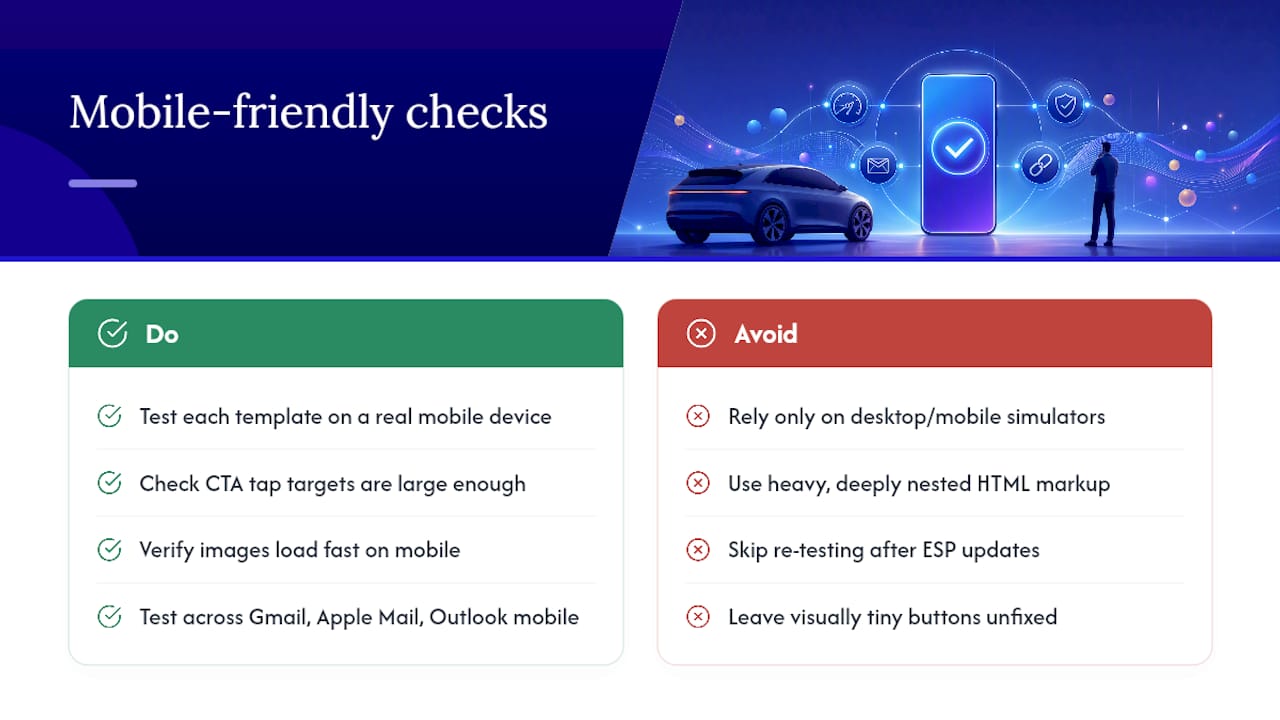
Most dealership email opens now happen on a phone, which means a template that looks polished on a desktop preview can still fail where it matters most. Test every template on an actual mobile client, not just a desktop rendering tool that simulates mobile width, since simulated previews miss font-scaling and tap-target issues that only show up on a real device.
Check three things specifically: whether calls-to-action are large enough to tap without zooming, whether images load fast enough that impatient users don't abandon before the offer even renders, and whether subject lines and preview text truncate cleanly on smaller screens instead of cutting off mid-word. A "Schedule Service" button that's technically clickable but visually tiny on a phone screen is a common, easily fixed audit finding.
Heavy, complex HTML with deeply nested tables is a frequent culprit behind slow mobile rendering and inconsistent display across clients. Well-structured, accessible HTML renders more reliably across the range of email clients dealership customers actually use, which supports both usability and deliverability, per University of Wisconsin IT's accessibility guidance. Simpler markup isn't a compromise on design quality; it's often what makes the design actually work everywhere it needs to.
Run a rendering check across at least three major mobile clients (Gmail app, Apple Mail, Outlook mobile) every time a template changes, not just at initial launch. A template that renders fine today can break after an ESP platform update changes how it interprets certain HTML elements.
How Does Your Dealership's Email Program Compare to Competitors?
Competitive benchmarking in automotive email means comparing your program against category norms, not against a single rival dealership whose internal numbers you can't see anyway. The useful comparison points are send frequency, automation sophistication, and revenue per recipient relative to published automotive benchmarks.
Industry-wide, automotive email trends show a shift toward evening send times and more urgency-driven messaging in subject lines and CTAs, per TargetBay's analysis. That's a starting hypothesis to test against your own list, not a rule to copy blindly, since a dealership's local customer behavior can diverge from national patterns.
The more meaningful competitive gap isn't creative style. It's automation depth. A dealership running five well-targeted, trigger-based flows (service reminder, trade-in offer, lease-maturity, post-purchase follow-up, lapsed-customer win-back) will typically out-earn a competitor sending a larger volume of manually scheduled blast campaigns, because automated sends generate meaningfully more revenue per recipient than standard sends, according to Web Tonic's benchmark data.
Benchmark your own program against that automation-depth standard first. Count how many of the five core flow types you actually have live and firing correctly, not just built and forgotten in the ESP's automation library. A dealership with three working flows is ahead of a competitor with eight flows where half are broken or firing on stale data.
When Should You Audit In-House vs. Hire a Specialist?
Run the audit internally if your team has direct technical access to the ESP and CRM/DMS, someone comfortable pulling and interpreting segment-level data, and a consistent reporting cadence already in place. Bring in a specialist when deliverability problems persist despite fixes, when a vendor dispute needs independent evidence, or when you have no working closed-loop attribution at all.
An external audit engagement should deliver a clear vendor scorecard, a prioritized action plan ranked by impact and effort, and a defined timeline for remediation, typically measured in weeks rather than months for the initial findings phase.
— AutoROIQ
Get an Independent Email Marketing Audit for Your Dealership
Independent advisory services offer alternative ways to evaluate your email program beyond vendor self-reported dashboards. Such evaluations of CRM/DMS integration, deliverability setup, and automation performance can provide unbiased insights.
Engagements typically produce an executive summary, a vendor scorecard grading performance across integration, deliverability, and reporting accuracy, and a prioritized action plan ranked by revenue impact and implementation effort. Pricing and timelines vary by dealership size and the number of vendors under review, and a scoping call is the fastest way to get a specific estimate for your situation.
If your team has been staring at conflicting reports from your email vendor and your CRM for months without a clear answer, visit AutoROIQ's marketing intelligence services to schedule a consultation and get a scorecard built specifically around your dealership's data.
Sources
Compliance guidance comes from the CAN-SPAM Act overview. Automotive benchmarks and vendor-evaluation frameworks are drawn from TargetBay's automotive analysis and the automotive email RFP template. Dealership-specific frameworks are available through AutoROIQ's insights library and its guide to agency performance metrics.
- Automotive Email Marketing Statistics (2026 Benchmarks) | Web Tonic™
- HTML email accessibility and usability — University of Wisconsin IT
FAQ
How do I do an email marketing audit for a dealership?
Start by setting KPI-linked goals, then export CRM/DMS and ESP data, analyze performance by lifecycle segment, prioritize fixes using an impact-versus-effort view, and implement changes with a daily-to-monthly monitoring cadence.
What are the 5 T's of email marketing?
Definitions of the "5 T's" vary by source and aren't a standardized industry framework; some versions cite Tease, Target, Teach, Test, and Track, but treat this as a loose mnemonic rather than a fixed audit standard.
How many types of audits does an automotive email program need?
A thorough dealership email audit covers six areas: list health, deliverability and authentication, content and design, automation and lifecycle flows, CRM/DMS integration, and reporting and attribution.
How do I write an audit request or scoping email to a vendor?
State the specific data you need (campaign-level and flow-level reports, trigger logic documentation, consent audit trails), the timeframe covered, and the deadline, and reference the audit's purpose (vendor accountability, performance review) so the vendor understands the scope isn't a routine check-in.
What's a good open rate benchmark for automotive email?
Benchmarks vary by list size and segment, but a click-to-open rate above 15% generally signals healthy content and targeting, while a rate below 10% should trigger a content or offer test rather than a subject-line tweak alone.