
A marketing vendor SLA is an outcome-focused agreement that ties vendor deliverables to measurable pipeline or conversion targets, not just activity counts. The single most important step is choosing one or two revenue-linked service level objectives (SLOs) before you draft another clause.
Start here:
- Marketing-sourced pipeline: at least a defined dollar or lead volume per month
- Speed-to-lead: contact within a set number of minutes for high-intent leads
Activity-only SLAs, the kind that track posts published or calls dialed, fail because they measure motion, not outcomes. A vendor can hit every activity target and still deliver zero qualified pipeline.
Key Takeaways
Marketing vendor SLAs work only when SLOs are tied to revenue outcomes, measured through independent data, and governed by a recurring review cadence.
| Point | Details |
|---|---|
| Pick revenue SLOs first | Choose one to two outcomes, like speed-to-lead or pipeline volume, before drafting other clauses. |
| Separate SLA from MSA | Keep operational thresholds in the SLA and legal terms in the MSA for cleaner renegotiation. |
| Require independent data | Integrate vendor feeds into your CRM or a neutral dashboard to prevent vendor-controlled reporting. |
| Build governance into the contract | Set weekly, monthly, and quarterly review cadences with named decision rights. |
| Get an outside review | AutoROIQ's vendor-agnostic scorecards help dealerships verify SLA compliance without relying on vendor self-reporting. |
Table of Contents
- What Is a Marketing Vendor SLA, and How Does It Differ From an MSA?
- Why Do Vendor SLAs Matter, and Where Do They Break Down?
- What Should a Marketing SLA Actually Include?
- How Do You Create and Negotiate an SLA With a Marketing Vendor?
- How Should Governance and Review Cadence Work?
- How Do You Keep SLA Data Honest?
- What Remedies and Escalation Steps Should You Require?
- What Should Go in Your SLA Checklist or RFP?
- How AutoROIQ Audits Vendor SLAs
- Get an Independent Review of Your Marketing Vendor Contracts
- Sources
What Is a Marketing Vendor SLA, and How Does It Differ From an MSA?
A marketing vendor SLA is the operational layer of your vendor relationship. It defines what "good performance" looks like in measurable terms. The master service agreement (MSA) governs the broader legal relationship, things like liability, term length, and termination rights, while the SLA specifies performance thresholds and remedies inside that legal frame. Legal counsel typically treats the SLA as a living document, renegotiated as goals shift.
Most marketing SLAs fall into three categories:
- Response SLAs: how fast the vendor acts on a lead or request (e.g., "Respond to inbound leads within 15 minutes during business hours")
- Campaign launch SLAs: turnaround time for deliverables (e.g., "Launch approved campaigns within 3 business days of asset sign-off")
- Quality or accuracy SLOs: first-time approval rates or error thresholds (e.g., "Achieve 90% first-time approval on ad copy submissions")
Why Do Vendor SLAs Matter, and Where Do They Break Down?
Sales and marketing alignment is not a soft goal. Gartner's 2023 survey found that aligning commercial functions was the top priority for sales leaders that year, and alignment correlates with stronger revenue growth. A well-built SLA is the mechanism that forces that alignment, because it makes vendor accountability specific instead of aspirational.
Statistic Callout: Vendor management guidance from Venminder suggests targeting roughly 90% compliance on critical SLOs, with anything below 80% signaling a relationship that needs intervention.
Most breakdowns trace back to vague language. "Best efforts" and activity counts (impressions delivered, emails sent) let a vendor claim success while pipeline stays flat. Dealerships that replace those terms with lead-to-appointment or lead-to-sale conversion targets tend to see the gap close fast, because the vendor's incentives finally point at the same outcome you care about.
What Should a Marketing SLA Actually Include?
A workable SLA needs four building blocks: a service definition, measurable SLOs, clear thresholds, and a way to verify performance.
- Service definition and scope. Spell out exactly what the vendor owns (campaign strategy, creative production, lead routing) and what falls outside the agreement (organic social, in-store promotions, third-party ad platforms the dealer manages directly).
- Speed-to-lead. "Contact new leads within 10 minutes during business hours, 30 minutes after hours." Measure via CRM timestamp between lead creation and first logged contact.
- MQL to SQL conversion. "Maintain at least a 25% conversion rate from marketing-qualified to sales-qualified leads, reviewed monthly." Measure using CRM stage-change data, not vendor-reported estimates.
- Campaign launch turnaround. "Launch approved campaigns within 3 business days of final asset sign-off." Measure from the sign-off timestamp to the live date in the ad platform.
- First-time content approval rate. "Achieve 85% first-time approval on submitted creative assets." Measure as approved-on-first-submission divided by total submissions per month.
Pro Tip: Write every threshold as a number tied to a data source, not a description. "Fast response" is unenforceable. "Contact within 10 minutes, verified by CRM timestamp" is a clause you can actually hold someone to.
Effective frameworks also define first-time approval percentages and turnaround windows by asset type, which keeps scope from quietly drifting past the original agreement.
How Do You Create and Negotiate an SLA With a Marketing Vendor?
Building the SLA is a sequence, not a single meeting. Skipping steps is how dealerships end up with a document nobody actually follows.
- Agree on business outcomes the vendor can realistically influence. A vendor controls lead volume and speed-to-lead; they don't control your finance department's close rate. Set targets within their span of control.
- Select 2 to 4 SLOs and define measurement and thresholds. More than four invites confusion about what actually matters this quarter.
- Assign responsibilities using a RACI structure (Responsible, Accountable, Consulted, Informed) and agree on a single source of truth for data, usually your CRM or dealer management system (DMS).
- Set a reporting cadence and calendar the review meetings before the contract is signed, not after the first missed target.
- Agree on remedies, an escalation matrix, and a recalibration schedule so the SLA can evolve without a full renegotiation every time goals shift.
Two negotiation habits separate SLAs that hold up from ones that quietly dissolve:
- Share your actual business context (seasonal inventory swings, model launches, regional competition) so thresholds reflect reality instead of a generic benchmark.
- Build in incentives for over-performance, not just penalties for missing targets. Vendors respond better to upside than to a document that only threatens them.
How Should Governance and Review Cadence Work?
An SLA without governance decays into an activity-based retainer within a year. That's not a hypothetical, it's the pattern enterprise marketing operations teams see when nobody owns the document after signature.
A functioning governance structure includes:
- A steering committee with representation from marketing, sales, and finance, meeting monthly or quarterly depending on contract size
- Weekly execution reviews between the day-to-day marketing and vendor teams, focused on tactical adjustments
- Monthly SLA assessments where compliance against each SLO gets scored against the agreed threshold
- Quarterly strategic recalibration, where targets get adjusted for seasonality, inventory shifts, or new business priorities
- A documented change-control process naming who can approve scope or threshold changes, so a vendor can't quietly renegotiate terms through a single account manager
Without named decision rights at each cadence level, "review meetings" become status updates instead of accountability checkpoints.
How Do You Keep SLA Data Honest?
The biggest threat to any SLA isn't a missed target, it's a vendor grading their own homework. Manual, vendor-supplied reporting raises the risk of cherry-picked numbers and undocumented "adjustments." Integrated feeds into your CRM, or an independent dashboard your team controls, close that gap and preserve an audit trail.
| Report Element | Why It Matters |
|---|---|
| Raw leads export | Confirms lead volume independent of vendor dashboards |
| Timestamped contact logs | Verifies speed-to-lead claims against CRM data |
| Conversion event tracking | Ties vendor activity to MQL-to-SQL and sale outcomes |
| Reporting cadence | Weekly execution data, monthly SLA scoring |
A closed-loop attribution setup, where lead source data flows straight into your CRM, is the difference between a report you can trust and one you have to take on faith.
What Remedies and Escalation Steps Should You Require?
Every SLA needs teeth, but the teeth should scale with the size of the miss. Vendor SLA guidance generally points to three remedy types, each with trade-offs:
- Service credits (a percentage discount on fees) are easy to enforce but don't fix the underlying performance problem.
- Corrective action plans require the vendor to document what changes and by when, which builds accountability but takes longer to show results.
- Earn-back clauses, where a vendor can recover withheld fees by hitting a make-up target, preserve the relationship while still applying pressure.
Name the escalation path in the contract itself: which account manager gets notified first, which executive gets looped in after two consecutive missed months, and how many business days each step gets before moving up. Keep the paper trail: monthly scorecards, timestamped data exports, and written notice of any SLO breach.
What Should Go in Your SLA Checklist or RFP?
Before you send an RFP or sign a renewal, run it against this list:
- Header fields: parties, term length, effective date, and a scope statement separating SLA items from MSA items
- 3 to 5 sample SLOs with measurement definitions and numeric thresholds (speed-to-lead, MQL to SQL rate, campaign turnaround, first-time approval rate)
- Reporting schedule: what gets reported weekly, monthly, and quarterly, and who receives it
- Escalation steps: named roles, timelines, and remedy triggers
- Governance responsibilities: steering committee membership and change-control sign-off authority
Pro Tip: Pair this checklist with a formal dealership marketing audit before renewal season. You'll spot which SLOs the current vendor is quietly missing before you're locked into another term.
An agency performance metrics framework built around revenue, not clicks, gives you the vocabulary to fill in SLO thresholds that actually reflect what matters to your store.
How AutoROIQ Audits Vendor SLAs
AutoROIQ built its scorecard playbooks around one recurring problem: two vendors reporting completely different numbers for the same campaign. Because AutoROIQ doesn't sell advertising, its evaluations aren't skewed toward keeping any vendor's budget intact.
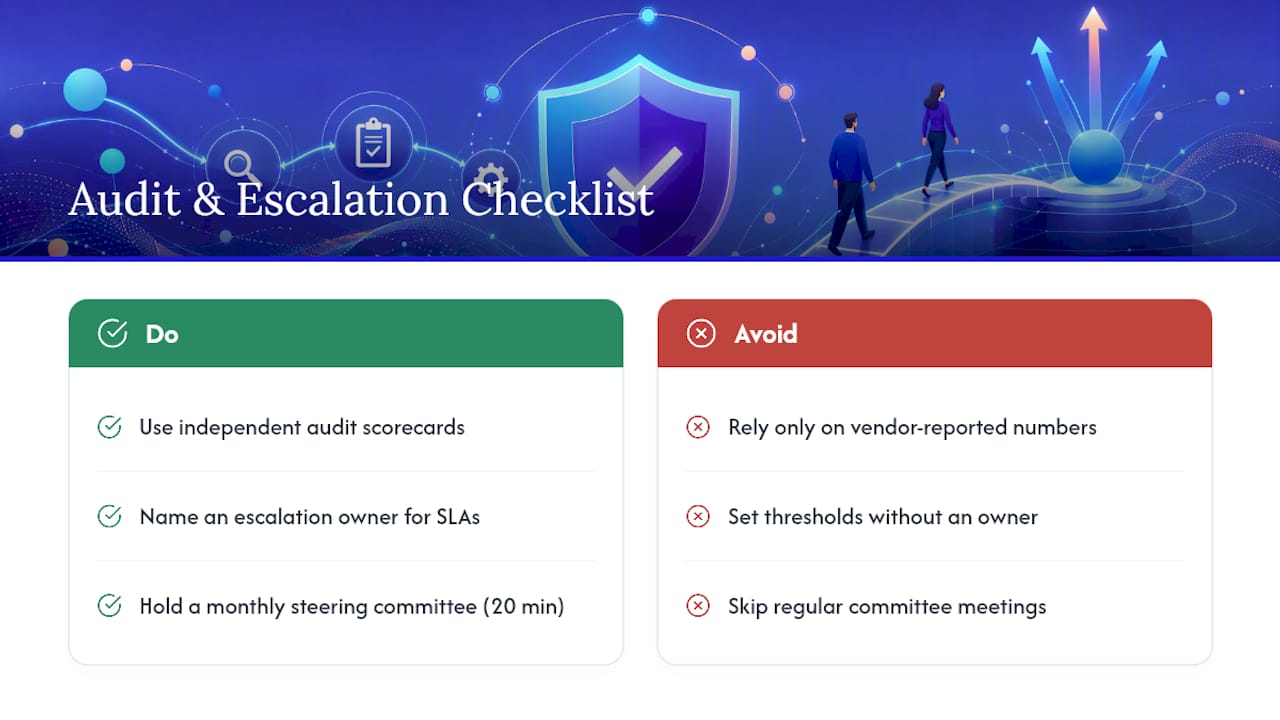
The most common gap in dealership SLAs isn't a missing metric, it's a missing escalation path. Dealers write good thresholds, then have no named owner when a vendor misses them two months running. A steering committee that actually meets monthly, even for 20 minutes, catches that drift before it becomes a wasted quarter of spend.
Get an Independent Review of Your Marketing Vendor Contracts
Drafting a strong SLA is only half the work. Enforcing it requires data your vendor doesn't control, which is exactly where most dealership contracts fall apart. AutoROIQ reviews vendor scorecards, reconciles conflicting performance reports, and builds independent recommendations your leadership team can act on without guessing whose numbers to trust.

Because AutoROIQ never sells media, its evaluations of speed-to-lead, conversion accuracy, and campaign turnaround carry no incentive to protect a vendor's renewal. If your current SLA reads more like a wish list than an enforceable agreement, a vendor contract review is the fastest way to find out where it's exposed. Visit AutoROIQ to request a marketing vendor scorecard review and get a playbook tailored to your dealership's current vendor mix.
Sources
- Marketing sales service level agreement
- Enterprise MaaS SLAs and governance for integrated campaigns