
Performance Max belongs in a dealer's paid strategy only when conversion tracking, inventory feeds, and CRM offline conversions are already clean. Get those three right, and PMax typically delivers more reach, incremental leads, and a lower cost per store visit than standard search alone. Skip the setup work, and it will spend budget efficiently against the wrong goals. The checklist section below shows exactly what to fix first.
TL;DR:
- Performance Max requires accurate conversion tracking, inventory feeds, and CRM offline data to deliver significant cost and store visit improvements.
- Keeping brand and model search campaigns separate while using Performance Max for upper funnel reach ensures targeted results without sacrificing control.
- Proper segmentation of asset groups, clean inventory data, and updated CRM signals are crucial for predictable performance and to avoid wasting budget.
- Tracking offline sales and qualified leads through consistent import and using multi-touch attribution metrics are essential for measuring true success.
- Ongoing creative refreshes and disciplined audience exclusion keep Performance Max campaigns effective and compliant with automotive advertising regulations.
Table of Contents
- What Performance Max Is and How It Differs From Standard Google Campaigns
- Why Performance Max Matters for Dealerships
- How Performance Max Works for Dealers: Asset Groups, Feeds, and Signals
- Common Pitfalls and Quality Control Risks
- Practical Setup Checklist and Initial Test Plan
- Measurement and Attribution: What to Actually Optimize
- Advanced Tactics That Push Performance Further
- Case Evidence: Sample Outcomes From Dealer Case Studies
- Integrating Performance Max With Your Existing Marketing Strategy
- Creating Creative Assets That Actually Work for Automotive Shoppers
- Legal and Compliance Considerations for Automotive Ads on Google
- AutoROIQ's Perspective: Where PMax Fits in a Revenue-First Program
- Get an Independent Read on Your PMax Performance
- Sources
- FAQ
What Performance Max Is and How It Differs From Standard Google Campaigns
Performance Max is a single campaign type that places ads automatically across:
- Search
- YouTube
- Display
- Discover
- Gmail
- Maps
Google's machine learning handles bidding, budget pacing, and creative mixing across all six inventories at once, using whatever conversion, audience, and product signals you feed it. That's the tradeoff: you gain reach and automation, but you give up the placement-level control a standard search campaign gives you.
For dealers, the practical rule is this: keep dedicated search campaigns for brand and high-intent model terms where you want tight control over bids and match types. Use Performance Max for the reach layer, model pushes, and conquest traffic where automation can find incremental buyers you'd otherwise miss.
Why Performance Max Matters for Dealerships
Performance Max reaches shoppers earlier in the funnel than search alone. Someone browsing YouTube reviews or scrolling Discover hasn't typed a query yet, but they're already forming a shortlist. Reaching them there, before they hit a competitor's search ad, is the reach case for PMax.
The business case gets stronger with quality controls in place. One cross-dealer analysis found campaigns run with strict conversion hygiene generated roughly 8.6 times higher store visit rates and eight times lower cost per store visit than comparable accounts without those controls.
That gap is the whole story with PMax: the algorithm performs well, or badly, in direct proportion to the quality of what you feed it.
Performance Max works best as a complement, not a replacement:
- Keep brand and model search funded and protected
- Let PMax cover conquest and upper-funnel reach
- Route service and fixed-ops intent into its own asset groups, never blended with sales
How Performance Max Works for Dealers: Asset Groups, Feeds, and Signals
Performance Max runs on three inputs: asset groups, an inventory feed, and audience signals. Getting all three right is most of the job.
- Segment asset groups by objective. Build separate groups for new-vehicle brand campaigns, specific model pushes, conquest against competitor models, and service or fixed-ops offers. Blending these into one group forces the algorithm to average performance across incompatible goals.
- Feed clean inventory data. Your vehicle feed needs accurate price, VIN, availability status, and trim level. Stale pricing or sold units still showing as available will burn budget on ads for cars you can't sell.
- Send the right CRM signals. Upload lease-end dates, lifetime value tiers, and service history through Customer Match so Google can find lookalike shoppers with real purchase intent, not just page-view behavior.
- Build suppression lists early. Exclude recent purchasers and service-only customers from new-vehicle conquest groups, or you'll pay to advertise trucks to someone who bought one from you last month.
Dealers who structure asset groups this way, mapped to funnel stage and backed by CRM activation for Customer Match, consistently get more predictable targeting than accounts running one undifferentiated campaign.
Common Pitfalls and Quality Control Risks
Performance Max optimizes toward whatever conversion actions you've defined, nothing more. That single fact explains most of the disappointing PMax results dealers report. If your conversion action fires on a form view instead of a form submission, PMax will happily inflate that number without moving a single actual sale.
The most common mistakes:
- Counting page visits, video plays, or chat opens as conversions instead of qualified leads
- Running sales, service, and Maps store-visit intent through one campaign
- Never importing offline sold data, so the algorithm never learns what a real sale looks like
- Letting CRM data go stale, which corrupts audience signals over time
Pro Tip: Before you launch anything, audit your conversion actions in Google Ads and ask: "Would my GM count this as a real lead?" If the answer is no, fix the definition before you touch budget.
The fix is almost always the same: tighten conversion definitions to match what your sales team actually counts, split campaigns by objective, and get sold-unit data flowing back into Google Ads.
Practical Setup Checklist and Initial Test Plan
Before you launch, work through this sequence:
- Lock conversion definitions. Define what counts as a qualified lead, not just any form fill or click.
- Validate the inventory feed. Check price accuracy, VIN completeness, and availability status against your DMS.
- Build the offline conversion pathway. Confirm your CRM or DMS can push sold-unit data back into Google Ads.
- Separate campaigns by objective. New vehicle, conquest, and service each get their own asset groups and budgets.
- Set audience signals deliberately. Include high-value CRM segments; exclude recent buyers and service-only customers.
- Run for 6 to 8 weeks minimum before judging results. PMax needs a real data window to learn.
- Set scale and stop-loss triggers in advance. Decide your cost-per-qualified-lead ceiling before launch, not after you've overspent.
Start with a modest test budget, roughly 10 to 15% of your total digital spend, and resist the urge to touch settings daily. Constant edits reset the learning phase and undo campaign guardrails that took weeks to establish. Review weekly for the first two months, then move to a monthly cadence once conversion volume stabilizes.
Measurement and Attribution: What to Actually Optimize
Cost per click tells you almost nothing useful for a dealership. The metrics that matter are cost per sold unit, cost per qualified lead, and show rate, the percentage of leads that actually walk into your store.
Getting there requires mapping your CRM and DMS fields into Google's offline conversion import. Push closed-won sale events back into Google Ads on a defined schedule, ideally daily, so the algorithm learns from real outcomes instead of top-of-funnel proxies. A common pitfall here is mismatched click IDs between your CRM and Google Ads, which silently break the entire import.
On attribution, avoid last-click models entirely. A position-based or data-driven attribution model gives PMax, and every other channel, appropriate credit for its role in a multi-touch path, which matters enormously when you're deciding where to shift budget next quarter.
- Track cost-per-sold-unit as your north star metric
- Import offline conversions on a consistent schedule, not sporadically
- Use position-based attribution over last-click for budget decisions
- Compare cost-per-lead against cost-per-sale monthly to catch drift early
Advanced Tactics That Push Performance Further
Once conversion data is stable, usually after that 6 to 8 week window, you can layer in tactics that squeeze more value out of the same budget.
Segment budgets by profit center rather than running one blended target. Allocate spend and set distinct target CPAs for test drive requests, financing applications, and service appointments, since each carries a different dollar value to the dealership.
Pro Tip: A financing application is worth more to most stores than a generic "contact us" lead. Set your target CPA per segment accordingly instead of using one blended number across the whole account.
Creative matters more in PMax than most dealers assume, since the algorithm can only mix what you give it:
- Short vertical video (15 to 30 seconds) outperforms static images on YouTube and Discover placements
- Highlight specific trims and features rather than generic dealership branding
- Include a clear call to action for scheduling a test drive, not just "learn more"
- Refresh creative every 4 to 6 weeks to avoid fatigue
Maintain suppression lists on a rolling basis. Recent purchasers and service-only customers should be excluded from new-vehicle conquest campaigns continuously, not just at launch.
Case Evidence: Sample Outcomes From Dealer Case Studies
The clearest evidence comes from a cross-dealer analysis showing store visit rates roughly 8.6 times higher and cost per store visit eight times lower when Performance Max ran under strict quality controls.
The common thread across dealers who saw results like this: clean CRM integration, asset groups split by objective, and disciplined measurement from day one. Expect the first 3 to 6 months to be a calibration period. If cost per qualified lead isn't trending down by month three, that's your signal to revisit conversion definitions before adding more budget.
Integrating Performance Max With Your Existing Marketing Strategy
Performance Max isn't a replacement for your full marketing mix. It's a reach layer that needs to sit inside a coordinated plan alongside traditional media, your other digital campaigns, and dedicated search.
Think of your paid channels as a stack with different jobs. Local TV, radio, and direct mail build awareness and drive branded search volume. Dedicated search campaigns capture that high-intent demand with tight control over bids and messaging. Performance Max fills the gap between the two, reaching shoppers on YouTube, Discover, and Gmail before they've typed a query, while also picking up incremental Search and Display impressions your standard campaigns don't reach.
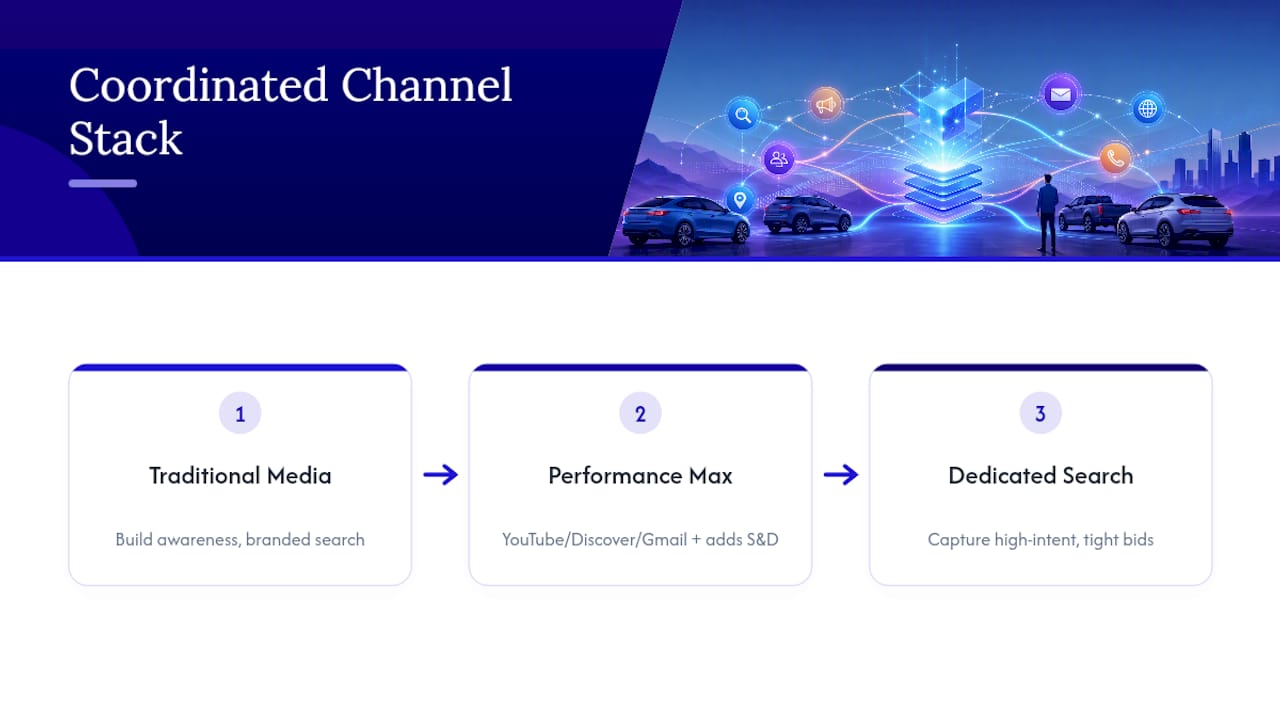
Coordination matters more than most dealers expect. If your traditional media push announces a model-year clearance event, your PMax asset groups should reflect that same offer and timeline, not run generic evergreen messaging out of sync with the rest of your marketing calendar. The same discipline applies to your other digital channels. If you're running Facebook automotive inventory ads alongside PMax, keep vehicle metadata, pricing, and promotional messaging consistent across both feeds. Inconsistent inventory data across platforms confuses shoppers and can trigger compliance issues if pricing doesn't match.
Budget allocation across this mix should follow the same profit-center logic as your PMax segmentation. Compare what each channel actually contributes to sold units, not just leads or clicks, and revisit the split quarterly as seasonal demand and inventory levels shift. A well-integrated stack outperforms any single channel run in isolation, no matter how well that channel is optimized on its own.
Creating Creative Assets That Actually Work for Automotive Shoppers
Performance Max builds its ads by combining whatever headlines, images, and video you upload, so weak creative inputs cap your results no matter how well the campaign is structured underneath.
Video carries the most weight on YouTube, Discover, and Gmail placements. Short vertical clips, 15 to 30 seconds, showing a specific vehicle in motion or highlighting a distinct feature tend to outperform generic dealership branding spots. One dealer group tracked a 47% lift in sales tied to video advertising once creative shifted from static branding toward vehicle-specific footage with a clear call to action.
For static assets, resist the temptation to reuse OEM stock photography across every asset group. Shoppers researching a specific trim or color respond better to imagery that matches what's actually on your lot. Pair vehicle photos with headlines referencing real inventory details, current mileage, available colors, trim packages, rather than generic phrases like "great deals available."
Calls to action need specificity too. "Schedule your test drive" or "See this vehicle in person" performs better than vague prompts like "Learn more" or "Contact us," because they map directly to the action you actually want a shopper to take.
Test creative in batches and refresh every 4 to 6 weeks. Performance Max will naturally favor whichever assets get the best early engagement, so feeding it only your strongest creative from the start, rather than uploading everything you have on hand, gives the algorithm better material to work with from day one.
Legal and Compliance Considerations for Automotive Ads on Google
Automotive advertising carries compliance obligations that generic retail ads don't, and Performance Max's automated creative mixing makes oversight harder, not easier, because you don't control which asset combinations Google serves in every placement.
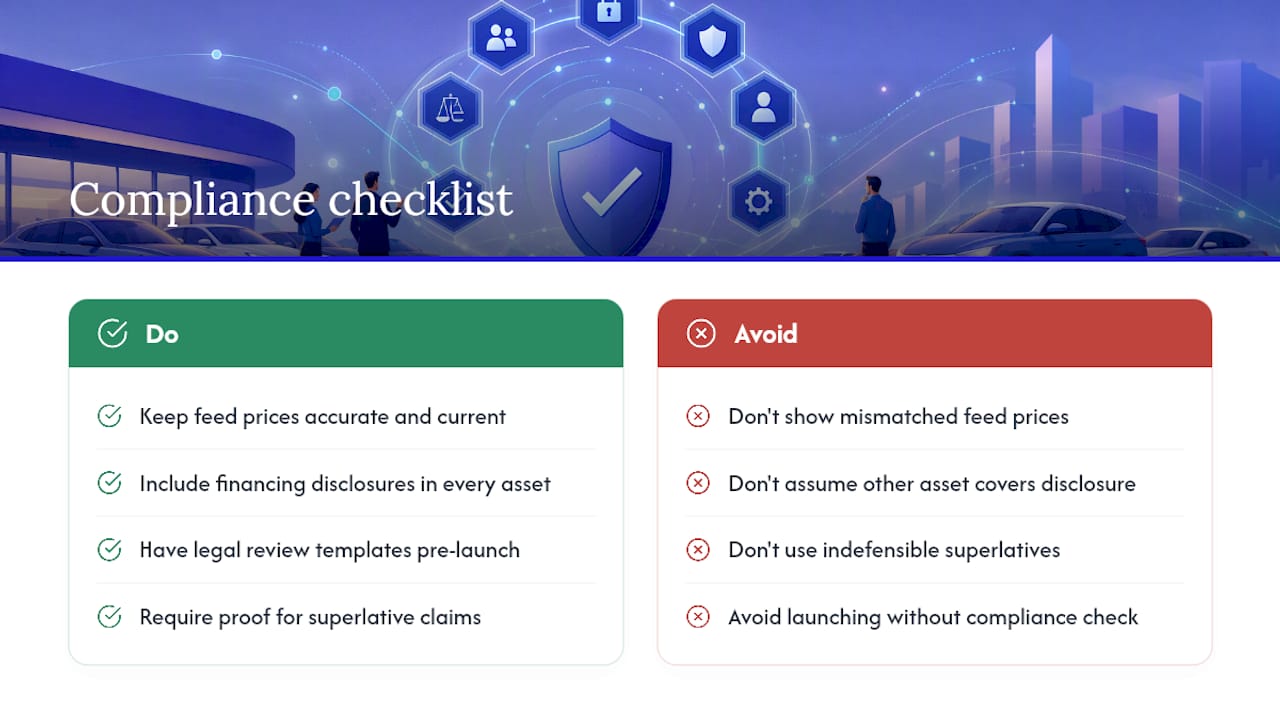
Pricing claims need to stay accurate and current. If your inventory feed shows a price that doesn't match what's actually offered at the dealership, that's both a Google Ads policy violation and a potential Federal Trade Commission concern under truth-in-advertising rules. Stale feed data isn't just a performance problem, it's a compliance risk.
Financing and lease offers carry specific disclosure requirements. Any ad referencing a monthly payment, APR, or lease term needs to include the required disclosures, mirroring what's regulated under the Truth in Lending Act and Consumer Leasing Act. Because Performance Max assembles ads automatically from your uploaded assets, make sure every headline and description referencing financing terms carries its own complete disclosure rather than assuming a companion asset will cover it.
Superlative claims, "best price in town," "guaranteed the lowest rate," need to be defensible if challenged. Google's policies around misleading claims apply across every PMax placement, including Discover and Gmail, where ad review tends to be less strict than standard Search.
Work with your compliance or legal team to review asset group templates before launch, not after a campaign has been running for weeks. Catching a disclosure gap in month two costs far more in exposure than catching it in setup.
AutoROIQ's Perspective: Where PMax Fits in a Revenue-First Program
Vendor reports on Performance Max almost always look good, because the vendor is grading its own homework. That's exactly the blind spot independent measurement is built to catch.
Dealers should ask their agency three questions every quarter: What counts as a conversion in this account, and does it match a real sale? Is offline conversion data actually flowing back from the CRM? And does reported ROAS survive comparison against DMS sold-unit records?
Integrated measurement, not another dashboard, is what separates dealers who see real productivity gains from technology investment from those chasing inflated conversion counts. A quarterly governance review, run by an independent party, is valuable insurance for a dealership.
— AutoROIQ
Get an Independent Read on Your PMax Performance
Every dealer running Performance Max eventually asks the same question: is this actually working, or does it just look like it's working? An independent marketing intelligence provider can answer that question objectively, without selling advertising, managing campaigns, or taking commissions from platforms.
A Marketing Intelligence Review audits your conversion definitions against what your DMS actually counts as a sale, checks whether your CRM data is mapping correctly into Google's offline conversion imports, and reconciles what your agency is reporting against what genuinely closed. The result is an executive-level scorecard that shows exactly where budget is working and where it's being wasted on inflated metrics.
If you want a defensible answer before your next budget conversation, start with a Marketing Intelligence Review or explore AutoROIQ's ongoing advisory services built for dealership leaders who need vendor-agnostic clarity, not another vendor pitch.
Sources
- Why More Dealerships Should Prioritize Performance Max Campaigns | Aronson Advertising
- Google Ads AI 7 Performance Max auto tactics | MyDigipal
- Boosting auto sales productivity: A playbook for excellence | McKinsey
FAQ
Is Performance Max Worth It for Dealerships?
Performance Max is worth it when conversion tracking, inventory feeds, and CRM offline conversions are set up correctly first. Under those conditions, dealers have seen store visit rates roughly 8.6 times higher and cost per store visit eight times lower than accounts without quality controls. Without clean setup, it can spend efficiently toward the wrong outcomes.
What CRM Do Most Car Dealers Use?
Most dealerships run a dealer-specific CRM tied to their DMS, and the specific platform matters less than whether it can export offline conversion data cleanly. What matters for Performance Max is that lease-end dates, service history, and lifetime value data can flow into Google Ads through Customer Match, regardless of which CRM generates that data.
What Does Performance Max Include?
Performance Max is a single Google Ads campaign type that serves ads across Search, YouTube, Display, Discover, Gmail, and Maps from one campaign. It uses automated bidding and creative mixing based on the asset groups, inventory feed, and audience signals you provide.
What Is the Purpose of PMax?
Performance Max is designed to find incremental conversions across Google's full inventory by using machine learning to match your assets and signals to shopper intent in real time. For dealers, its purpose is reaching in-market shoppers earlier, on YouTube or Discover, before they reach a competitor's search ad.
How Do I Know If My PMax Setup Is Actually Working?
Compare cost-per-sold-unit and show rate against your DMS records, not just the conversion numbers reported inside Google Ads. An independent Marketing Intelligence Review can reconcile vendor-reported performance against actual closed sales, since Autoroiq has no stake in your ad spend either way.